The Defeat of Napoleon and the Occupation of France

My French historian colleague, Christine Haynes, recently published Our Friends the Enemies, a new book on the defeat of Napoleon and the occupation of France.

The book description at Harvard University Press’s website reads:

“The Napoleonic wars did not end with Waterloo. That famous battle was just the beginning of a long, complex transition to peace. After a massive invasion of France by more than a million soldiers from across Europe, the Allied powers insisted on a long-term occupation of the country to guarantee that the defeated nation rebuild itself and pay substantial reparations to its conquerors. Our Friends the Enemies provides the first comprehensive history of the post-Napoleonic occupation of France and its innovative approach to peacemaking.

“From 1815 to 1818, a multinational force of 150,000 men under the command of the Duke of Wellington occupied northeastern France. From military, political, and cultural perspectives, Christine Haynes reconstructs the experience of the occupiers and the occupied in Paris and across the French countryside. The occupation involved some violence, but it also promoted considerable exchange and reconciliation between the French and their former enemies.

“By forcing the restored monarchy to undertake reforms to meet its financial obligations, this early peacekeeping operation played a pivotal role in the economic and political reconstruction of France after twenty-five years of revolution and war. Transforming former European enemies into allies, the mission established Paris as a cosmopolitan capital and foreshadowed efforts at postwar reconstruction in the twentieth century.”

Haynes-OurFriends

Haynes has written a post entitled “The Occupation of France after Napoleon, or Confessions of a Cultural-Turned-Military Historian,” on Age of Revolutions about her historical research and the genesis of her book project.

Haynes explains that: “The ‘Age of Revolutions’ was also an Age of Wars. While this point may be obvious to most readers of this site, as well as historians of the period, it took me an embarrassingly long time to understand. Trained as a cultural historian focused on nineteenth-century France, I saw military history as separate from, and tangential to, the dramatic political and social changes unleashed by the French Revolution and Napoleonic Empire. Sure, I studied and eventually taught the wars that ensued from the French Revolution and their role in the rise and fall of Napoleon, but it took me a good while to recognize the centrality of war to all aspects of life in this period. … Paradoxically, my realization of the importance of war in this period came while researching a topic that, on the surface, could not be farther from military history: book history.”

Haynes discusses the trajectory of her research process: “While writing what ultimately became my first book on the ‘politics of publishing’ in France during the century after the re-regulation of the book trade by Napoleon in 1810, I noticed that following the fall of the Empire, many of the booksellers and printers in Paris came from outside of France. Curious about why so many foreigners arrived in the French capital at that time, I realized that this influx was spurred by the aftermath of the Napoleonic Wars, particularly the military occupation of France by the powers allied against the Emperor following his defeat in the Battle of Waterloo. Seeking to sell books to the thousands of foreign soldiers and civilians in occupied France, these cosmopolitan printers and booksellers served as a reminder that the years after 1815 were a period of post-war reconstruction.”

OccupiedParis

Christine Haynes’s new book is Our Friends the Enemies: The Occupation of France After Napoleon (Cambridge, MA: Harvard University Press, 2018).

Posted in Early Modern Europe, Empires and Imperialism, European History, French History, French Revolution and Napoleon, Paris History, Strategy and International Politics, War and Society, War, Culture, and Society, Warfare in the Early Modern World | Leave a comment

History of Women’s Rights in the News

A renewed search is on for the original signed copy of the Declaration of Sentiments and Resolutions from the Seneca Falls Convention of 1848.

Megan Smith, who served in President Obama’s administration, has announced that a new plan to locate the original document.

“We’d like to find the original,” Smith said, “and give it the correct position of prominence it deserves with the Charters of Freedom in the rotunda of the National Archives.”

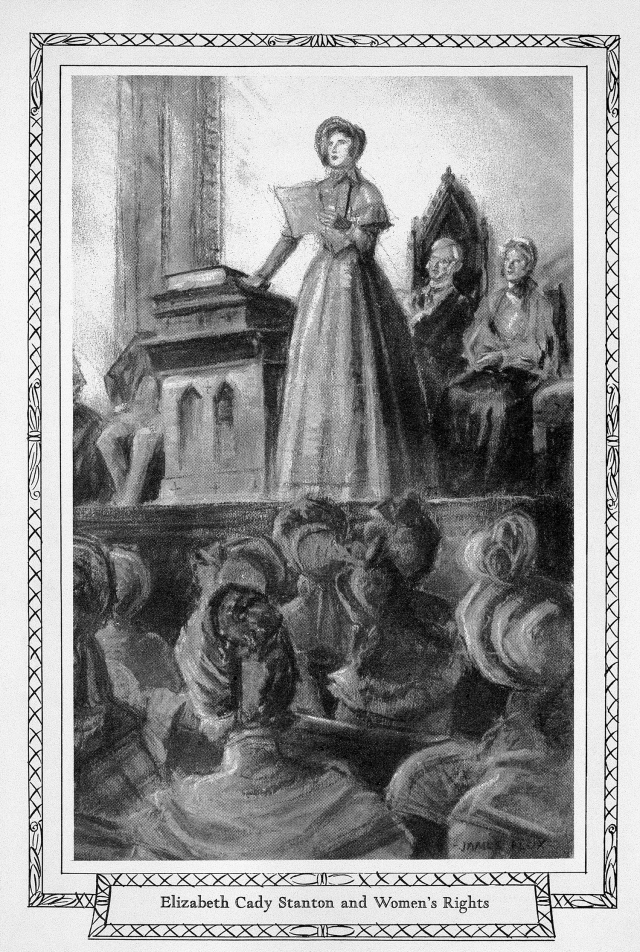
Elizabeth Cady Stanton organized the convention, which deliberated on a series of resolutions for women’s rights that became the Declaration of Sentiments and Resolutions.

When male politicians and journalists mocked the women who met at the Seneca Falls Convention, Stanton wrote that: “No words could express what seemed to us so timely, so rational, and so sacred, should be a subject for sarcasm and ridicule to the entire press of the nation.”

The New York Times reports that “A scholar of Elizabeth Cady Stanton, Ann D. Gordon, wrote a blog post in 2015 criticizing the search for the declaration as ‘Megan Smith’s romantic quest for something truer or more authentic.’ In fact, other historians see Ms. Smith’s public search as a Quixotic quest because the content of the Declaration of Sentiments is widely available.”

Nonetheless, Smith’s search for the document has arguably renewed interest in the history of women’s rights in the news media in the United States.

“For Ms. Gordon, the renewed attention on a document that is lesser known in American history has served as a reminder of the never-ending fight for women’s rights,” according to The New York Times.

Gordon commented: “Maybe what we learn is that this generation of women could think a whole lot of it through and lay down some rules, and then we only later discovered how hard it would be to implement that.”

It is refreshing to see women’s historians like Ann D. Gordon being interviewed by journalists and to have women’s history featured in major newspapers.

The New York Times reports on the Seneca Falls declaration.

Posted in Archival Research, History in the Media, Human Rights, Political Culture, Women and Gender History | Leave a comment

Renaissance History and Franco-Italian Quarrels

French President Emmanuel Macron has recalled the French Ambassador to Italy, in response to the Italian government’s support of the Gilets Jaunes (Yellow Vests) protest movement in France.

Italian Deputy Prime Ministers Matteo Salvini and Luigi Di Maio have both made multiple comments praising the Gilets Jaunes. Di Maio escalated tensions by meeting with Gilets Jaunes protesters and declaring that a “new Europe is being born.”

This dispute grew out of nationalist rhetoric, immigration policies, domestic politics, and European Union politics. However, Renaissance history also figures in the expanding Franco-Italian quarrels, as politicians and their supporters compete over the heritage of Leonardo da Vinci and Catherine de’ Medici.

A major exhibition on Leonardo da Vinci being organized at the Louvre Museum in Paris is now caught in the middle of the Franco-Italian dispute. The Guardian reports that “as Europe stages a year-long frenzy of events to mark 500 years since Leonardo da Vinci’s death, Italy and France are engaged in a diplomatic tussle over him that threatens a blockbuster exhibition at the Louvre in Paris.”

Illaria Maria Sala observes that “The Louvre museum in Paris, where the Mona Lisa is exhibited, has been preparing to commemorate later this year the 500th anniversary of Leonardo da Vinci’s death. The painting became the property of Francis I, a king of France and da Vinci’s patron, after da Vinci’s death in France in the early 16th century — a time when the concept of Italy as a nation was shaky at best. Last year, Italy promised to contribute to the special exhibit by lending the Louvre major, sumptuous pieces, but the new government is mulling how to renege on that pledge.”

Meanwhile, Italian politicians are engaging in “French-bashing,” according to Sala, using an array of Renaissance historical references to claim Italian superiority. For example, “a popular myth has resurfaced on Twitter in these fractious days about how both haute cuisine and humble utensils were introduced to the French court by Catherine de Medici, after she was sent from Florence to Paris to marry Henry II in 1533.”

Illaria Maria Sala’s op-ed was published by The New York Times. See The Guardian for a report on Salvini and Di Maio’s support of the Gilets Jaunes. The Guardian also reports on the Leonardo da Vinci exhibition at the Louvre.

Posted in Art History, Court Studies, Cultural History, Early Modern Europe, Empires and Imperialism, European History, Food and Cuisine History, French History, French Wars of Religion, History in the Media, Italian History, Noble Culture and History of Elites, Political Culture, Renaissance Art and History, Women and Gender History | Leave a comment

“Time for Another Kent State”? Politicians Target Campuses for Violence

Politicians are targeting university campuses for repressive violence.

One of the of the most shocking recent incitements to violence against students came in 2017, when Dan Adamini (Republican), Secretary of the Marquette County Republican Party, advocated using firearms to stop protests on university campuses. Adamini was reacting specifically to the student protest against Milo Yiannopoulos (Breitbart News editor) speaking at the University of California-Berkley.

Adamini tweeted: “Violent protesters who shut down free speech? Time for another Kent State perhaps. One bullet stops a lot of thuggery.”

Then, in a Facebook post, Adamini clarified his position: “I’m thinking that another Kent State might be the only solution… They do it because they know there are no consequences yet.”

Kent State University officials responded that Adamini’s comments are “abhorrent.”

The Kent State University statement reads:

“May 4, 1970, was a watershed moment for the country and especially the Kent State University family. We lost four students that day while nine others were wounded and countless others were changed forever. This abhorrent post is in poor taste and trivializes a loss of life that still pains the Kent State community today. We invite the person who wrote this statement to tour our campus and our May 4 Visitors Center, which opened four years ago, to gain perspective on what happened 47 years ago and apply its meaning to the future.”

Adamini’s shocking comments seemed to confirm worries that politicians’ anti-student rhetoric would lead to another episode of deadly violence on university campuses.

A Politico article by James Robenalt published during the 2016 Presidential Election Campaign considered the troubling possibility of “another Kent State” resulting from then-candidate Donald Trump’s comments. Robenalt wrote that “Donald Trump is now openly inciting violence at his rallies. In Kansas City, he mouthed the words, ‘I’ll beat the crap out of you,’ when describing what he would have done to a protester who charged him in Dayton, Ohio, earlier in the day. ‘Boom, boom, boom,’ he said, mimicking a schoolyard beat down with his fists.”

Robenalt warned that candidate Trump’s incitements to violence were remarkably similar to President Nixon’s labeling of student protesters as “bums” in 1970, just a few days before National Guard troops gunned down student protesters at Kent State.

USA Today reports on Adamini’s statements and Kent State’s response. Dan Adamini later resigned from his position as Secretary of the Marquette County Republican Party.

The issue of guns on campuses and the references to the 1970 shooting of college students at Kent State have remained in the news over the past several years.

A graduate of Kent State controversially posed for a photo on campus with an AR-10  rifle in May 2018. The Washington Post reported on this incident, which went viral as gun rights activists celebrated “gun girl.”

In September 2018, a “tense” gun rights rally was held on the campus of Kent State.

This story has reemerged recently as other politicians seem to advocate violence on college campuses.

Meanwhile, the School of Peace and Conflict Studies at Kent State University is now preparing a conference on “Commemorating Violent Conflicts and Building Sustainable Peace.”

As a professor at Northern Illinois University, a university that has suffered a mass shooting, I call upon politicians to condemn incitements to violence on university campuses.

Gun violence has no place on college campuses.


Posted in Academic Freedom, Arms Control, Civil Conflict, Conferences, History in the Media, History of Violence, Human Rights, Northern Illinois University, Peacemaking Processes, Political Culture, Terrorism, War, Culture, and Society | Leave a comment

History, Identity Politics, and the “French Destiny”

History and identity politics are intimately interwoven in modern French society. The history of the French Revolution and Napoleonic period to define the landscape of  political ideologies (socialism, liberalism, conservatism) in the nineteenth century and forged the language of modern political culture.

Political writer and pundit Eric Zemmour is once again provocatively stirring identity politics in France with a new book, Destin français (or, French Destiny). He has been accused of inciting racial hatred with his anti-immigrant rhetoric.

In his previous books, Zemmour has argued for a French nationalist agenda based on imperial nostalgia, anti-immigrant politics, and Great Man history. “Zemmour’s detractors often link him to the Rassemblement National — formerly the National Front — but his true allegiance is to Bonapartism,” according to The New York Times.  He even strikes a classic Napoléon Bonaparte pose for his photo.

Although he is not a trained historian, Zemmour’s political writing relies heavily on historical references and historiographical interpretations. Although he studied political science and launched his career as a political reporter, Zemmour presents himself as a historian.  “Most of Zemmour’s books are what he calls ‘historical essays,'” according to The New York Times. “His narratives, based on a personal reading of many works by historians, are long (the last three were more than 500 pages each) and intended for an audience already familiar with Robespierre and the Girondins.”

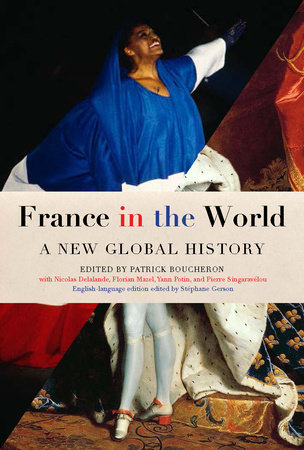
Zemmour utilizes highly selective and idiosyncratic readings of French history in his political writing and punditry. The New York Times reports that “Zemmour’s newest book, French Destiny, is in some ways a response to the surprisingly successful World History of France, compiled and edited by the noted historian Patrick Boucheron and published the year before. Where Boucheron presents French history as a product of diverse ethnic and geographical influences, Zemmour adheres to Thomas Carlyle’s dictum that history is ‘but the biography of great men’: the most powerful win, and rightly so. For Zemmour, the strict hierarchical social order born of Catholicism, divorced from the church and joined with the principles of Roman law is what gives French society its unique structure.”

Historiographical debates continue to shape current political identities, historical memory, and national politics in modern France.

The New York Times reports on Zemmour’s new book, Destin français. Patrick Boucheron’s book, France in the World: A New Global History, is available in English.

Posted in Cultural History, Early Modern Europe, Early Modern World, Empires and Imperialism, European History, French History, French Revolution and Napoleon, Globalization, History in the Media, Museums and Historical Memory, Political Culture, Revolts and Revolutions, Strategy and International Politics, World History | Leave a comment

Doctoral Travel Fellowship in Reformation History

SOCIETY FOR REFORMATION RESEARCH

CHRISMAN TRAVEL FELLOWSHIP FOR DOCTORAL RESEARCH

2019 CALL FOR APPLICATIONS

To honor a long-time member and past president of the Society for Reformation Research, the society offers the Miriam Usher Chrisman Travel Fellowship of $2000 every other year in odd-numbered years to doctoral students who need to travel abroad to do research for their dissertations. The award competition is open to all students of European studies, ca. 1450-1650, whose dissertations deal with religion or the Reformation in some significant way. All geographic and confessional concentrations are eligible, and students just beginning their archival research as well as those finishing are encouraged to apply. The purpose of the award is to help defray the expenses of working abroad.

Applicants should provide a 3-5 pp. description of their research projects, which must include when and where they plan to use the fellowship. (This description should be double-spaced with 1″ margins and 12-point type.) Applicants should keep in mind that just sending in a dissertation prospectus is insufficient, as the selection committee wants to know more specifically how the fellowship will be used and how the funds will help the applicants complete their dissertations. Applicants should also provide a curriculum vitae and ask their dissertation advisers to submit a letter of recommendation. All applicants must be members of the Society for Reformation Research at the time of application. The current student rate is$10.

http://www.reformationresearch.org/membership.html

All materials should be sent directly via email as attachments (in MS Word or as a pdf) to R. Ward Holder <wholder@anselm.edu>, the Recording Officer of the society. He will then forward all materials to the Chrisman selection committee appointed by the current President of the Society.

The Recording Officer must receive all materials by Friday, March 8, 2019. The award recipient will be notified by late April and may choose to use the award for travel in summer 2019 or during the academic year 2019-20.

Posted in Early Modern Europe, Early Modern World, European Wars of Religion, Graduate Work in History, Grants and Fellowships, Reformation History, Religious History, Religious Politics, Religious Violence, Renaissance Art and History | Leave a comment

Preliminary Peace Agreement to End the Afghan War?

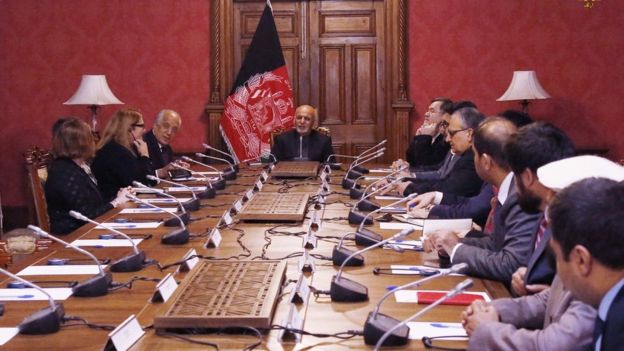
The United States and the Taliban have reportedly agreed to a preliminary process for a peace agreement to end the Afghan War.

The New York Times reports that “American and Taliban officials have agreed in principle to the framework of a deal in which the insurgents would guarantee to prevent Afghan territory from being used by terrorists, and that could lead to a full pullout of American troops in return for larger concessions from the Taliban, the chief United States negotiator said Monday.”

The United States envoy, Zalmay Khalilzad, indicated that: “We have a draft of the framework that has to be fleshed out before it becomes an agreement. … The Taliban have committed, to our satisfaction, to do what is necessary that would prevent Afghanistan from ever becoming a platform for international terrorist groups or individuals.”

According to the New York Times, “A senior Taliban official with direct knowledge of the talks on Monday confirmed the draft agreement on the issue of foreign troop withdrawal and that the Taliban pledge that Afghan soil would not be used against others. He said ‘working groups’ would iron out details on the timeline of the withdrawal.”

Khalizad-Talks.jpg

The BBC is confirming the peace process, indicating that “A senior Taliban official who attended the talks told the BBC over the weekend that both sides had agreed to form two committees to draw up detailed plans on how to implement agreements in principle on two key issues:

  • When will American-led forces be withdrawn from Afghanistan?
  • A commitment from the Taliban that the group will not allow international jihadist groups like al-Qaeda to use the country as a base in the future”

“The Taliban official, speaking on condition of anonymity, said the committees would ‘identify routes for the withdrawal, and how much time is needed. We suggested six months, but are flexible.'”

The New York Times reports on this breaking news. The BBC also reports on the peace process.


Posted in Civil Conflict, History of Violence, Peacemaking Processes, Political Culture, Religious Violence, Strategy and International Politics, War and Society, War, Culture, and Society | Leave a comment

Historical Memory of the Spanish Civil War

The historical memory of the Spanish Civil War is being contested regularly in modern Spanish society and in the European Union.

Historians such as Jay Winter and Pierre Nora have been studying the construction of historical memory through memorial, commemorations, and museums for several decades. War and historical memory studies have often focused on the First World War and the Second World War, but scholars such as Michael Richards and Aurora Morcillo have also been investigating the memory of the Spanish Civil War. Basque and Catalan separatist politics have gradually pushed the Spanish government and society to confront the historical memory of the Civil War.

The New York Times explores these issues by focusing on the wartime experience of José Moreno, a Basque teenager who fought in Republican forces against General Francisco Franco’s Fascist army during the Spanish Civil War.

The New York Times reports that “Mr. Sánchez wants to give greater recognition to the victims of Franco, in accordance with a law of historical memory. That measure was approved in 2007, under a previous Socialist government, but was shelved and deprived of government funding under a conservative government led by Mariano Rajoy. One of the main goals of the 2007 law was to facilitate the opening of over 2,000 mass graves to identify the remains of those inside, most of whom died during the civil war.”

The iconic status of Franco and the emplacement of his tomb has been a contentious political issue for some time. “For now, Mr. Sánchez has made it a priority to remove Franco’s remains from the basilica of the Valley of the Fallen, which the general had built to honor those who ‘fell for God and Spain’ in the civil war. But the plan has been stalled by a legal dispute with Franco’s relatives, who argue he can be reburied only in Madrid’s cathedral. Politicians are also feuding over what to do with Franco’s current burial site once his remains are moved. For Mr. Moreno, Franco not only needs to be physically removed from the Valley of the Fallen but also reinterpreted in Spanish history books, so as to get “the same treatment as Hitler and Mussolini, the other fascist war criminals.”

The issues of war, political culture, and historical memory have become entangled in far right politics, anti-immigration politics, Brexit, and European Union politics. The debates over the memory of the Spanish Civil War are therefore not contained within Spain, but relate to broader political questions and historical issues across Europe.

There is a growing historiography on the historical memory of the Spanish Civil War. For an entry into this historical literature, see: Michael Richards, After the Civil War: Making Memory and Re-Making Spain since 1936 (Cambridge: Cambridge University Press, 2013) and Aurora G. Morcillo, ed., Memory and Cultural History of the Spanish Civil War: Realms of Oblivion (Leiden: Brill, 2013).

For a general history of the Spanish Civil War, see: Michael Seidman, Republic of Egos: A Social History of the Spanish Civil War (Madison, WI: University of Wisconsin Press, 2002).

The New York Times reports on José Moreno and the Spanish Civil War.

Posted in Civil Conflict, European History, European Union, History of Violence, Human Rights, Italian History, Political Culture, Revolts and Revolutions, War and Society, War, Culture, and Society | Leave a comment

Fulbright-Hays Doctoral Dissertation Awards

Fulbright-Hays Doctoral Dissertation Research Abroad Fellowships

The Fulbright-Hays Doctoral Dissertation Research Abroad (DDRA) Fellowship Program provides opportunities to doctoral candidates to engage in full-time dissertation research abroad in modern foreign languages and area studies. The program is designed to deepen research knowledge and increase the study of modern foreign languages, cultural engagement, and area studies not generally included in U.S. curricula.

Program Features

The institutional project period is 18 months. Students may request funding for a period of no less than six months and no more than 12 months. Funds support travel expenses to and from the residence of the fellow and the country or countries of research; maintenance and dependent allowances based on the location of research for the fellow and his or her dependent(s); an allowance for research related expenses overseas; and health and accident insurance premiums. Projects may focus on one or more of the following geographic areas: Africa, East Asia, Southeast Asia and the Pacific Islands, South Asia, the Near East, Central and Eastern Europe and Eurasia, and the Western Hemisphere (excluding the United States and its territories).


Eligible Applicants

Institutions of higher education (IHEs) in the United States are eligible to apply for grants under this program. As part of the application process, students submit individual applications to the IHE. The IHE then submits all eligible individual student applications with its grant application to the U.S. Department of Education. A student is eligible to receive a DDRA fellowship from their IHE if he or she

  • is a citizen, national, or permanent resident of the United States;
  • is a graduate student in good standing at an IHE;
  • is admitted to candidacy in a doctoral degree program in modern foreign languages and area studies at that institution when the fellowship period begins;
  • is planning a teaching career in the United States upon completion of his or her doctoral program; or
  • possesses sufficient foreign language skills to carry out the dissertation research project.

Please refer to the official Federal Register notice for detailed information about the FY 2019 competition.

Deadline: March 25

Apply here

Source: US Department of Education

Posted in Archival Research, Graduate Work in History, Grants and Fellowships, World History | Leave a comment

A Rehearsal for a Government Shutdown

Daily headlines relate the grim details of the current U.S. federal government shutdown of December 2018 to January 2019, now the longest in the history of the United States.  Detailed news reports analyze the growing economic and social impact of the shutdown on federal workers, their families, and American society.

Federal workers who are furloughed or working without pay are most directly affected by the government shutdown, but many American citizens are learning (once again) that the federal government shapes many aspects of their daily lives.

The State of Illinois experienced a prolonged partial state government shutdown from 2015-2017 that seems to have been a rehearsal for the federal government shutdown.

Curiously, national news media did not pay much attention to the two-year Illinois state shutdown and have not focused on the comparisons between the Illinois shutdown and the current federal government shutdown. The local and state reporters who did cover the shutdown repeatedly labelled it as a “budget impasse” rather than as a “government shutdown.”

Governor Bruce Rauner (R), a billionaire business leader, presented himself as a political outsider who was unbeholden to the Illinois political machine and would “shake up Springfield” and disrupt state politics.

When Governor Rauner issued his first budget proposal in February 2015, he claimed that “for far too long we have been living beyond our means—spending money that Illinois taxpayers could not afford.” Rauner’s proposed solution was to slash the state budget by $6 Billion—cutting state workers’ benefits, higher education funding, and state support to local governments in order to instill budget “discipline” on the state. Rauner simultaneously sought to cut state income taxes and undermine union operations in the state.

The Democratic-controlled Illinois Senate and House naturally refused to pass such massive budget cuts and anti-union “reforms”. The result was a partial state government shutdown that lasted two years.

Rauner had actually long planned to engineer a government shutdown in Illinois.

NPR reported that “on September 18, 2012, the year before Bruce Rauner declared his candidacy for governor, he shared his vision for a crisis that could help reshape state government.” Rauner intended to use a government shutdown to provoke a political crisis that would divide the Democratic party between union workers and non-unionized workers.

Rauner argued that “In Illinois there’s been a long-time history of what I would call social service, social justice, a bigger role for government in the safety net than in many other states,” speaking at a tax policy conference sponsored by the George W. Bush Institute. Social services, he claimed, simply cost too much money for Illinois citizens.

Rauner proposed a political strategy to create a crisis that would allow cuts to social services: “I think we can drive a wedge issue in the Democratic Party on that topic and bring the folks who say, ‘You know what? For our tax dollars, I’d rather help the disadvantaged, the handicapped, the elderly, the children in poverty. I’d rather have my tax dollars going to that than the SEIU or Af-scammy (AFSCME), who are out there for their own interests.’” NPR reported in October 2015 on Rauner’s political strategy.

Although Rauner’s communication style and media presence was very different from President Trump’s, the two leaders’ billionaire backgrounds and “disruptive” agendas were similar.

President Trump has bragged that he “owns” this federal government shutdown. In December, just prior to the beginning of the shutdown, Trump threatened: “I’ll be the one to shut it down. I will take the mantle. And I will shut it down for border security.” NPR reported at the time on Trump’s comments and the breakdown of negotiations.

Trump’s willingness to engage shutdowns reflects a long-standing Republican approach to federal budgetary policy. Government shutdowns have actually been part of stated Republican political strategy ever since Newt Gingrich’s days as Speaker of the House in the 1990s. NPR provides a brief history of federal government shutdowns.

President Trump and his administration are attempting to follow former Governor Rauner’s and former Speaker Gingrich’s political strategies. As Rauner attempted to engineer a fiscal crisis in Illinois, Trump is creating a crisis over a border “wall.” Both politicians aimed to utilize a government shutdown to ram through their policy agendas, while damaging government agencies and trimming social services in the process.

The current federal government shutdown is affecting many of the same Illinois agencies, state universities, local governments, and non-governmental organizations (food banks, mental health clinics, rape crisis centers) that were severely impacted during the Illinois state government shutdown of 2015-2017. WILL reports on effects of the federal government shutdown on rape crisis centers in Illinois. WILL also has reported on how food banks are responding to the federal government shutdown.

Newly-installed Illinois Governor J.B. Pritzker, who has replaced former Governor Rauner, has offered financial assistance to federal workers in Illinois who are affected by the U.S. government shutdown. WQAD reports on this development.

I had a front-row seat to the Illinois government shutdown’s impact on higher education, since I served as Associate Dean for Research and Graduate Affairs in the College of Liberal Arts and Sciences at Northern Illinois University during most of the Illinois government shutdown of 2015-2017. So, I am focusing here largely on the government shutdown’s impact on higher education.

State legislatures have been cutting their direct support to state universities for decades, so state universities now rely heavily on student tuition and cost-sharing between local, state, and federal governments for their core teaching and research missions.

When state or federal governments shutdown (even partially), higher education institutions suffer directly and immediately as universities cannot pay part or all of the salaries to professors, instructors, researchers, technicians, office staff, and other individuals who engage in instruction, research, and student services at public universities.

If a shutdown lasts very long, academic studies are suspended, field missions are halted, and scientific equipment is dormant. Shutdowns have the potential to disrupt research in the sciences, social sciences, humanities, law, medicine, and other fields—however news media seem to report more frequently on disruptions to scientific research. Science Magazine and Nature have both reported on the federal government shutdown’s impact on scientific research. The Daily Illini, at the University of Illinois at Urbana-Champaign, reports on how the federal government shutdown is affecting the research supported by the National Science Foundation (NSF).

Research offices at all research universities are closely tracking the federal government shutdown. My own university, Northern Illinois University, has posted information about the shutdown for professors, researchers, and graduate students who may deal with disruptions to their research activities.

News media across Illinois reported on the state “budget impasse” of 2015-2017 and its impact on higher education, but I would argue that the reporters really never effectively represented how the lack of state budget was affecting Illinois state universities. Nonetheless, articles such as this one from 2016 by WPSD are a good reminder of the severe scars left by the lengthy government shutdown on Illinois higher education.

These are merely preliminary reflections on the comparisons between the Illinois government shutdown of 2015-2017 and the federal government shutdown of 2018-2019. I will need to write many more posts to develop these comparisons further.  We’ll see how long the current shutdown lasts and how much time I find to write….

UPDATE: Several hours after I published this piece, President Trump has announced a temporary end of the federal government shutdown. The New York Times reports on Trump’s announcement.

Posted in Current Research, Education Policy, Graduate Work in History, Humanities Education, Northern Illinois University, Political Culture | Leave a comment