French Revolution and the Let Them Eat Cake Shutdown

Welcome to the “Let Them Eat Cake Shutdown.”

The French Revolution has now entered into the current federal government shutdown in the United States.

The BBC reports that “US commerce secretary Wilbur Ross has attracted scorn for suggesting workers affected by the ongoing government shutdown should take out bank loans. … Mr Ross also downplayed the number of people affected by the prolonged shutdown, saying it is ‘not like it’s a gigantic number overall.'”

The New York Times sums up the United States Secretary of Commerce’s advice to furloughed federal workers: “The latest advice the Trump administration is giving government employees who are missing their paychecks: Just borrow some money.”

Commerce Secretary Ross, a Republican and Trump appointee, is a multimillionaire former investment banker, so his comments seem especially callous. Memes are already appearing to portray Ross as an indifferent Marie Antoinette.

“It was Speaker Nancy Pelosi of California, Mr. Trump’s most visible shutdown adversary, who invoked the French Revolution,” the New York Times reports.

“Is this the ‘let them eat cake’ kind of attitude,” Speaker Pelosi said, “or call your father for money?”

Pelosi’s last comment is allegedly “a reference to an earlier taunt of the president after a shutdown meeting,” according to the New York Times.

Democratic Senator Chuck Schumer, the Senate Minority Leader, also responded to Ross’s comments with an allusion to the French Revolution.  According to the BBC, “Schumer called the comments ‘appalling,’ and said they were ‘the 21st Century equivalent of ‘let them eat cake.'”

The BBC explains that “Marie Antoinette, wife of French King Louis XVI and the last queen before the French Revolution in 1789, is apocryphally thought to have used the phrase when she learnt that people had no bread. Social media users quickly picked up on Mr Ross’s comments, deriding the commerce secretary for being ‘out of touch.'”

Politicians’ rather facile reference to the comments that Marie Antoinette almost certainly did not actually make nonetheless are recognizable and effective, precisely because the apocryphal statement “let them eat cake” captured the French royal family’s detachment and indifference to ordinary people’s suffering during the French Revolution.

So, unsurprisingly, news media are picking up on the allusion to the French Revolution and referring to the shutdown as the “Let Them Eat Cake Shutdown.”

Political cartoonists like Dave Whamond (distributed on CagleCartoons) are already exploiting Ross’s tone-deaf comments:

The New York Times reports on the “Let Them Eat Cake Shutdown.” Washington Monthly published an article on “The ‘Let Them Eat Cake’ Administration.”

The New York Times reports on Ross’s advice. The BBC reports on Ross’s interview and Schumer’s comments. NPR also reports on Ross’s comments and Democratic reactions.
Posted in Comparative Revolutions, French History, French Revolution and Napoleon, History in the Media, Political Culture, Revolts and Revolutions | Leave a comment

The Atlantic World before Jamestown

Professor Peter Mancall will be presenting a lecture on the sixteenth-century Atlantic World at the Newberry Library on Saturday, 2 February 2019 at 10 AM – 11:30 AM.

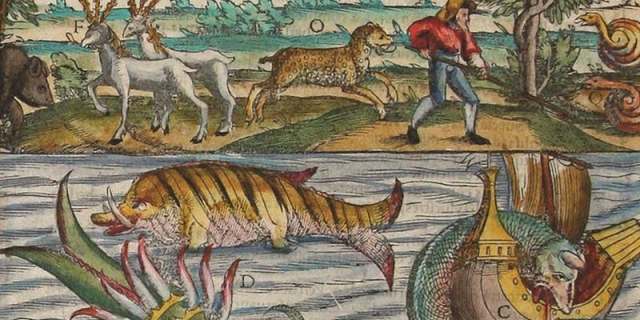
“In the 16th-century Atlantic world, nature and culture swirled in people’s minds to produce fantastic images. In the South of France, a cloister’s painted wooden panels greeted parishioners with vivid depictions of unicorns, dragons, and centaurs, while Mayans in the Yucatan created openings to buildings that resembled a fierce animal’s jaws, known to archaeologists as serpent-column portals. Throughout the 16th century, the borders between the natural world and the supernatural remained more porous than modern readers may realize. Native Americans and Europeans alike thought about monsters, spirits, and insects in considerable depth.”

“Historian Peter Mancall reveals how Europeans and Native Americans thought about a natural world undergoing rapid change in the century following the historic voyages of Christopher Columbus. Drawing on oral history and folklore maintained for centuries by Native Americans, as well as spectacular manuscript atlases, paintings that depict on-the-spot European representations of nature, and texts that circulated imperfectly across the ocean, Dr. Mancall will explore how the encounter between the old world and the new changed the fate of millions of individuals.”

“After the talk, Dr. Mancall will sign copies of his new book, Nature and Culture in the Early Modern Atlantic, which will be available for purchase in the Newberry Rosenberg Bookshop.”

For more information, and to register, please visit: https://www.eventbrite.com/e/before-jamestown-the-real-origins-of-america-tickets-50805959994

Posted in Atlantic World, Cultural History, Early Modern Europe, Early Modern World, Empires and Imperialism, Environmental History, European History, Globalization, Lectures and Seminars, Maritime History, Renaissance Art and History | Leave a comment

Cultural Exchange in Renaissance Europe Summer School

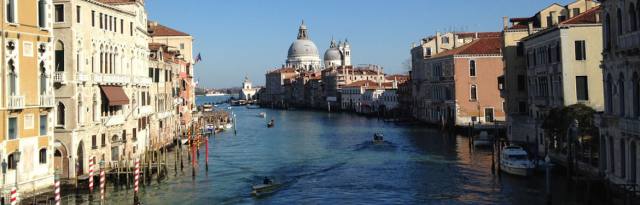
Warwick’s Centre for the Study of the Renaissance has announced a joint Summer School in Venice with the Charles S. Singleton Center for the Study of Premodern Europe (Johns Hopkins University) and the Istituto Veneto di Scienze, Lettere e Arti.

The Summer School (27 May-7 June 2019) will have as its theme Cultural Exchange in Renaissance Europe: Texts and Objects, and will be largely taught by academic staff at Warwick and JHU. It will include lectures, seminars, and many site visits, both in Venice and in Padua and Bologna. It will treat Venice as an instance of the intense cultural exchanges that took place across Europe in the period.

Doctoral students from across the world are invited to take part in this interdisciplinary summer school, where the main language of teaching will be English. Preference may be given to students who are already working on their dissertations.

Further information and instructions on how to apply are available at https://warwick.ac.uk/fac/arts/ren/jhu/summerschool2019 . The deadline for applications is Monday 18 February. Questions about the programme may be directed to Mrs Jayne Sweet (renaissance@warwick.ac.uk), the administrator of Warwick’s Centre for the Study of the Renaissance.

Posted in Art History, Cultural History, Early Modern Europe, Early Modern World, European History, Graduate Work in History, Italian History, Maritime History, Mediterranean World, Renaissance Art and History | 1 Comment

Painting from Louis XIV’s Reign Discovered in Paris

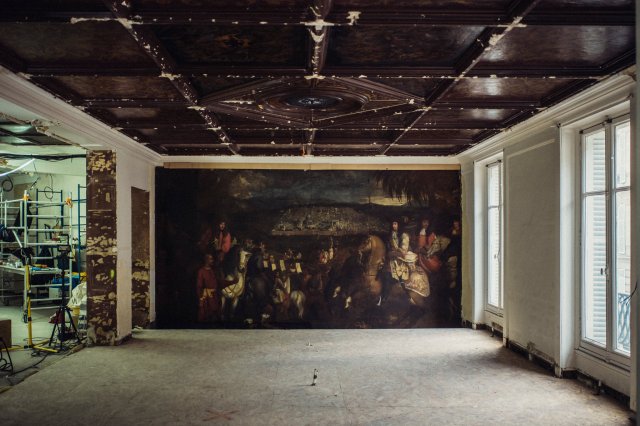
A large seventeenth-century oil painting (measuring 10-by-20-foot) has been discovered behind a wall in a building that is currently being restored for an Oscar de la Renta boutique in Paris.

After workers discovered the painting, Oscar de la Renta brought in art historian Stephane Pinta to examine the artwork.

Pinta was able to make an attribution: “Mr. Pinta determined that the painting was an oil on canvas created in 1674 by Arnould de Vuez, a painter who worked with Charles Le Brun, the first painter to Louis XIV and designer of interiors of the Château de Versailles. After working with Le Brun, de Vuez, who was known for getting involved in duels of honor, was forced to flee France and ended up in Constantinople.”

Pinta investigated art history sources and “traced the painting to a plate that was reproduced in the 1900 book “Odyssey of an Ambassador: The Travels of the Marquis de Nointel, 1670-1680” by Albert Vandal, which told the story of the travels of Charles-Marie-François Olier, Marquis de Nointel et d’Angervilliers, Louis XIV’s ambassador to the Ottoman Court. On Page 129, there is a rotogravure of an artwork depicting the Marquis de Nointel arriving in Jerusalem with great pomp and circumstance — the painting on the wall.”

The painting is now being restored.  The New York Times reports on the discovery of the Vuez painting.

Posted in Art History, Court Studies, Cultural History, Early Modern Europe, European History, French History, Mediterranean World, Noble Culture and History of Elites, Paris History, Religious History, Religious Politics, Strategy and International Politics, War and Society, War, Culture, and Society, Warfare in the Early Modern World | Leave a comment

Italian Paleography Seminar

2019 Mellon Summer Institute in Italian Paleography
July 8-26, 2019
Newberry Library

Application Deadline: March 1, 2019

CRS is pleased to announce that applications are now being accepted for the 2019 Mellon Summer Institute in Italian Paleography, which will be directed by Maddalena Signorini (Università degli Studi di Roma).

This three-week institute will offer intensive training in the accurate reading and transcription of handwritten Italian vernacular texts from the late medieval though the early modern periods. The instruction is intended to enable scholars in various fields of specialization to acquire the skills to work with primary sources. While the major emphasis is on paleographical skills, the course offers an introduction to materials and techniques, and considers the history of scripts within the larger historical, literary, intellectual, and social contexts of Italy. Participants receive an introduction to a wide range of types of writing and documents from literary to legal, notarial, official, ecclesiastical, business, and family documents. The course offers an overview of the system of Italian archives-public, ecclesiastical, and private. Participants also have the opportunity to work with original texts, using manuscripts and documents in the collections of the Newberry Library.

The institute will enroll 15 participants by competitive application. First consideration will be given to advanced PhD students and junior faculty at U.S. colleges and universities, but applications are also accepted from advanced PhD students and junior faculty at Canadian institutions, from professional staff of U.S. and Canadian libraries and museums, and from qualified independent scholars.

This graduate-level course is taught entirely in Italian; advanced language skills are required.

All successful applicants will receive a stipend, and non-local participants will receive additional funds to help defray the costs of travel, housing, and food. There are no fees associated with the institute.

For more information about the Institute and instructions for applying, visit the Institute calendar page here: http://www.newberry.org/07082019-2019-mellon-summer-institute-italian-paleography

The application deadline is March 1, 2019.

Posted in Archival Research, Graduate Work in History, Humanities Education, Italian History, Mediterranean World, Renaissance Art and History | Tagged | 1 Comment

Vietnam War Conference

1969: Vietnamization and the Year of Transition in the Vietnam War

April 25-27, 2019, Lubbock Texas

The Vietnam Center and Archive (VNCA) and the Institute for Peace & Conflict (IPAC) at Texas Tech University are pleased to announce a conference focused on the year 1969. We expect in this conference to approach a wide range of historical events and topics by hosting presenters who examine diplomatic, military, international, regional, and domestic aspects of the Vietnam War. We also seek presentations that reflect the recent and emerging scholarship on the transition of leadership from Johnson to Nixon and from Westmoreland to Abrams in challenging and complicating existing interpretations of them and their policies. We are also particularly interested in papers that address the concepts of “Vietnamization” and the shift toward “pacification.” We seek presentations that reflect all participants and perspectives, including those of the US, RVN, DRV, NLF, and other nations involved. Additional areas of interest include the strategic and tactical decision-making to expand the war into Cambodia with OPERATION MENU. We also encourage presentations that examine the social and religious aspects of the war, the antiwar and peace movements at home and abroad, the effect of journalism and reporting on the war, and the efforts to end the conflict through international diplomacy and military and diplomatic means in Vietnam and Southeast Asia.

This two-day conference will be hosted in Lubbock, Texas. Conference organizers welcome both individual presentation proposals as well as pre-organized panel proposals that include a moderator/commentator and three individual presentations. Conference sessions will follow the standard 90-minute format to include 60 minutes for presentations (20 minutes per presentation) followed by 30 minutes for commentary, questions, and discussion. Presentations by veterans are especially encouraged as are presentations by graduate students. Graduate student travel grants will be made available to select students. All presentations will be video recorded and made publicly available after the conference via the Vietnam Center and Archive website. Select papers may also be published in a collection by the TTU Press.

This two-day conference will be hosted at the MCM Elegante Hotel and Suites in Lubbock, Texas. Conference organizers welcome both individual presentation proposals as well as pre-organized panel proposals that include a moderator/commentator and three individual presentations. Conference sessions will follow the standard 90-minute format to include 60 minutes for presentations (20 minutes per presentation) followed by 30 minutes for questions and discussion. Presentations by veterans are especially encouraged as are presentations by graduate students. Graduate student travel grants will be made available to select students. All presentations will be video recorded and made publicly available after the conference via the Vietnam Center and Archive website. Select papers may also be published in a collection by the TTU Press.

Proposal submission deadline is February 15, 2019. Please submit a 250 word abstract and separate two-page CV/resume to VietnamConference.TTU@gmail.com. The program committee of Ron Milam, Steve Maxner, Justin Hart, Dave Lewis, and Laura Calkins will evaluate all paper proposals and develop a program that reflects the many remarkable aspects of 1969. If submitting a panel proposal, please include separate abstracts for each proposed presentation and CVs/resumes for each speaker.

Posted in Conferences, Strategy and International Politics, War and Society, War, Culture, and Society | Leave a comment

U.S. Army Releases Iraq War Study

The United States Army has released its highly anticipated study of the Iraq War (2003-2011), entitled The U.S. Army in the Iraq War (2 vols.) (United States Army War College Press, 2019).

This internal U.S. Army study was commissioned by the former Army Chief of Staff, General Ray Odierno in 2013 and authored by a team of U.S. Army colonels and lieutenant colonels.

A draft of the study was apparently completed two years ago in 2016. The draft study reportedly includes criticism of policymakers and commanders, generating controversy and delaying the study’s release.

The lengthy study has now been released, along with numerous declassified documents that were used in analyzing Iraq War strategies, operations, and tactics.

The U.S. Army in the Iraq War is organized into two volumes: Volume 1: Invasion, Insurgency, Civil War (2003-2006) and Volume 2. Surge and Withdrawal (2007-2011).

The United States Army War College has posted The U.S. Army in the Iraq War (2 vols.) in its entirety on its official Publications website.

The Wall Street Journal reports on the release of the study.

Students in HIST 384 History of War since 1500 at Northern Illinois University may be interested in exploring this study.

Posted in Civil Conflict, History of Violence, War and Society, War, Culture, and Society | Leave a comment

The World of the Siege

A new volume on The World of the Siege: Representations of Early Modern Positional Warfare will soon be published by Brill in its History of Warfare series.

This collective volume is edited by Anke Fischer-Kattner and Jamel Ostwald and includes diverse essays on early modern siege warfare. The volume grew out of a fascinating conference organized by Anke Fischer-Kattner at Duke University in 2014 on The World of the Siege. I participated in the conference and contributed a chapter on “‘The Enterprises and Surprises that They Would Like to Perform’: Fear, Urban Identities, and Siege Culture during the French Wars of Religion,” to the collective volume.


The World of the Siege examines relations between the conduct and representations of early modern sieges. The volume offers case studies from various regions in Europe (England, France, the Low Countries, Germany, the Balkans) and throughout the world (the Chinese, Ottoman and Mughal Empires), from the 15th century into the 18th. The
international contributors analyse how siege narratives were created and disseminated, and how early modern actors as well as later historians made sense of these violent events in both textual and visual artefacts. The volume’s chronological and geographical breadth
provides insight into similarities and differences of siege warfare and military culture across several cultures, countries and centuries, as well as its impact on both military combatants and civilian observers.”

The book description is available on the Brill website and the book is listed on Brill’s History of Warfare series site.

Posted in Civil Conflict, Civilians and Refugees in War, Early Modern Europe, Early Modern World, European History, History of Violence, Reformation History, Renaissance Art and History, War and Society, War, Culture, and Society, Warfare in the Early Modern World | Leave a comment

Generous Amazons Article in Spanish

I am excited to see that my “Generous Amazons” article on besieged women in the French Wars of Religion is now available in Spanish!

Antonio Escobar Tortosa has kindly translated the article and Revista Universitaria de Historia Militar (RUHM) has published the Spanish translation in its latest issue.

The full citation is: “‘Generosas amazonas acudieron a la brecha’: mujerees sitiadas, agencia y sujeción durante las Guerras de Religión en Francia,” Revista Universitaria de Historia Militar 7: 15 (2018): 213-245. The translation is available at the RHUM website.

The article was originally published in English in a special issue of the journal Gender & History: Brian Sandberg, “‘Generous Amazons Came to the Breach’: Besieged Women, Agency and Subjectivity during the French Wars of Religion”, Gender & History, 16:3 (2004), pp. 654-688. The special issue was later published as a collective volume on Violence, Vulnerability and Embodiment: Gender and History, ed. Shani D’Cruze and Anupama Rao.

Posted in Civil Conflict, Civilians and Refugees in War, Early Modern Europe, European History, European Wars of Religion, French History, French Wars of Religion, Gender and Warfare, History of Violence, Religious Violence, War and Society, War, Culture, and Society, Warfare in the Early Modern World | Leave a comment

The Antichrist and Apocalyptic Thinking Today

Apocalyptic thinking is alive and well in today’s world. The Patriarch of the Russian Orthodox Church has ignited controversy by prognosticating that the Antichrist will use the internet to gain control of humanity.

The BBC reports on the Patriarch’s apocalyptic thinking. “Speaking to Russian state TV, Patriarch Kirill said smartphone users should be careful when using the ‘worldwide web of gadgets’ because it represented ‘an opportunity to gain global control over mankind.'”

Image: Getty Images

The Patriarch claimed that “The Antichrist is the person who will be at the head of the worldwide web, controlling all of humankind.”

The Patriarch continued: “Every time you use your gadget, whether you like it or not, whether you turn on your location or not, somebody can find out exactly where you are, exactly what your interests are and exactly what you are scared of.”

Processes of secularization are relatively weak in many regions and the entire secularization narrative has been challenged over the past several decades.

Although news media have focused heavily on religious violence in the Muslim world in the 2000s and 2010s, we should remember that religious conflicts have arguably intensified since the 1990s. The breakup of Yugoslavia and the Bosnia War fueled religious violence, ethnic cleansing, and massacres.

The resurgence of Orthodox religiosity in areas of the former Soviet Union following the Fall of the Berlin Wall has encouraged new forms of religious politics in Russia, Ukraine, and Central Asia.

Religious politics is also contributing to the conflict between Ukraine and Russia and schism in Orthodox Christianity. The BBC reports that “On Saturday, the Orthodox Church of Ukraine split from the Russian Church following centuries of Russian leadership, formalising a decision announced in October. The move sparked a furious response in Moscow and deepened a split in the world wide Orthodox Church.”

Undergraduate students in my course on European Wars of Religion, 1520s-1660s, consider apocalyptic thinking through Andrew Cunningham and Ole Peter Grell’s Four Horsemen of the Apocalypse and articles on radical preaching and prognostication in early modern Europe.

Posted in Early Modern Europe, Early Modern World, Empires and Imperialism, European Wars of Religion, History of Violence, Religious History, Religious Politics, Religious Violence, War, Culture, and Society | Leave a comment