Religion, Politics, and Violence in Early Modern France at the ASCH 2019

Historians discussed religion, politics, and violence in early modern France at the American Society of Church History (ASCH) conference in Chicago this weekend.

The ASCH promotes the academic study of the history of Christianity and is one of the affiliated societies of the American Historical Association. The conference often hosts sessions on the history of Protestant and Catholic Reformations of the sixteenth century.

I was pleased to chair a session at the ASCH on “Failures of Religious Dialogue in Early Modern France.” John McCormack presented research on the Colloque of Poissy during the French Wars of Religion and Xavier Maréchaux offered a paper on refractory clergy during the French Revolution. The discussion developed around clergy, religious politics, and church-state relations in early modern France.

The conference program is available at the ASCH 2019 conference website.

Posted in Conferences, Early Modern Europe, European History, European Wars of Religion, French History, French Revolution and Napoleon, French Wars of Religion, Political Culture, Reformation History, Religious History, Religious Politics, Religious Violence | Leave a comment

American Historical Association Annual Meeting in Chicago

The American Historical Association 2019 Annual Meeting wrapped up yesterday.

Historians from across the United States (and beyond) met for four days in Chicago to discuss new research, graduate education, undergraduate education, professional concerns, and public history.


I attended sessions on French, Caribbean, Mediterranean, and Global history, learning about historical research. One of the highlights of the conference was Lauren Benton’s Toynbee Prize Lecture on “Law and Conquest in World History,” sponsored by the Toynbee Foundation.

I enjoyed meeting with numerous friends and colleagues in early modern history, historical publishing, and digital humanities. Many of my faculty and graduate student colleagues from Northern Illinois University were able to participate in the conference and I was able to reconnect with old friends at the reception hosted by the Department of History at the University of Illinois at Urbana-Champaign, my doctoral alma mater.

I was able to spend some time in the AHA book exhibit, examining potential course adoptions and gauging current trends in historical publishing.

Each year, the American Historical Association (AHA) organizes a series of sessions to provide historical perspectives on contemporary issues. Some of the current issues that historians considered this weekend included refugees, migration,  populist politics, and gender issues. Historian Rachel Van Bokkem provides a summary of a plenary session on displaced persons on AHA Perspectives.  Another panel on gender history at the conference is assessed elsewhere on AHA Perspectives.

Many professors and graduate students at AHA were discussing the state of the discipline and concerns about the recent nationwide decline in History majors. Liz Lehfeldt, my friend and early modernist colleague, responds to this discussion with an essay on “Why Study History?” in Inside Higher Ed.

Although academic job interviews are moving increasingly to video phone interviews at this point, some interviews are still held at the AHA. There are also numerous professional sessions at the AHA on the CV construction, interviewing skills, and professionalization issues, and the state of the job market in History. The Chronicle of Higher Education reports on the job market in the humanities fields, based on sessions at the AHA and the MLA last week.

This conference seems to have attracted fewer blog and twitter posts than previous conferences, perhaps due to the end of the AHA Today blog, which ceased activity in Summer 2018 and has been replaced by AHA Perspectives Daily. The twitter traffic can be found at hashtags #AHA19 and #AHA2019.

Posted in Careers in History, Conferences, Digital Humanities, Graduate Work in History, Historiography and Social Theory, Humanities Education | 1 Comment

First World War Soldiers in Color

Peter Jackson’s They Shall Not Grow Old has been released in the United States, with screenings in selected cities this month. I was lucky to get to view the film yesterday in Chicago and want to offer some initial responses here.
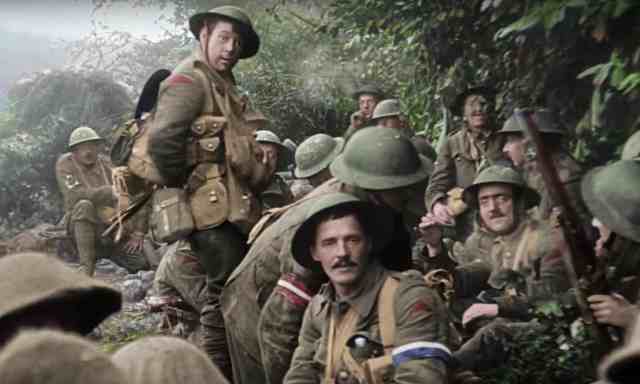
The New York Times states that “The documentary, which will screen nationwide Dec. 17 and Dec. 27, concentrates on the experiences of British soldiers as revealed in footage from the archives of the Imperial War Museum. Jackson and his team have digitally restored the footage, adjusted its frame rate, colorized it and converted it to 3-D. They chose not to add a host or title cards. Instead, veterans of the war ‘narrate’ — that is, the filmmakers culled their commentary from hundreds of hours of BBC interviews recorded in the 1960s and ’70s. The result is a transformation that is nothing less than visually astonishing.”
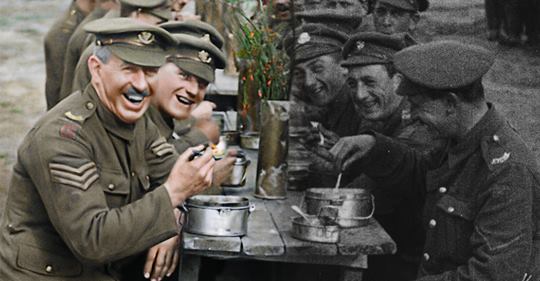
The restored film definitely offers amazing visuals! Jackson edited many of the original shots, zooming in for close-ups and panning for more active motion of the subjects. Jackson’s team colorized much of the footage, especially for scenes of soldiers’ life in the trenches on the Western Front. However, I often found the restored black-and-white film segments more effective than the colorized ones.
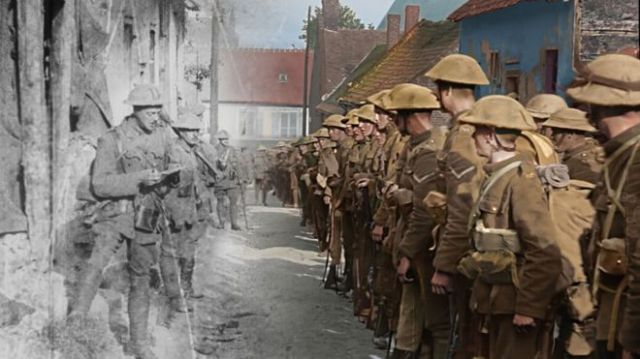
I saw the film in 3-D and found that aspect done well (not overdone). The “reconstructed” sounds are impressive and visceral, but will also be controversial.

Alice Kelly (Harmsworth Postdoctoral Fellow, University of Oxford) has reviewed the film for The Conversation, and I agree with her assessment: “What the reviews or the film’s billing don’t discuss is the implicit fictionalisation or ethics of Jackson’s method. Obviously all documentaries are fictionalised to some extent – created through editorial selections that have biases, both explicit and implicit. But I don’t think we should even be calling this a documentary; it’s really an artwork or a fictionalised feature film. ”

The film’s narrative is nonexistent, simply a mishmash of British front-line soldiers’ experiences on the Western Front, drawn mostly from BBC interviews with First World War veterans taped during the 1960s. Jackson’s “reconstruction” of the First World War focuses rather myopically on British experiences of trench warfare in Flanders in 1916, but extrapolated to encapsulate the entirety of the war. This creates a rather ahistorical approach to the First World War, reifying British mythologies of the Lost Generation.

In interviews, Peter Jackson has acknowledged leaving out British Imperial, French, Belgian, German, Austrian, Ottoman, Italian, Russian, Balkan, American, and colonial perspectives. The film concentrates exclusively on one section of the Western Front, excluding all other theaters of war. It is jarring to see First World War British soldiers (and some German prisoners-of-war) in color, and yet no “colored” soldiers here at all.

Jackson seems to dismiss concerns that his film largely ignores the home front, colonial forces, government propaganda, wartime politics, military industry, women and gender issues, non-combatants, disease, shell shock conditions, and post-war suffering.

Jackson’s reconstruction of the Western Front in the First World War, draws heavily on the British newsreal/propaganda film, Battle of the Somme (1916) and its outtakes. The British Topical Committee for War Film, a film production company sponsored by the War Office, sent film crews to the Western Front and other locations to film the British war effort during the First World War. Edited films such as Battle of the Somme were screened at movie cinemas in the United Kingdom during the war.
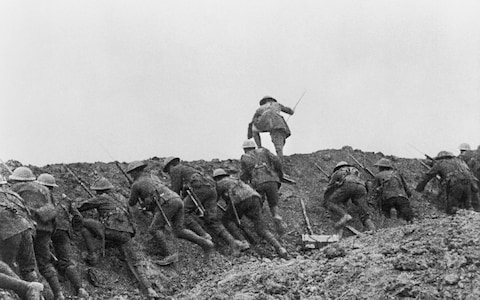
The film uses contemporary recruitment posters effectively to illustrate the excitement of soldiers’ wartime experiences, but the combat scenes rely too heavily on problematic propaganda drawings from War Illustrated magazine.

The New York Times reports on Peter Jackson’s They Shall Not Grow Old.

Alice Kelly’s review, entitled “They Shall Not Grow Old: World War I Film a Masterpiece of Skill and Artistry – Just Don’t Call it a Documentary,” is published by The Conversation (5 November 2018).

The Imperial War Museums website provides streaming access to the film, Battle of the Somme(1916).


Posted in Historical Film, History in the Media, History of Violence, War and Society, War in Film, War, Culture, and Society | Leave a comment

Frank Valadez AHA Spotlight

Frank Valadez, my friend and fellow UIUC graduate History alum, is featured in an American Historical Association spotlight today!

Frank is an amazingly flexible history thinker and practitioner who currently serves as  Director of the Division for Public Education at the American Bar Association. He pursued undergraduate studies in History at Northwestern University and then received an MA in History from the University of Illinois at Urbana-Champaign.

Graduate students in History will be interested in the broad range of positions that Frank has held as writer, editor, and educator. He has served in administrative and leadership roles in historical and humanities organizations such as the Newberry Library, Chicago Public Schools, and the Chicago Metro History Fair. Frank’s career trajectory demonstrates how historians can make a real difference in historical education and public humanities.
Frank’s spotlight is featured on the AHA Persectives website.

Posted in Careers in History, Education Policy, History in the Media, Humanities Education, The Past Alive: Teaching History | Leave a comment

Promoting Diversity in Undergraduate Admissions

Educational Evaluation and Policy Analysis has published an article presenting new research on diversity in undergraduate admissions.

The article considers the State of Texas’s 10 percent plan, which provides guaranteed admissions into state universities for the top 10 percent of high school graduates in the state. “For the study, Kalena E. Cortes, an associate professor of public policy at Texas A&M University, and Jane Arnold Lincove, an associate professor of public policy at the University of Maryland Baltimore County, looked at the records of 146,000 Texas public high school students who graduated in spring 2008 and spring 2009 and who applied to at least one four-year public university in Texas,” according to Inside Higher Ed.

The study finds that “the Texas 10 percent plan, one of the most prominent experiments in guaranteed admissions, made high-talent, low-income students more likely than they historically have been to apply to the flagship universities in Texas.”

Inside Higher Ed emphasizes that the study’s findings demonstrate that flagship state universities, such as the University of Texas at Austin and Texas A&M University, are able to attract more minority and underprivileged students with the 10 percent plan than they previously did. “So guaranteed admissions, the paper argues, can reduce the problem of ‘undermatching,’ in which talented, disadvantaged students apply to few if any competitive colleges — even though in many cases they would be admitted and awarded aid. Given the better graduation rates and (in many cases) significantly greater resources available at the more competitive colleges, many education experts see undermatching as a major problem.”

State universities with declining enrollments may wish to consider adopted guaranteed admission plans such as this to encourage high school graduates in economically distressed areas to apply for university admission. Private universities that have tried other plans for diversifying enrollments may also find the 10 percent plan an effective alternative approach.

The article by Cortes and Licove appears in Educational Evaluation and Policy Analysis. The American Education Resesarch Association (AREA) summarizes the study’s findings at its website. Inside Higher Ed reports on the study and the Texas 10 percent plan.

Posted in Education Policy, Humanities Education | Leave a comment

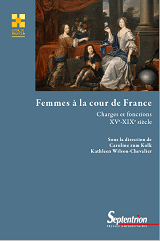
Femmes à la cour de France. Charges et fonctions, XVe-XIXe siècle

Femmes à la cour de France. Charges et fonctions (XVe – XIXe siècle), ed. Caroline zum Kolk, Kathleen Wilson-Chevalier (Villeneuve d’Ascq, Septentrion, 2018), ISBN-102757423614, has been released.

This collective volume on women at the royal court of France in the early modern period includes interdisciplinary studies in English and French languages on noblewomen and their households, their official and family roles, women and court politics, motherhood and parenting, mistresses and sexuality, and gender and court culture.

I contributed an essay on “« Je ne vis jamais cette cour plus pleine de tourment » : Montmorency Women and Confessional Politics at Court during the French Wars of Religion,” to the volume.

This collective volume is an outgrowth of an engaging conference on Femmes à la cour de France – charges et fonctions (Moyen Âge – XIXe siècle) that was organized by Caroline zum Kolk, Kathleen Wilson-Chevalier, Flavie Leroux, and Pauline Ferrier-Viaud, and held at the Institut d’Études Avancées de Paris in October 2015.

Scholars working on early modern women, gender, and sexuality will be interested in this volume, as will historians of the French court and early modern France.

Posted in Court Studies, Cultural History, Early Modern Europe, European History, European Wars of Religion, French History, French Wars of Religion, Noble Culture and History of Elites, Reformation History, Renaissance Art and History, Women and Gender History | Leave a comment

Postdoctoral Fellowships on the European Fiscal-Military System

The Faculty of History at the University of Oxford is seeking six Research Associates to join the team from September 2019, or as soon as possible thereafter, for an ambitious 5-year multi-national research project. ‘The European Fiscal-Military System 1530-1870’ is funded by a €2.5 million European Research Council Advanced Grant, directed by Professor Peter Wilson, and hosted and coordinated by the University of Oxford.

Through six case studies (one for each appointee), this project will detail the extent to which co-operative processes were intrinsic to the growing scale of warfare and the rise of the European states system.

You will conduct independent research on one of the project’s six case studies, in libraries and archives in the UK and abroad. You will collaborate with the wider project team, take part in meetings, workshops and conferences, and contribute to public engagement work.

You will hold a doctorate in a relevant field (or show evidence that a doctorate is imminent), have sufficient knowledge of the languages relevant to your case study, and outstanding spoken and written English. You will have excellent communication and data handling skills, a demonstrable capacity for independent research and be capable of working to strict deadlines.

These posts are fixed-term for up to 3 years. For an informal discussion about the role, please contact Professor Peter Wilson: peter.wilson@history.ox.ac.uk.

For Further Particulars and how to apply, visit https://www.recruit.ox.ac.uk/pls/hrisliverecruit/erq_jobspec_version_4.jobspec?p_id=138343

This announcement was posted on H-Net.

Posted in Archival Research, Early Modern Europe, Early Modern World, Empires and Imperialism, European History, Grants and Fellowships, History of Violence, Reformation History, Renaissance Art and History, State Development Theory, Strategy and International Politics, War and Society, War, Culture, and Society, Warfare in the Early Modern World | Leave a comment

Featured Review on War and Culture in American Historical Review

I am happy to report that my review essay on three new books on war and culture in early modern Europe has been published in the American Historical Review (AHR).

The books under review are:

Ilya Berkovich. Motivation in War: The Experience of Common Soldiers in Old-Regime Europe. New York: Cambridge University Press, 2017. Pp. xii, 280. $29.99.

Christy Pichichero. The Military Enlightenment: War and Culture in the French Empire from Louis XIV to Napoleon. Ithaca, N.Y.: Cornell University Press, 2017. Pp. xi, 301. $49.95.

Thomas Dodman. What Nostalgia Was: War, Empire, and the Time of a Deadly Emotion. (Chicago Studies in Practices of Meaning.) Chicago: University of Chicago Press, 2018. Pp. xi, 275. $35.00.

This review essay was selected to appear as a featured review in the latest issue of AHR. Here is the full citation: American Historical Review 123:5 (December 2018): 1629-1633.

The review essay is available online at the AHR website on Oxford Academic.


Posted in Early Modern Europe, European History, French History, French Revolution and Napoleon, History of Violence, Revolts and Revolutions, War and Society, War, Culture, and Society, Warfare in the Early Modern World | Leave a comment

Newberry Library Early Career Fellowships

Center for Renaissance Studies, Newberry Library

Early Career Postdoctoral Fellowship, 2019-2020

Application Deadline: January 4, 2019

The Center for Renaissance Studies (CRS) at the Newberry Library is pleased to announce an Early Career Postdoctoral Fellowship for recent PhDs from one of our CRS consortium schools. Applicants must have the PhD in hand by June 2019 or have recently completed the PhD in 2018. Half of the fellow’s time will be devoted to research of her/his choosing and half time to working with the CRS on projects related to the activities of a lively Renaissance research center, including curatorial work, digital humanities initiatives, programming, paleography studies, and collection presentations of rare books and materials. Applicants are invited from all fields of the humanities whose work is particularly well connected to the Newberry’s medieval and early modern collections.

Due date: 11:59 PM CST on January 4th, 2019

Stipend amount: $4,200 a month plus health insurance

Eligibility: PhD from a CRS consortium university in 2018 or by June 2019

Requirements: letter of interest, project description, CV, 3 letters of recommendation (one from the PhD advisor)

Duration: 10 months starting September 3, 2019

Applications will be accepted online only. For a step-by-step guide for preparing to submit your application, visit http://www.newberry.org/how-apply

Please direct all inquiries regarding the fellowship to renaissance@newberry.org.

Posted in Digital Humanities, Early Modern Europe, Early Modern World, European History, Graduate Work in History, Grants and Fellowships, Reformation History, Renaissance Art and History | Leave a comment

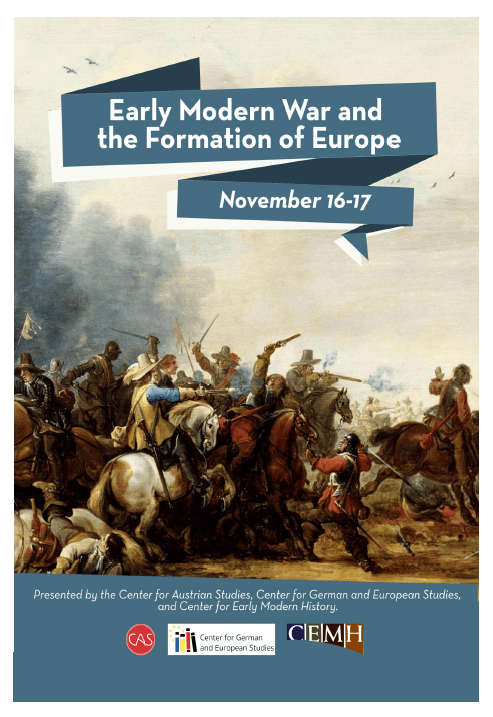
Early Modern War and the Formation of Europe

The Center for Austrian Studies at the University of Minnesota at Minneapolis hosted an interdisciplinary conference on Early Modern War and the Formation of Europe this weekend (16-17 November 2018).

The conference included diverse perspectives on war, culture, and society in the seventeenth century from historians, art historians, musicologists, and literary scholars. I was pleased to be able to participate in the conference and present new research on the concept of religious warfare and the language of “troubles” in early modern France.

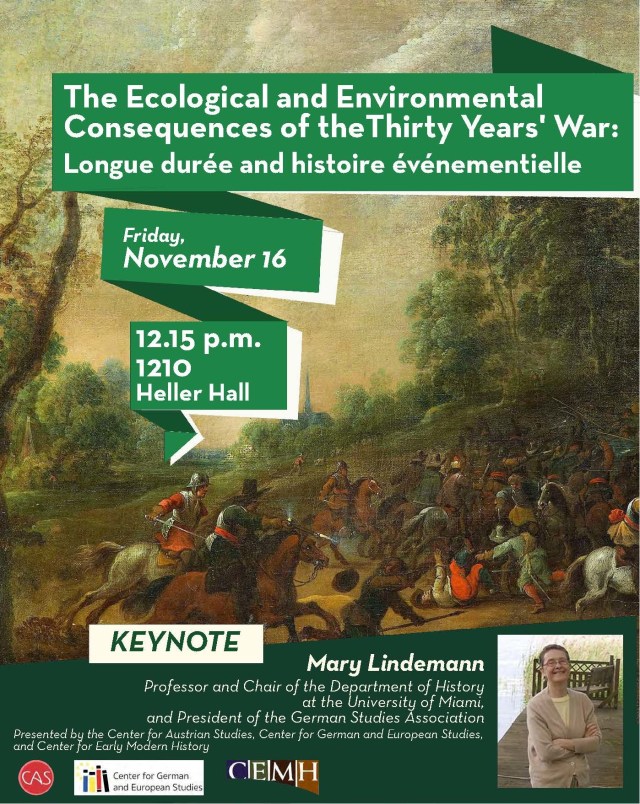
Mary Lindemann delivered a keynote lecture on “The Ecological and Environmental Consequences of the Thirty Years’ War: Longue durée and histoire événementielle” at the conference.

The conference Program is available as a .pdf file.

Posted in Conferences, Cultural History, Early Modern Europe, Early Modern World, Empires and Imperialism, European History, European Wars of Religion, French Wars of Religion, History of Violence, Mercenaries, Noble Culture and History of Elites, Reformation History, Religious Violence, War and Society, War, Culture, and Society, Warfare in the Early Modern World | Leave a comment