Beyond the Binary: Trans* History in Early America

Beyond the Binaries: On Gender History

Posted in Cultural History, Human Rights, Women and Gender History | Leave a comment

Renaissance History Postdoc

The University of Warwick has posted an announcement for a Renaissance history postdoctoral position.

Below is the announcement:

Research Fellow

£28,695 – £37,394 pa                                                                                                Ref: 75510-015

Fixed Term Contract for 36 months

Italian Studies at the University of Warwick is seeking a Research Fellow as part of the ERC-funded Starting Investigator Grant on ‘Aristotle in the Italian Vernacular: Rethinking Renaissance and Early-Modern Intellectual History (c. 1400-c. 1650)’. The project is a collaboration between the University of Ca’ Foscari, Venice (Dipartimento di Filosofia e Beni Culturali) and the University of Warwick (Italian Studies, School of Modern Languages and Cultures).

You will conduct research on topics related to the interpretation of Aristotle’s works in the Italian vernacular (roughly 1400–1650), with particular attention to Aristotelian poetics, rhetoric or moral philosophy. Your main activities will involve research, writing articles as the basis for a monograph, the organization of colloquia, the editing of colloquia proceedings, and other tasks as required. You will have opportunities to develop your professional and teaching profile. You will work under the direction of Dr David Lines and Professor Simon Gilson.

You will have a PhD or equivalent in Italian, Classics, Philosophy, Intellectual History, or a relevant field; an excellent knowledge of at least English, Italian and Latin; and first-hand familiarity with Medieval/Renaissance philosophy and the methods of research in Renaissance literature and/or intellectual history.

You are requested to submit a cover letter (outlining their interest in the position), academic CV (including list of publications and any awards received), sample of their written work (preferably one article in English; another in any other Western language) and three reference letters to Sharon.Murray@warwick.ac.uk, in addition to the application form.

For informal enquiries, please contact Dr David Lines, D.A.Lines@warwick.ac.uk, telephone +44 (0)24 7652 3250.

For further details and to apply online please visit the website below.

Closing date: 1 March 2015

www.warwick.ac.uk/jobs


Posted in European History, Grants and Fellowships, Information Management, Italian History, Jobs and Positions, Noble Culture and History of Elites, Renaissance Art and History | Leave a comment

Religious Fundamentalism and Terrorism

briansandberg's avatarCluster for the Study of Religious Violence

Olivier Roy (Professor at the European University Institute, Firenze) is giving a presentation on “Are terrorism and jihadism a consequence of a religious fundamentalist radicalization?”

The lecture will be held on 5 February 2015 at the University of Chicago Center in Paris.

The Chicago Center in Paris website indicates that: “Oliver Roy holds a Chair in Mediterranean Studies at the European University Institute in Florence. Roy is widely known for his works on Islamic fundamentalism and its consequences in Europe. He is the author, among other books, of The Failure of Political Islam (trans, 1994), Globalized Islam (2004), and Holy Ignorance (trans, 2010). Roy will be speaking at the University of Chicago Center in Paris on issues related to the Charlie Hebdo massacre, and will take audience questions following his talk.”

I will be attending the lecture and taking notes for my teaching of a graduate seminar on Religious Violence…

View original post 20 more words

Posted in French History, Lectures and Seminars, Paris History, Religious History, Religious Politics, Religious Violence, Terrorism | Leave a comment

Insurgencies Conference

Northwestern University is organizing a graduate conference on “Insurgencies” this spring.

The conference announcement reads: “This graduate conference to be held April 10, 2015 at Northwestern University aims to broaden historical understanding of insurgency. Insurgencies challenge legitimacy from below. Theorists often understand insurgencies as challenges to political and military authority, but insurgencies also arise against social, cultural, and economic authority. The concept of insurgency overlaps with concepts like revolution and rebellion, but it avoids the teleology inherent in those concepts by not presuming eventual success or a fixed time horizon. With its companion concept counterinsurgency, insurgency emphasizes the multi-directionality of power. This concept has prominently reemerged in recent years, and historians have much to gain by joining the conversation.”

“This conference provides an opportunity to reexamine the history of insurgency, drawing attention to insurgencies in previously under-examined domains such as culture and economics, periods such as medieval and early modern history, and modes such as transnational insurgency. It calls for papers on “insurgency” broadly construed.  Papers can address questions including (but not limited to): How have insurgencies shaped and reshaped political, social, and cultural institutions? What makes insurgencies succeed? What happens to insurgencies after they succeed? What happens to insurgencies that fail?  How does power reconstitute itself in wake of an insurgency? What is the life of an insurgent? What are the power dynamics within an insurgency? What are the dynamics of transnational insurgency?”

“This conference features keynote speaker Martin A. Miller of Duke University, author of The Foundations of Modern Terrorism: State, Society, and the Dynamics of Political Violence (Cambridge, 2013), and distinguished commentator Paul Thomas Chamberlin of the University of Kentucky, author of the The Global Offensive: The Palestinian Liberation Organization, and the Making of the Post-Cold War Order  (Oxford, 2012) and of the forthcoming The Cold War’s Killing Fields: The Human Tragedy of the Superpower Struggle (HarperCollins). Professors from the history department at Northwestern University will also participate.”

For more information on this conference, see the Northwestern University website.

Posted in Civil Conflict, Civilians and Refugees in War, Conferences, Empires and Imperialism, Graduate Work in History, History of Violence, Religious Violence, Revolts and Revolutions, State Development Theory, Strategy and International Politics, Terrorism, War, Culture, and Society | Leave a comment

Un Courage Viril

I am giving a presentation on “Un Courage viril. Le genre et la violence en France pendant les Guerres de religion, 1562-1629,” at the séminaire interne of the Institut d’Études Avancées de Paris on Tuesday 3 February 2015.

This presentation will introduce my book project on A Virile Courage: Gender and Violence in the French Wars of Religion, 1562-1629,  through a broader discussion of research methodologies on gender and violence.

Religious politics and civil warfare disrupted gender relations during the French Wars of Religion, allowing individuals to challenge gender stereotypes and transgress gender boundaries in new ways. Some “women warriors” engaging directly in violence during the religious wars that devastated France from 1562 to 1629. Religious divisions separated Calvinist and Catholic communities in early modern France, erecting confessional (or sectarian) boundaries and simultaneously establishing new gender distinctions in French society. Despite these social barriers, women were important historical actors in the religious wars, promoting various religious reforms and political agendas in the context of intense sectarian violence.

My book project, A Virile Courage: Gender and Violence in the French Wars of Religion, 1562-1629, examines the gendered nature of violence and political culture in early modern France. The book will provide a detailed examination of the roles that gender played in confessional politics and religious violence in early modern France, contributing new perspectives on the dynamics of religious activism and sectarian violence.

The IEA de Paris website provides more information on my book project.

Posted in Civil Conflict, Civilians and Refugees in War, Cultural History, Current Research, Early Modern Europe, European History, French History, French Wars of Religion, Gender and Warfare, History of Violence, Noble Culture and History of Elites, Political Culture, Reformation History, Religious History, Religious Politics, Religious Violence, War, Culture, and Society, Warfare in the Early Modern World, Women and Gender History | Leave a comment

Guerre, Circulations et Transferts Culturels

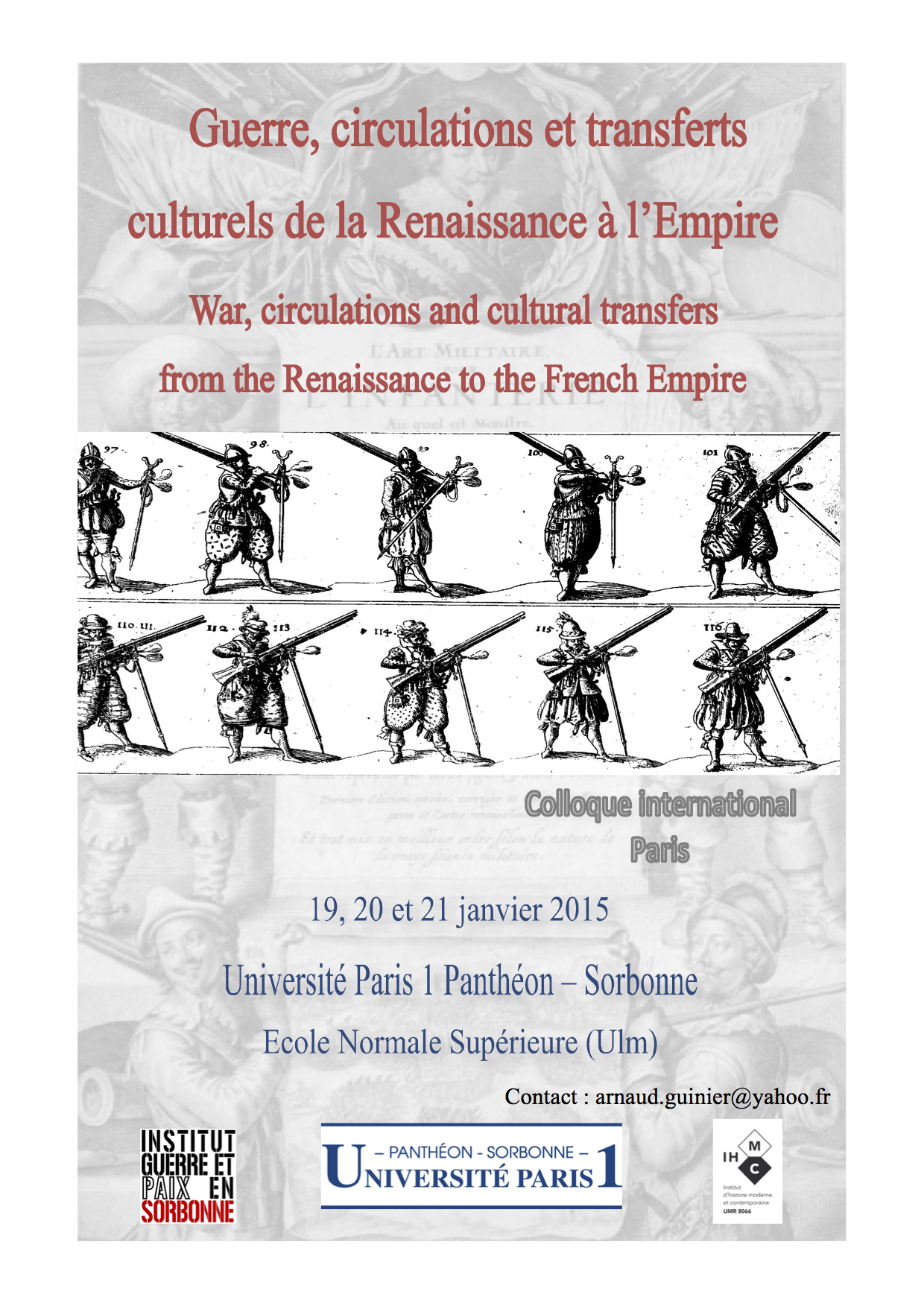
I recently participated in a fascinating conference in Paris on “Guerre, circulations et transferts culturels de la renaissance à l’Empire” (War, Circulation and Cultural Transfers from the Renaissance to the French Empire), organized by Hervé Drévillon and Arnaud Guinier. Conference participants presented new research on the circulation of war news, technical knowledge, and military intelligence in early modern and modern Europe. Papers explored diverse aspects of war reporting, military treatises, officer training, technical expertise, military migrants, historical memory, military espionage, and technology transfers.

GuerreCirculations-affiche

I offered a research paper in French on “‘Actions Héroïques et Dignes de Mémoire’ : Les nouvelles de guerre et la circulation des connaissances militaires pendant les Guerres de religion.” The title of my paper translates as: “‘Actions Heroïques et Dignes de Mémoire’ : War News and the Circulation of Military Knowledge during the Wars of Religion.”

The conference was sponsored jointly by the Institut d’Histoire Moderne et Contemporaine at the École Nationale Superieure and the Institut des Études sur la Guerre et la Paix en Sorbonne. Conference sessions were held at the Université de Paris I (Panthéon-Sorbonne) and at the ENS in rue d’Ulm.

The conference program is available at the website of the Institut des Études sur la Guerre et la Paix en Sorbonne and of the Institut d’Histoire Moderne et Contemporaine.


Posted in Conferences, Early Modern Europe, Early Modern World, European History, European Union, European Wars of Religion, French History, French Revolution and Napoleon, French Wars of Religion, Globalization, History of Science, History of Violence, Maritime History, Mediterranean World, Noble Culture and History of Elites, Religious Violence, War, Culture, and Society, Warfare in the Early Modern World | Leave a comment

Paris, Ville de Cour ?

Conférence de Caroline zum Kolk will present a lecture on “Paris, Ville de Cour ?” as part of the “Les Mardis de Lauzun” lecture series at the Institut d’Études Avancées de Paris.

Mardi 03 Février 2015, 18h0020h00

IEA de Paris

17 quai d’Anjou

75004 Paris

The abstract for the lecture reads:

À la fin du Moyen Âge, les cours réduites et fonctionnelles du Moyen Âge se transforment en des organes politiques de premier plan qui brillent par leur taille et leur faste. La cour de France suit cette évolution tout en conservant un mode de vie itinérant, se déplaçant sans cesse d’une ville et d’un château à l’autre. Ce n’est qu’au début des années 1560, période où Catherine de Médicis assure la régence pour le jeune Charles IX, qu’apparaissent les indices d’une réforme qui vise à mettre un terme à l’itinérance curiale et l’installation de la cour à Paris. Les mesures prises par la reine, dont la construction du palais des Tuileries, modifient le statut de la capitale et les fonctions des résidences royales des alentours. La réforme va de pair avec une réflexion sur l’étiquette de cour et l’organisation d’une société curiale qui a perdu son caractère exclusivement masculin.

Documentée par des indices très disparates, cette tentative de réforme est passée inaperçue, d’autant plus qu’elle n’a pas porté les fruits escomptés : la crise de la fin du règne des Valois a mis un terme au séjour parisien de la cour. Elle a laissé néanmoins de nombreuses traces dans le tissu urbain et marque une étape décisive dans l’histoire de la capitale et de son rapport souvent conflictuel avec le pouvoir royal.

See the IEA de Paris website for more information.

Posted in Art History, Cultural History, Early Modern Europe, European History, Food and Cuisine History, French History, French Wars of Religion, Noble Culture and History of Elites, Paris History, Urban History | Leave a comment

The Insufficient Ark at U of C

The Early Modern Workshop at the University of Chicago is holding a discussion of Maura Capps’ dissertation chapter “The Insufficient Ark: A Political Ecology of a Failed Agricultural Department at the Cape of Good Hope, 1795-1806.”

Maura is a PhD candidate in the Department of History specializing in the environmental history of Britain’s settler empire.

The workshop will take place Monday 2 February 2015, at 5pm in Pick 319.

Graduate students at Northern Illinois University may want to participate in this workshop.

Posted in Atlantic World, Cultural History, Early Modern Europe, Early Modern World, Empires and Imperialism, Environmental History, European History, Food and Cuisine History, Globalization, Lectures and Seminars, Northern Illinois University | Leave a comment

Shipbuilding and Mediterranean Ports

Many observers have focused on the decline of industrial factories in Europe when discussing the emergence of a post-industrial economy in the Eurozone. Changes in naval and commercial shipbuilding have often been ignored, except by persons engaged in maritime industries and residents of port cities.

Mediterranean ports have been transformed significantly over the past generation, as shipbuilding operations have moved to Indian Ocean and East China Sea port facilities. Marseille, Barcelona, and Genoa are three of the major Mediterranean ports often cited as examples of major economic and cultural transformations.

The smaller port of La Ciotat, once a significant naval shipbuilding site, offers a different sort of example. This port has increasingly focused its shipyards on refurbishing luxury superyachts, rather than building new ships.

LaCiotat-shipyard

A recent New York Times article offers a portrait of the new maritime industries at La Ciotat.

Posted in European History, European Union, French History, Maritime History, Mediterranean World | Leave a comment

Northern Star Report on Charlie Hebdo Attacks

The Northern Star, the student-run newspaper of Northern Illinois University, has published several reports on the Charlie Hebdo attacks.

MarcheRepublicaine

The latest piece, “NIU professor to take lessons from Paris’ Charlie Hebdo marches to history class,” featured an interview I did with student reporter Margaret Maka concerning the aftermath of the terrorist attacks in Paris and the grand Marche républicaine.

The Northern Star article is available online.

Posted in European History, European Union, French History, Globalization, History in the Media, History of Violence, Human Rights, Northern Illinois University, Paris History, Religious Violence, Study Abroad, Terrorism | Leave a comment