History Wars Continue

In the 1990s, one theater of the “Culture Wars” became dubbed the “History Wars,” as politicians and political interest groups attempted to influence or control the presentation of historical events and developments in high school textbooks, college curricula, and museum exhibitions.

The “History Wars” were never really resolved and have been heating up once again recently.

The latest battleground in the “History Wars” is Oklahoma, where state legislators proposed a bill that describing the new AP History curriculum as an “emergency” that allegedly threatens the “public peace, health and safety.” These legislators are outraged by the AP History curriculum’s treatment of American history, claiming that it “includes little or no discussion of the Founding Fathers, the principles of the Declaration of Independence, the religious influences on our nation’s history and many other critical topics that have always been part of the APUSH course.” The lawmakers also complain that the AP History curriculum “excludes discussion of the U.S. military (no battles, commanders or heroes) and omits many other individuals and events that greatly shaped our nation’s history (for example, Albert Einstein, Jonas Salk, George Washington Carver, Rosa Parks, Dr. Martin Luther King, Tuskegee Airmen, the Holocaust).” The bill, if passed, would defund AP History beginning in Fall 2015.

The AP History curriculum authors and the American Historical Association, the flagship professional association of historians in the United States, defend the AP History curriculum’s content and methodological approaches. Many historians in Oklahoma have already spoken out to oppose the proposed legislation, which could result in no AP History courses being offered in Oklahoma.

“History has an unusual combination of being politically sensitive and also a discipline that more people feel they know more about than some other disciplines,” according to Jim Grossman, who is the Executive Director of the American Historical Association. Grossman argues that: “Historians have been successful writing for the general public and many people have a deep and abiding interest in history, and that’s a wonderful thing. But there are going to be more legislators who feel they are qualified in this area.”

Expect the “History Wars” to continue.

Inside Higher Ed, NPR, and the Guardian report on the AP History controversy in Oklahoma. The College Board publishes the AP curricula in the United States. For an analysis of the political aspects of the Oklahoma “History Wars,” see an article on Politico.

For a deeper background on the current “History Wars,” see Jim Grossman’s op-ed for the New York Times, as well as Edward T. Linethal and Tom Engelhardt’s History Wars: The Enola Gay and Other Battles for the American Past (New York: Metropolitan, 1996), and Gary B. Nash, Charlotte Crabtree, and Ross E. Dunn’s History on Trial: Culture Wars and the TEaching of the Past (New York: Knopf, 1997).

Posted in Academic Freedom, Academic Publishing, Education Policy, History in the Media, Humanities Education | Leave a comment

The Thank You for Your Service Phenomenon

Some United States veterans of the Iraq and Afghanistan Wars are speaking out about the “thank you for your service phenomenon.”

“Who doesn’t want to be thanked for their military service? Many people, it turns out,” according to a New York Times report.

Mike Freedman, who served as a Green Beret, refers to this issue as the “thank you for your service phenomenon.”

Garth-veteran

The New York Times reports: “To some recent vets — by no stretch all of them — the thanks comes across as shallow, disconnected, a reflexive offering from people who, while meaning well, have no clue what soldiers did over there or what motivated them to go, and who would never have gone themselves nor sent their own sons and daughters. To these vets, thanking soldiers for their service symbolizes the ease of sending a volunteer army to wage war at great distance — physically, spiritually, economically. It raises questions of the meaning of patriotism, shared purpose and, pointedly, what you’re supposed to say to those who put their lives on the line and are uncomfortable about being thanked for it.”

“‘Thank you for your service,’ … is almost the equivalent of ‘I haven’t thought about any of this,'” according to Freedman.

Some veterans “find that “something in the stomach tumbles” from expressions of appreciation that are so disconnected from the “evil, nasty stuff you do in war,” suggests Tim O’Brien, a Vietnam War veteran and noted author who was interviewed for the New York Times article.

Many veterans of the wars in Iraq and Afghanistan attend classes at my campus, Northern Illinois University. I think that students and faculty at NIU and other universities would benefit from reading the article in the New York Times and reflecting on how to communicate effectively with veterans and how to discuss their military service.

Posted in History of Violence, Political Culture, War and Society, War, Culture, and Society | 2 Comments

French Paleography Seminar

The Newberry Library is offering a seminar in French paleography.

The Newberry’s announcement is reposted below:

Application deadline: March 1

Mellon Summer Institute in French Paleography
June 22 to July 16, 2015, at the Newberry Library, Chicago
Led by Marc Smith, École Nationale des Chartes, Paris

Find application instructions here: http://www.newberry.org/06222015-mellon-summer-institute-french-paleography

This institute will examine French manuscripts and archival materials from the thirteenth to the seventeenth century. Professor Smith will provide a summary outline of the history of handwriting in France, followed by intensive training in reading from facsimiles, both in class and at home. Students will become familiar with the development of handwriting as well as further aspects of written communication in the late-medieval and early-modern period.

The institute will enroll 15 participants. First consideration will be given to advanced graduate students and junior faculty at U.S. colleges and universities, but applications are also accepted from advanced graduate students and junior faculty at Canadian institutions, from professional staff of U.S. and Canadian libraries and museums, and from qualified independent scholars. Successful applicants will receive a stipend to help defray travel and living expenses.


Posted in Archival Research, European History, French History, Graduate Work in History, Humanities Education, Lectures and Seminars, Reformation History, Renaissance Art and History | Leave a comment

War Diaries and Digital Humanities

The growing pace of archival digitization is creating tensions in communities of researchers and archivists. Digital Humanities projects hold great promise, but also substantial risks for today’s researchers and for future generations of scholars.

Andrew Hoskins (Interdisciplinary Research Professor at University of Glasgow) points out that “digital networks and databases appear to crush historical distance. Archives of war increasingly come to us. A simple YouTube search throws up a chaotic mix of official and unauthorised, user-generated content, from helmet cam footage to images of snipers in the field. But this immediacy, volume and pervasiveness can mean less reflection. The rawness of media memory distills a history without horizon and without hindsight. The sheer scale and complexity of digital data as primary source creates an immediate but unwieldy archive. It also hides what is really lost in paper’s demise.”

So, as war diaries and other military records are increasingly being digitized, Hoskins asks: “what are the prospects for the future of the history of warfare?”

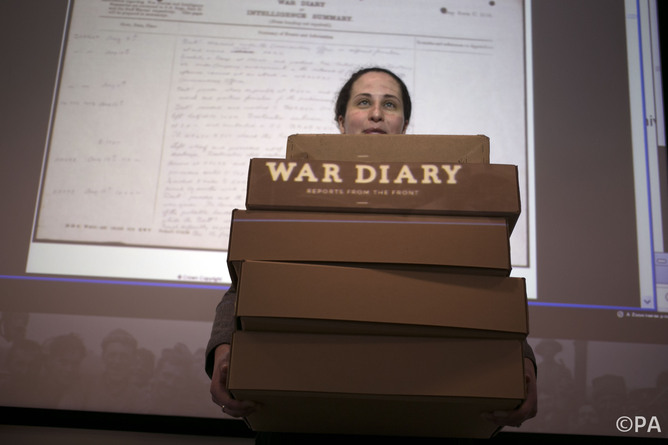
First World War diaries go online

The digitization of documents “might make records easier to find,” but Hoskins warns that: “something important is lost. The digital file strips away the subliminal context that comes with the finding, filing, handling and searching through the physical file. The mental map of the archive and its contents dissolve.”

Hoskins raises important questions on preserving, organizing, accessing, and utilizing digitized documents in archival collections dealing with the history of war and society. His own work seems concerned particularly with war diaries as a distinct textual genre. But, many of the issues he discusses are equally relevant for Digital Humanities work in other fields of research.

Hoskins’s article is available online at The Conversation.

Posted in Archival Research, Cultural History, Current Research, Digital Humanities, European History, European Union, Globalization, History in the Media, Humanities Education, Information Management, War, Culture, and Society | 1 Comment

Masters in Social Sciences

The University of Chicago’s M.A. Program in the Social Sciences (MAPSS) is seeking applicants.

Note that the University of Chicago includes History in its Social Sciences division, so this announcement may interest History majors and minors at Northern Illinois University.

The University of Chicago has very strong programs in French history, European history, pre-modern history, intellectual history, international relations history, European studies, political theory, political science, anthropology, Mediterranean studies, and other fields in the Social Sciences.

The MAPSS announcement reads:

“Our one-year program is an excellent choice for persons who seek a rigorous, intellectually transformative experience, clarifying their commitments while preparing for doctoral and professional paths. …

“Unlike other M.A. programs, MAPSS is highly competitive for admission; it offers students access to nearly all graduate courses in all Divisions and professional schools; it allows students to work directly with members of the regular faculty on the thesis; it offers merit aid right up to full tuition; and it is structured in such a way that students are not competing with one another for faculty attention or program support.

“To our knowledge, there is no other M.A. program anywhere in the world that reliably places so many of its graduates in funded doctoral programs. Each year, we send 55-70 students on for the Ph.D. Over the past 10 years, our success rate for funded Ph.D. placements has consistently been 90%. There are over 100 MAPSS graduates now pursuing the Ph.D. at UChicago alone.

“Fully 2/3 of our graduates opt for professional careers. Unusually for an M.A. program, we have a dedicated, in-house Career Services Director who brings recruiters to campus; distributes weekly digests with job openings and alumni contacts; leads all of the usual preparation workshops; and develops innovative programming with alumni-in-residence, externships, short-term consulting partnerships, and more.

“Finally, our completion rate is off-the-charts: 80% of our entering students earn the degree within 12 months, and 90% within 15 months.

“More information on our program can be seen here:
mapss.uchicago.edu/the_ma/why_mapss/our_outcomes/

“Any interested applicants are encouraged to contact our Student Affairs Administrator, E.G. Enbar (egenbar@uchicago.edu, 773-702-8312), with questions.”

Posted in Early Modern Europe, Early Modern World, European History, European Union, French History, Graduate Work in History, Human Rights, Mediterranean World, Social History | Leave a comment

On Brutality and Executions

Lynchings of African-Americans have been in the news over the past week, since President Obama’s remarks at the National Prayer Breakfast (see my previous post) produced a sustained media discussion of brutality and executions.

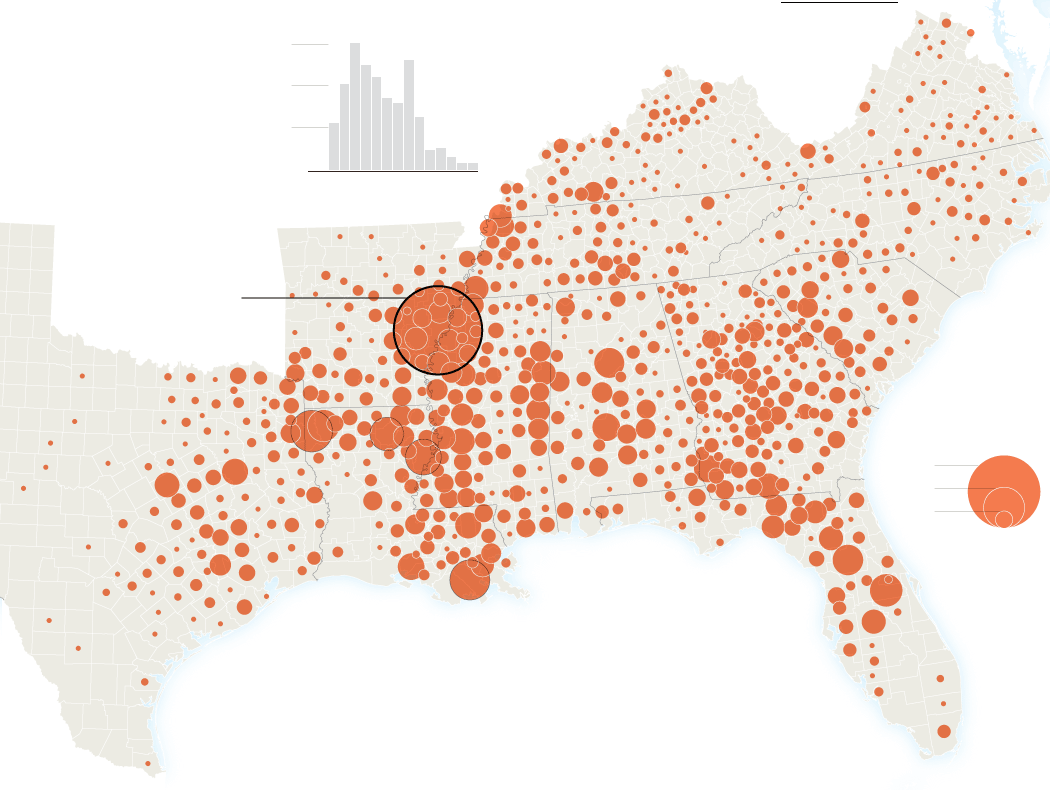
Now, the New York Times reports that “the Equal Justice Initiative in Montgomery, Ala., released a report on the history of lynchings in the United States, the result of five years of research and 160 visits to sites around the South. The authors of the report compiled an inventory of 3,959 victims of ‘racial terror lynchings’ in 12 Southern states from 1877 to 1950.”

The map below presents the geographic distribution of these lynchings of African-Americans.

US-Lynchings-map

David Krugler’s 1919, The Year of Racial Violence: How African-Americans Fought Back (Cambridge, 2014) provides historical context on lynching in the United States—including racial violence that occurred in Illinois, Oklahoma, and other regions beyond the scope of this map.

The New York Times published an article on the Equal Justice Initiative and its map of lynchings in the United States in the late nineteenth and early twentieth centuries.


Posted in Atrocities, Civilians and Refugees in War, History in the Media, History of Violence, Human Rights, Museums and Historical Memory, Political Culture, Religious Politics, Religious Violence, Terrorism, War, Culture, and Society | Leave a comment

Summer Program in Early Modern Digital Humanities

A summer program in early modern digital humanities is being offered by the Folger Shakespeare Library.

“Following on the success of the first “Early Modern Digital Agendas” institute—an intensive survey of the most current resources and methods in digital research to be found in July 2013—”Advanced Topics” is a second three-week NEH institute to be hosted by the Folger Institute at the Folger Shakespeare Library. Jonathan Hope, Professor of Literary Linguistics at the University of Strathclyde, will direct an advanced exploration of data creation and management to be followed by various forms of hands-on investigation, including text analytics, social network analysis, dimensionality reduction, research process design, and even historical reflection on the nature of “exemplarity” claims in humanistic argument.

“The “Early Modern Digital Agendas: Advanced Topics” Institute will meet from 15 June through 1 July 2015, and admitted participants are expected to be in residence for the entire time. It will convene a technically advanced cohort of fifteen early modern digital humanists for scholarly assessment of the most effective tools by which data sets are gathered, curated, and analyzed. EMDA2015 will build in more time than its predecessor for application and experimentation with the tools to which its participants will be introduced; it will also encourage participants to bring their own data and, as often as is practical, process that data for analysis with the tools that the visiting faculty introduce. Details about the Institute’s curriculum are available.

“Participants will reflect on the ways DH expands the universe of possible questions that literary scholars can ask while new technologies produce exponentially larger bodies of evidence faster than ever before. Among the questions visiting faculty will pose and consider with the participants: What is “data”? What transformations lie behind statistical analysis? How is corpus-wide variation being treated? What are the principles of visualization? The aim is to enable participants not just to perform analysis, or curate data, but to understand the processes they engage in—where they enable, how they restrict, and how they might be improved. It remains the Folger’s goal to ensure that DH practitioners question not only what is possible with digital tools, but why one would put them to certain uses, and at what costs.”

For more information, see the Folger website for EMDA 2015.

Posted in Cultural History, Digital Humanities, Early Modern Europe, Early Modern World, European History, Graduate Work in History, Grants and Fellowships, History of the Book, Humanities Education, Information Management, Renaissance Art and History | Leave a comment

ReligioWest Research Program

briansandberg's avatarCluster for the Study of Religious Violence

The ReligioWest research program, based at the European University Institute, pursues research on issues of religious pluralism, secularism, religion and the law, religion in the political sphere, and religious violence.

The ReligioWest website indicates: “ReligioWest studies how different western states in Europe and North America are redefining their relationship with religions under the challenge  of increasing religious activism in the public sphere due to new religious movements and Islam. Although each country starts from very different and specific contexts of the relationship between state, religion and public sphere, this move seems to lead to a more uniform perception of what the relationship should be.”

For more information, see the ReligioWest page at the website of the European University Institute in Florence, Italy.

Graduate students working on devotional activism, sacred politics, religious conflict, and sectarian violence will be interested in this research project.

View original post

Posted in Uncategorized | Leave a comment

Fear and Racism in Film

Racism seems to feed on intense fears, portraying ethnic groups as representing an exaggerated threat to social order, employment, and family life.

For over a hundred years, films have played an important role in the construction of racial stereotypes, the expression of collective fears, and the articulation of racial politics.

A new BBC article considers how D.W. Griffith’s The Birth of a Nation altered racial politics in early twentieth-century society in the United States. This highly controversial film was much debated on its release and has become a classic case in film studies. The Birth of a Nation draws on well-established tropes of nineteenth-century racist politics, Southern historiography, and chivalric literature to present a powerful, shocking vision of racial conflict.

BirthofaNation-poster

The BBC article adds little to the scholarly work that has already been done on The Birth of a Nation. But, undergraduate students working on American history, European history, history of racism, and history of violence might find this article to be an interesting introduction to the film’s legacy.

The BBC article is available online.


Posted in Cultural History, European History, Historical Film, History of Violence, Human Rights, Noble Culture and History of Elites, Political Culture, Religious Politics, Religious Violence, War in Film, War, Culture, and Society | Leave a comment

Masters Program in Mediterranean Studies

There is a new call for applications to the Masters Program in Mediterranean Studies at NYU.  Here is the announcement:

The Center for European and Mediterranean Studies (CEMS) at New York University is pleased to announce a call for applications to its Masters in European and Mediterranean Studies program. Please forward this to any students you might think are interested.

Applications for Fall 2015 are being accepted and reviewed on a rolling basis. Applicants who apply before April 1, 2015 are eligible to receive significant financial aid packages to fund their studies. It is recommended to apply as soon as possible, as funds are limited.

The Master’s in European and Mediterranean Studies is an interdisciplinary program in the social sciences and humanities that is designed to prepare students for professions in the public, non-profit, or private sectors requiring an advanced understanding of Europe and the Mediterranean region. Our graduates also go on to pursue Ph.D. studies in history, political science, international relations, international development, and a range of other fields.

CEMS graduate students choose one of three tracks for specialization:

1. European Culture and Society
2. European Politics and Policy
3. Mediterranean Studies

In addition to courses offered by the CEMS Department, graduate students may take classes with a European/Mediterranean focus offered by other departments—including, but not limited to, history, politics, anthropology, cinema studies, French studies, Italian studies, Irish studies, and many other disciplines.  Students may also take courses at other NYU schools—such as the School of Law or Graduate School of Public Service—as well as at Columbia University, through a special Consortium agreement existing between the two institutions.  CEMS students have the advantage of being part of a small department with dedicated faculty, ensuring close access to professors, while being part of a large research institution with a wide variety of resources available to them. Additionally, if students wanted to gain more professional experience, they can take advantage of the many internship opportunities in New York City, most of them for academic credit.

Students can also broaden their studies with various opportunities abroad, and are encouraged to apply for summer grants to perform research, to work, or to study abroad. In the past, our candidates have received funding to study at one of our several NYU campuses abroad, to work at various NGOs, think tanks, and other European organizations, or to carry out research either independently or in the program of their own choosing.

For more information on NYU’s Center for European and Mediterranean Studies, please follow this link.

Students wishing to apply can follow this link.

For any inquiries, please email european.studies@nyu.edu or call 1.212.998.3838

Posted in Early Modern Europe, Early Modern World, European History, European Union, French History, Graduate Work in History, Italian History, Maritime History, Mediterranean World | Leave a comment