Revisiting the Costa Concordia Disaster

The cruise liner Costa Concordia wrecked into the isola di Giglio, off the coast of Tuscany, on 13 January 2012. The ship then heeled over and partially capsized while its roughly 4,000 passengers were evacuating the ship. Thirty-two people died in the shipwreck.

Criminal trials and lawsuits began soon after the shipwreck. Five Costa Concordia crew members and company officials have been found guilty this week after plea bargains. Captain Francesco Schettino remains on trial and faces a stiff prison sentence if found guilty. Repubblica and the BBC reports on the trials.

The complex salvage operation to remove the Costa Concordia from the isola di Giglio still continues.

CostaConcordia-salvage

BBC reports on salvaging the Costa Concordia.

Posted in Environmental History, European Union, Italian History, Maritime History, Mediterranean World | Leave a comment

Judith Slaying Holofernes (in Chicago)

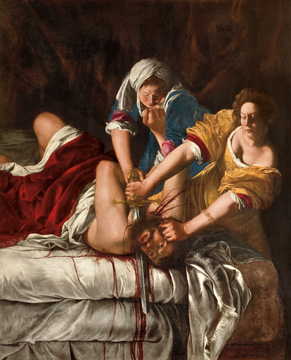
Artemesia Gentileschi’s Judith Slaying Holofernes (c. 1620) is coming to Chicago!

Gentileschi-Judith

This famous painting is one of the quintessential images of gender and violence in the early modern period, as well as one of the masterpieces of one of the most famous women artists ever.

The Art Institute of Chicago is hosting an exhibition built around the Gentileschi painting, focusing on the theme of Judith in art.

The Art Institute of Chicago’s website states: “An exceptional loan from the Uffizi Gallery in Florence, Artemisia Gentileschi’s sensational Judith Slaying Holofernes (c. 1620) comes to Chicago for the first time. In this monumental picture, Artemisia Gentileschi—the most famous 17th-century Italian woman artist—captured the decisive moment of the biblical narrative of Judith. To save the Jewish people, Judith savagely decapitated the Assyrian general Holofernes. Rather than focus on the ideals of beauty and courage inspired by the Jewish heroine, as did many other artists, Artemisia chose to depict the story’s gruesome climax, producing a picture that is nothing short of terrifying. As Judith severs Holofernes’s head with a sword, her brow is furrowed in concentration, her forearms are tensed, and blood spurts wildly from her victim’s neck. Artemisia was known as a follower of Caravaggio, and the startling naturalism of the scene is enhanced by her technique of painting directly from life and employing sharp contrasts of light and dark colors. This work represents not just the apogee of Artemisia’s oeuvre but stands as a masterpiece of Baroque art.”

Northern Illinois University students of Renaissance and Early Modern European history will want to see this exhibition. Graduate students working on issues of religion and violence will want to study the artworks and exhibition catalog.

Posted in Art History, Early Modern Europe, European History, European Wars of Religion, Gender and Warfare, History of Violence, Reformation History, Religious Violence, Renaissance Art and History, War, Culture, and Society, Warfare in the Early Modern World, Women and Gender History | 2 Comments

MOOCs and Remedial Education

Some community colleges have found a new way of incorporating MOOCs—not by replacing their courses, but by creating online study guides for students taking remedial classes or placement examinations.

Community colleges such as Cuyahoga Community College (Cleveland, Ohio) “have created their own online content, sometimes tapping free lectures from the Khan Academy or other sources. And rather than using it for stand-alone courses, the colleges have designed supplemental study guides for remedial classes or for the placement tests incoming students take,” according to Inside Higher Ed.

The Bill and Melinda Gates Foundation reportedly gave Cuyahoga Community College a $50,000 grant to support the development of their online course. Much of the content for the courses is then simply taken from free websites.

The college’s new online remedial course “isn’t aimed at the college’s students. It is shopping the class to local high schools. … The idea is to encourage students who are likely to attend Tri-C to brush up on their math skills before they arrive on campus.”

MOOCs may work well for remedial education as a pragmatic approach to preparing pre-college students with basic high school skills.

But, this is a far cry from the promises of the MOOC providers and their supporters, who tout the transformative potential of MOOCs in higher education.

Inside Higher Ed reports on remedial MOOC courses.


Posted in Education Policy, Humanities Education, Information Management, Undergraduate Work in History | Leave a comment

Feminism, Politics, and Nudity in France

Nude protests by women in Femen and marches by Muslim women who want to wear a veil in public have both created sustained controversy on feminism in French society and politics.

An essay by Mona Chollet entitled, “Femen partou, féminisme nulle parte,” in Le Monde Diplomatique critiques French media and its coverage of feminist issues.

Chollet deplores the sexism and voyeurism of the French and European news media, mockingly stating that: “Femmes, vous voulez vous faire entendre ? Une seule solution : déshabillez-vous !”

The activist organization Femen has adopted a pragmatic method of protesting, according to Chollet. “Les Femen, elles, ont été plus pragmatiques,” she argues. “Lors de leurs premières actions, en Ukraine, en 2008, elles avaient inscrit leurs slogans sur leurs dos nus, mais les photographes ne s’intéressaient qu’à leurs seins. Elles ont donc déplacé les inscriptions.” Below is one of Femen’s political ads:

Femen_Drapeau

But, there are costs for feminists who choose to use nudity to deliver their political messages. Chollet concludes that “il vaudrait mieux défendre la liberté des femmes à s’habiller comme elles le souhaitent.”

Le Monde Diplomatique has published Chollet’s essay online.

Posted in European Union, French History, Human Rights, Paris History, Political Culture, Women and Gender History | Leave a comment

The New Norm in Dorms

When considering the costs of higher education, keep in mind that educational costs should be separated from the costs of living.

Students (and their parents) are increasingly demanding luxurious accommodations and student facilities that increase the cost of living on or near campuses. Universities are compelled to build or renovate dorms to meet this demand, or lose potential students to other universities with more modern facilities.

GilbertHall

The result is gentrification of university and college campuses. In the end, students end up paying higher costs of living in order to attend classes, even if the costs of education itself remain stable.

If you are unaware of the new norm in dorms, check out the latest gut-rehab dorms at Northern Illinois University.

For news coverage of the dorm building and renovation campaign at NIU, see the Chicago Tribune, the Chicago Sun Times, and the Daily Herald.

Posted in Education Policy, Humanities Education, Northern Illinois University, Undergraduate Work in History | Leave a comment

Religion and Politics on Wikipedia (Edited)

Despite its encyclopedic pretensions, Wikipedia is an unstable and undependable as a repository of knowledge. Since each entry can be endlessly edited and re-edited by Wikipedia workers and users, none of the information provided on the platform is reliable.

Topics involving intersections of religion and politics seem to be among the most problematic entries on Wikipedia.

The BBC reports that “Researchers from the University of Oxford and three other institutions analysed logs of the changes made to Wikipedia pages to identify those in the throes of an ‘edit war’. Such a conflict involves editors of pages making changes that are almost instantly undone by another editor.”

Wikipedia’s model allows to “editors” (who usually do not have research expertise) to edit each other (and also contributors who are experts). Wikipedia also permits relatively open access to users, who can engage in malicious editing of entries. Meanwhile, corporations, sports teams, and other entities are able to control their own image by policing entries dealing with them.

According to the BBC, “The most controversial topics across all the 10 editions analysed were:

  • Israel
  • Adolf Hitler
  • The Holocaust
  • God

“In addition other religious subjects, such as Jesus, The Prophet Muhammad and Christianity were regularly fought over by editors.”

The study of editing on Wikipedia showed that local and national ‘edit wars’ have developed around politically contested concepts and histories. “Among French editors, the page about French politician Segolene Royal was the one contributors fought over the most.”

All of these factors make Wikipedia dangerously unreliable: use it at your own risk.

BBC reports on Wikipedia.

Undergraduate students in history should be especially cautious in using Wikipedia, as it is usually not an acceptable source for academic papers and projects in history—especially on issues of religious and politics.


Posted in French History, History in the Media, Humanities Education, Information Management, Religious Politics, Undergraduate Work in History | 1 Comment

PhD Dissertation Lengths

Marcus Beck, a PhD candidate at the University of Minnesota, has created a chart demonstrating the varying average lengths of PhD dissertations by discipline.

According to io9, “Beck took the pressure of readying for his defense and channeled it toward an incredibly interesting (if entirely thesis-unrelated) side project. For Beck, that meant coding a data scraper that could gather information about students’ dissertations (page-length, year and month of graduation, research focus, etc.) from the University of Minnesota’s electronic thesis database.”

AverageDissertationLengths

Beck’s calculations are based on data from University of Minnesota PhD dissertations from 50 departments, so they may or may not be representative.

But, historians will not be surprised to find that the longest dissertations in Beck’s data are those of history PhDs, with an average of almost 300 pages.

History PhD dissertations are arguably longer than those in other fields because of the discipline’s archival sources, citation formats, historiographical frameworks, and demanding standards of evidence.

DisserationsinLibrary

The io9 website reports on Beck’s findings on dissertation lengths. Marcus Beck’s blog discusses his methodology.

For the record, my own PhD dissertation came in at 731 pages.  Given its weight, perhaps we should consider assessing dissertations in pounds?

Posted in Academic Publishing, Archival Research, Education Policy, Graduate Work in History, Humanities Education, Information Management | Leave a comment

New Review of Warrior Pursuits in French

A new book review by Gregory Champeaud critiques my Warrior Pursuits: Noble Culture and Civil Conflict in Early Modern France (Baltimore, MD: Johns Hopkins University Press, 2010. Champeaud’s review was recently published in French in the online journal, Francia-Recencio.

The review is available for download as a .pdf file at: http://www.perspectivia.net/content/publikationen/francia/francia-recensio/2013-2/FN/sandberg_champeaud

Champeaud’s review assesses the main arguments in Warrior Pursuits and also identifies three contributions that the book makes to the field of early modern French history.

Posted in Civil Conflict, Early Modern Europe, Early Modern World, European History, European Wars of Religion, French History, French Wars of Religion, History of Violence, Noble Culture and History of Elites, Reformation History, Religious Violence, Revolts and Revolutions, War, Culture, and Society, Warfare in the Early Modern World | Leave a comment

Gates Foundation’s Influence on Higher Ed

The Bill & Melinda Gates Foundation has enormous influence on universities and colleges  in the United States and it is seeking to fundamentally transform higher education. According to the Chronicle of Higher Education, “the foundation wants nothing less than to overhaul higher education, changing how it is delivered, financed, and regulated.”

GatesInfluence

“The U.S. Department of Education recently allowed Southern New Hampshire to become the first university eligible to award federal aid for a program untethered from the credit hour, the time-based unit that underlies courses and degrees. The move, wrote one advocate, ‘could signal a new era for higher education,'” according to the Chronicle of Higher Education.

“The Bill & Melinda Gates Foundation, at $36-billion the world’s largest private grant-making foundation, has done much to orchestrate that new era. Its largess and sway helped get Southern New Hampshire’s program off the ground, supported a key think-tank report that advocated moving beyond the credit hour, and helped persuade a risk-averse Education Department to open federal coffers to competency-based education.”

Gates claims to be motivated to transform higher education with the aim of “getting more students to and through college, in an effort to lift more Americans out of poverty.”

Gates-Crosgrove

This is certainly a noble goal. However, his business and technology interests in changing the American higher education system also seem clear. Gates endlessly promotes the benefits of computer technology and sees faculty members and university curricula as traditional and antiquated.

The Chronicle of Higher Education provides a critical report on the Gates Foundation and its influence on higher education.

Posted in Education Policy, Humanities Education | 2 Comments

French Cuisine and Frozen Food

French haute cuisine restauranteurs are upset by revelations that many other restaurants are using frozen ingredients and even serving entire factory-frozen dishes. The Washington Post reports that “a chunk of tuna cooked Provencal style with an attractive ratatouille on the side, for instance, can be bought in a restaurant-supply factory for $4, stored in the freezer indefinitely and sold to a diner for $17 after three minutes in the microwave.”

Paris-cafeonSeine

Some Parisian restauranteurs are spearheading an effort to create a system to distinguish restaurants that use all fresh ingredients from other types of eating establishments. “Alain Fontaine, who runs Le Mesturet restaurant near the Opera in Paris — and who cooks his dishes from scratch — lamented the growing tendency not only because it cheats diners but also because it means that everybody ends up eating the same mass-produced food with the same homogenized tastes,” according to the Washington Post.

The Washington Post reports on frozen food in French cuisine.

Posted in European Union, Food and Cuisine History, French History, Paris History | Leave a comment