France and the Origins of the Great Depression

Did French economic policies contribute to, or even cause, the Great Depression of the 1930s?

This is the provocative question posed by historian Douglas A. Irwin (Dartmouth College) in an article on History News Network (HNN), which is an outgrowth of his latest book, Peddling Protectionism: Smoot-Hawley and the Great Depression (Princeton, NJ: Princeton University Press, 2011).

Irwin concludes that: “economic historians have traditionally focused on the tightening of U.S. monetary policy as the origin of the Great Depression. These findings suggest that the French contribution to the worldwide deflationary spiral deserves much greater prominence than it has thus far received.”

NIU students of Modern French History may be interested in this article.


Posted in European History, French History, Globalization | Leave a comment

Film and Fiction for French Historians

The new e-issue of Film and Fiction for French Historians is now out at a new website on the H-France platform. Historians of French history and scholars interested in historical filmmaking should find this website useful in their research and teaching.

My review of the film Louis, roi enfant, a depiction of the early reign of Louis XIV and the Fronde civil war, is one of the reviews published in this issue of the e-journal. This review appears alongside a review by Bill Beik of two films about Louis XIV’s reign.

Northern Illinois University students in HIST 311 Early Modern France, 1500-1789 and HIST 390 History and Film may be interested in this review and the overall website.


Posted in Current Research, Early Modern Europe, French History, Historical Film, History in the Media, Noble Culture and History of Elites, War in Film, War, Culture, and Society, Warfare in the Early Modern World | Leave a comment

Renaissance Society of America Conference 2012

The Renaissance Society of America Conference 2012 has now concluded.  The conference, which is the premier conference on interdisciplinary Renaissance studies in North America, was held from 21-24 March at the Grand Hyatt hotel in Washington, DC.

This annual conference on Renaissance and early modern European and Mediterranean studies is sponsored by the Renaissance Society of America and information about the 2012 RSA conference is available at their website. History students at Northern Illinois University may be interested in finding out more about the Renaissance Society of America or about historical conferences in general.

My sessions with the Medici Archive Project on Saturday afternoon went well.  I was chairing one of their sessions on information circulation and management.  My own paper on Mediterranean slavery and the French Mediterranean seemed to go over well, as did Mark Rosen’s on Livorno’s Quattro Mori statue, and then a good discussion of Mediterranean slavery developed in the lengthy Q&A.

I attended several of the sessions dedicated to the editorial career of Henry Tom, who was a senior acquisitions editor at Johns Hopkins University Press. Henry was the editor of my monograph, Warrior Pursuits: Noble Culture and Civil Conflict in Early Modern France (Johns Hopkins University Press, 2010), as well as a dizzying 1000 books over his career. The sessions were a splendid tribute to Henry and his life’s work, with papers and comments by Eric Dursteler, John Marino, Ed Muir, Guido Ruggiero, and others. It is rare to have sessions dedicated to editors’ work at an academic conference, but the presentations and questions from members of the audience prompted interesting discussions on the state of academic publishing today.

I also attended sessions on “Early Modern Globalization”, “Mediterranean Travel and Pilgrimage”, “Bent Broken and Shattered: European Images of Death and Torture, 1300-1650”, “Diplomacy, Secrecy, and Espionage in Early Modern France (1560-1630)”, and “The Politics of Culture of Violence”. The papers presented in these sessions will contribute new ideas to my teaching of my courses on HIST 458 Mediterranean World, 1450-1750, HIST 414 European Wars of Religion, 1520-1660, and HIST 640 Early Modern Globalization.

Finally, the conference offers Renaissance and early modern historians excellent opportunities for academic networking and exchange.  I enjoyed reconnecting with many colleagues in Renaissance studies, Mediterranean history, Italian history, and early modern French history.

Posted in Academic Publishing, Conferences, Current Research, Early Modern Europe, Early Modern World, Italian History, Mediterranean World, Renaissance Art and History | Leave a comment

History Open House

The Department of History at Northern Illinois University will be holding a History Open House for undergraduate students.

The History Open House will be held tomorrow (Tuesday, 27 March) from 11am – 3pm on the sixth and seventh floors of Zulauf Hall.

Faculty will be around to meet and talk with undergraduate students about their courses or history in general.  There will also be information on the Fall 2012 and Spring 2013 schedule, summer trips, graduate school, and history organizations.

Posted in Northern Illinois University, Undergraduate Work in History | Leave a comment

Tournées French Film Festival at NIU

The Tournées Festival: New French Films on Campus is once again at Northern Illinois University. The festival opened yesterday and will continue through Thursday evening.

The Tournées Festival is organized by FACE, in partnership with the Cultural Services of the French Embassy. Various departments and programs at NIU have participated in sponsoring the festival’s appearance at NIU.

The films will be shown at the Egyptian Theater in DeKalb.  For the festival schedule and information, see the Department of English website or NIU Today online.

The Déjeuner français conversation group and undergraduate and graduate students of French history in the Department of History will be interested in this film festival.


Posted in French History, Historical Film, Northern Illinois University | 1 Comment

Napoléon Restored (in Film)

Abel Gance’s epic silent film Napoléon (1927) utilized a number of innovative filmmaking techniques and it has since become a classic work in the linked genres of historical film and war film.

A new restored version of the film is being screened this month in San Francisco as part of the San Francisco Silent Film Festival.

The New York Times reports on the restored film.

Northern Illinois University students in HIST 390 Film and History: War in Film will be interested in this article.


Posted in Comparative Revolutions, Early Modern Europe, French History, French Revolution and Napoleon, Historical Film, History in the Media, War in Film, War, Culture, and Society, Warfare in the Early Modern World | Leave a comment

Coptic Christianity in Transition

Pope Shenouda III, head of the Coptic Christian Church in Egypt, has died. Shenouda III had led the Coptic Church through several periods of turmoil in Egypt, including the ongoing Egyptian Revolution. Coptics represent a small religious minority in present-day Egypt and their position in Egyptian society has been made more precarious by the instability in Egypt since the beginning of the Arab Spring movements.

NPR covers the legacy of Shenouda III and the current situation of Coptic Christianity in Egpyt.

Northern Illinois University students in HIST 420 The Renaissance and HIST 458 Mediterranean World, 1450-1750 will recognize the references to Saint Mark’s evangelization in Egypt from our study of Gentile and Giovanni Bellini’s Saint Mark Preaching in Alexandria (c. 1507).

NIU graduate students from HIST 640 Religious Violence in Comparative Perspective will also be interested in this story.

Posted in Civil Conflict, Mediterranean World, Religious Violence | Leave a comment

Lower State Funding for Higher Education = Higher Tuition

State governments in the United States continue to slash funding for “public” higher education. For a generation, states have been gradually gutting public funding for state universities, shifting the costs of college education to students, who must pay higher  tuition and fee payments as a result of underfunding universities.

The 2008 financial collapse and recession has greatly worsened the situation for students. State governments have further cut funding to public universities and colleges, as a new report by the State Higher Education Executive Officers shows.  The Chronicle of Higher Education summarizes the report’s findings:

“From the beginning of the recession, in the 2007-8 fiscal year, through the 2011 fiscal year, college enrollment increased nationally by 12.5 percent, to 11.5 million students, the report says. But state and local appropriations have decreased by $1.3-billion over the same period.”

These budget cuts directly affect the available education funds per student: “The national average for combined state and local support is now down to $6,290 per full-time student—2.5 percent less than in 2010 and the lowest amount in the past 25 years,” according to the Chronicle of Higher Education.

The result of successive budget cuts to public education funding is, of course, higher tuition and fees for students: “Over the past 25 years, the percentage of educational revenue supported by tuition has climbed steadily, from 23.2 percent in 1986 to 43.3 percent in 2011.”

The conclusion is clear: higher tuition rates at state universities result directly from the massive de-funding of public education by politicians. A 25-year low in funding equals a 25-year high in tuition.

If Americans want lower college tuitions, they must contact their state legislators and tell them that they want public universities funded by their states.

The Chronicle of Higher Education has a short article on the SHEEO report, as well as a link to download that report as a .pdf file.


Posted in Education Policy, Humanities Education, Undergraduate Work in History | 1 Comment

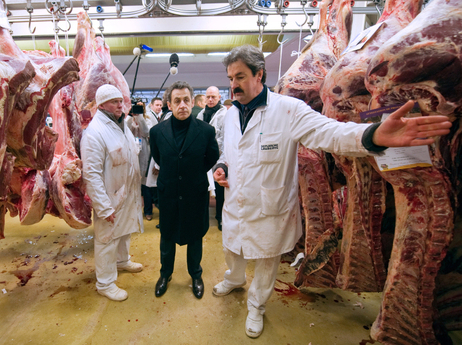
Halal Meat and French Politics

Meat often enters French politics, usually through the anti-immigrant rhetoric of the Front National (FN). In almost every recent election cycle, the FN pushes for the adoption of new anti-immigrant laws and regulations, especially targeted at France’s considerable Muslim population.

The FN often uses identity politics and racist rhetoric to get out its message. Over he past decade, the FN has also highlighted its anti-Muslim rhetoric by sponsoring soup kitchens that serve soupe au cochon (pig soup), so that only non-Muslims will benefit from the food donations.

Now, the FN is attacking halal meat (the Muslim equivalent of the Jewish Kosher process of slaughtering meat). The FN wants all halal meat to be labeled as such so that French consumers can choose to avoid halal meat and instead buy “traditional” meat.

The candidates for the French presidency will increasingly have to address identity politics during their election campaigns.  NPR reports on this story.

NPR also provides an update on Muslim bistrots that serve halal meat.

Northern Illinois University students in French and Mediterranean history courses will be interested in this story.

Posted in Food and Cuisine History, French History, Human Rights, Mediterranean World, Paris History, Religious Violence | 1 Comment

Graduate Programs in the Humanities

Graduate programs in the humanities across the United States are scaling back considerably by cutting their admissions.  The pattern of humanities departments limiting graduate admissions periodically (especially during economic recessions) is nothing new, but the scale of the cutbacks are significant.

Humanities departments and scholars are actively debating the ethical implications of admitting graduate students at a time of crisis in humanities funding and positions in academic institutions.

The American Historical Association and the Modern Language Association have published many reports and stories on the issue of graduate admissions and graduate program size.

The Chronicle of Higher Education reports on the admissions cutbacks and the academic debate over graduate admissions policies.

History departments figure significantly in The Chronicle of Higher Education’s report:

The history department at the University of Wisconsin at Madison cut its new graduate admissions in half this past fall, to just 21 students. “Why train people if the outlook for professional historians is not nearly as good as it was five years ago?” asks Laird Boswell, director of graduate studies in the department.

Pennsylvania State University’s history department has gone even farther, dropping entire subfields in which graduate students were once invited to specialize and keeping only those in which it has a good track record of helping graduates find jobs. As of this academic year, it is no longer admitting students who want to write dissertations in 20th-century American history, modern European history, or medieval history. In the process, it is hoping to cut overall graduate enrollment by around 30 students—to a total of 40—in two years.

“This is the way of the future, and we’re way ahead of the curve here,” says Michael Kulikowski, chairman of the history department, which was featured at this year’s annual meeting of the American Historical Association as one of 10 departments doing innovative things. “People have been talking about the oversupply of unemployable Ph.D.’s in the humanities for several decades, and I think we’ve found a part of the solution. We are concentrating on areas where we can place students competitively.”

Historians and other humanities scholars will continue to debate these issues each year, as the graduate admissions season approaches.

Graduate students at Northern Illinois University will be interested in following the development of graduate program admissions policies.

Posted in Education Policy, Graduate Work in History, Humanities Education | Leave a comment