French History Review of Warrior Pursuits

French History has published a review of my monograph, Warrior Pursuits: Noble Culture and Civil Conflict in Early Modern France (Baltimore, MD: Johns Hopkins University Press, 2010).
Fadi el Hage, who is based at the Institut Universitaire de Technologie at Université de Paris XIII – Saint-Denis, nicely situates Warrior Pursuits in the historical literature on history of the French nobility and studies of royal offices in France.

El Hage identifies one of the major theoretical issues addressed, stating that: “This book underlines how much we have to be wary of the concept, expounded by Max Weber, known as as the monopoly on legitimate violence. The permanent royal army was not the proof of a complete royal monopoly.”

El Hage rightly emphasizes the notion of confusion des pouvoirs in early modern French politics and society, seeing the provincial nobles analyzed in Warrior Pursuits as powerful political actors and members of the royal state.

French History is the leading academic journal published in the United Kingdom in the field of French historical studies. This book review has been published online at French History as an “advance access” review.  I will update the citation for El Hage’s review when the print version is released:

Fadi El Hage, “Review of Warrior Pursuits. Noble Culture and Civil Conflict in Early Modern France. By Brian Sandberg.” French History (2012).

Posted in Current Research, Early Modern Europe, European History, European Wars of Religion, French History, French Wars of Religion, Languedoc and Southern France, Noble Culture and History of Elites, Religious Violence, State Development Theory, War, Culture, and Society, Warfare in the Early Modern World | 1 Comment

Bernard Lewis Claims to Have Opposed Iraq War

Bernard Lewis, Professor Emeritus of History at Princeton University, is one of the most controversial figures in Middle Eastern and Mediterranean history. Lewis is known for his many books on Middle Eastern history, but also for his influential formulation of a “clash of civilizations” between Islam and the West in a 1990 article in The Atlantic. Samuel Huntington and conservative politicians later expanded and exploited this concept of a “clash of civilizations,” to justify the so-called War on Terror and the Iraq War of 2003-2011.

Bernard Lewis now claims that he opposed Dick Cheney’s drive to invade Iraq in 2003. An article in the Chronicle of Higher Education discusses Lewis’s claims, which stem from his new memoir, Notes on a Century: Reflections of a Middle East Historian (Viking, forthcoming).

It appears that Lewis is attempting to rehabilitate his academic reputation, which has been heavily tarnished by his clashes with Edward Said and his support for the War on Terror, as well as for his reductionist portrayal of Islam in constant opposition to the West in numerous books, such as The Crisis of Islam: Holy War and Unholy Terror (2004) and Islam and the West (1994).

If you need a quick reminder of Lewis’s positions during the Iraq War and the War on Terror, see an interview with him sponsored by the Pew Forum. Note that he quibbles with the term “War on Terror,” but completely supports its policies. Also note that toward the end of the interview he contemplates historians revising their own history: “Remember, Churchill was asked how he thought history would treat him, and he said, ‘Very well; I intend to write it myself.’ (Laughter.) And he did, of course.”

For confirmation of Lewis’s influence within the US policy community during the War on Terror, see pieces in the BBC and the Washington Monthly from the mid-2000s.

NIU students in HIST 458 Mediterranean World, 1450-1750 will be interested in reading this article, after having discussed historical models based on the “clash of civilizations” concept as well as critiques of it.

Posted in History in the Media, Mediterranean World, Political Culture, Strategy and International Politics, Terrorism, War, Culture, and Society | 1 Comment

Kuhn’s Paradigm Shift at 50

This year is the 50th anniversary of Thomas Kuhn’s The Structure of Scientific Revolutions, with its influential concept of the “paradigm shift.” The book has reportedly sold over 1.4 million copies and is still on science and history of science syllabi around the world.

The Structure of Scientific Revolutions examines in detail the so-called Scientific Revolution of the seventeenth century, so the book a must-read for historians of early modern European history and historians of early modern science in particular.

An article in the Chronicle of Higher Education discusses the legacy of Kuhn’s “paradigm shift.”


Posted in Academic Publishing, Early Modern Europe, Early Modern World, European History, Historiography and Social Theory, History of Medicine, History of Science | Leave a comment

Hollande Wins First Round of French Presidential Election

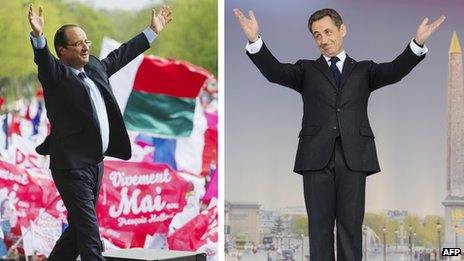
French citizens went to the polls today (22 April) to vote in the first round of the 2012 French Presidential Election.

François Hollande, the Socialist Party candidate, has won the first round with 28.8% of the vote, edging out President Nicolas Sarkozy, who had 26.1%.

Marine Le Pen of the extreme right-wing Front National won a surprising 18.5% of the vote. A number of other candidates gained marginal percentages of the electorate.

Hollande and Sarkozy, the top two vote-getters, now head into the Second Round Election.

Le Monde and Libération provide full coverage of the French Presidential elections.  See the BBC for coverage in English.

Posted in European History, European Union, French History, Political Culture | Leave a comment

French Elections and the Weight of History

French people are used to having their politicians make historical references in their campaign speeches and policy statements. As the French head to the polls, the weight of French history is again shaping the presidential campaigns.

The BBC reports on the use of history by the presidential candidates in France.  Olivier Guez comments in a New York Times op-ed on the inward-looking rhetoric and historical allusions of the presidential campaign.

Earlier posts have dealt with the use of Jeanne d’Arc (Joan of Arc) by candidates in the current 2012 French presidential campaign.

If historical rhetoric has been a major part of the 2012 presidential campaign, new techniques of campaigning have also been adopted, according to a report in the New York Times. For a summary of the presidential candidates and a description of their platforms in English, see the BBC.

Posted in European Union, French History, History in the Media, Political Culture | Leave a comment

Journal of Modern History Review of Warrior Pursuits

The Journal of Modern History has published a review by Jonathan Dewald of my book, Warrior Pursuits: Noble Culture and Civil Conflict in Early Modern France.

Jonathan Dewald, Professor of History at the University of Buffalo, is a noted historian of early modern French history and the history of the European nobility.

The JMH book review may be found at: http://www.jstor.org/stable/10.1086/663136

Posted in Current Research, Early Modern Europe, French Wars of Religion, History of Violence, Noble Culture and History of Elites, Religious Violence, Warfare in the Early Modern World | Leave a comment

Restrictions on Academic Speech

Universities normally tout their star professors, celebrating each newspaper op-ed or magazine article that showcases new scholarship and highlights the value of their institutions.  The marketing arms of universities effectively use faculty members’ media publications and appearances to advertise their institutions and to recruit students.

However, at Chicago State University, professors are paradoxically being silenced by their administrators. The Chicago Tribune reports that Chicago State University has issued a new policy threatening its faculty members with firing for communicating with any media without administrative authorization.

The Chicago Tribune report indicates that:

Sabrina Land, the university’s director of marketing and communications, wrote that all communications must be “strategically deployed” in a way that “safeguards the reputation, work product and ultimately, the students, of CSU.”

The policy applies to media interviews, opinion pieces, newsletters, social media and other types of communications, stating that they must be approved by the university’s division of public relations. “All disclosures to the media will be communicated by an authorized CSU media relations officer or designate,” the policy says.

Failure to follow the rules “will be treated as serious and will result in disciplinary action, possible termination and could give rise to civil and/or criminal liability on the part of the employee.”

This policy clearly violates the principle of academic freedom and may violate faculty members’ First Amendment rights.

The AAUP has already responded to this outrageous policy, aiming to lift these restrictions on academic speech at Chicago State University.  Faculty members at public universities in Illinois and across the nation should be alarmed by these dangerous restrictions on academic speech.

Posted in Academic Freedom, Academic Publishing, Education Policy, Humanities Education | 1 Comment

American Women in France

Study abroad programs have fundamentally transformed American higher education and presented new opportunities for thousands of students.

Often forgotten is how crucial study abroad programs have been for female students from the United States.  A new article by Alice Kaplan, professor of French at Yale University, argues that study abroad experiences were formative for American feminists in the postwar period.  Kaplan focuses especially on the Parisian sojourns of Jacqueline Bouvier Kennedy, Susan Sontag, and Angela Davis.

Alice Kaplan’s article appears in the Chronicle of Higher Education.

NIU students who are affiliated with the Women’s Studies Program or who are taking French history courses will be interested in this article.

Posted in Education Policy, European History, French History, Humanities Education, Study Abroad, Women and Gender History | Leave a comment

World War II in Soviet Film

Soviet filmmakers portrayed the Great Patriotic War (or World War II) in numerous films produced from the 1940s to 1980s.

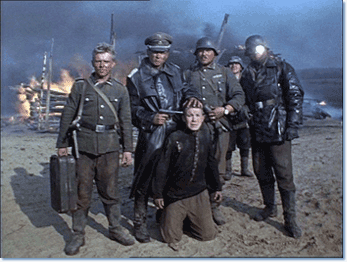
The AHA Perspectives provides an assessment of one of the last of the Soviet films about World War II, Elem Klimov’s Come and See (1985).

An introduction by Robert Brent Toplin is followed by Denise J. Youngblood’s analysis, “Apocalyptic Visions of the Great Patriotic War: Elem Klimov’s Come and See.”

Posted in European History, Historical Film, History of Violence, War in Film, War, Culture, and Society | Leave a comment

Body Counts and Human Rights

Body counts seem morbid, conjuring up grim memories of the horrifying language of the Vietnam War.  Yet, body counts have become key aspects of human rights law and efforts to prosecute individuals accused of war crimes.

A recent article by Tina Rosenberg in Foreign Policy discusses one of the modern body counters.

This article is recommended reading for people interested in war and society issues, particularly conflict resolution and reconciliation processes.  NIU students in HIST 640 Religious Violence in Comparative Perspective will want to read this piece.

Posted in History of Violence, Human Rights, Religious Violence, Strategy and International Politics, War, Culture, and Society | Leave a comment