Military Intervention in Libya

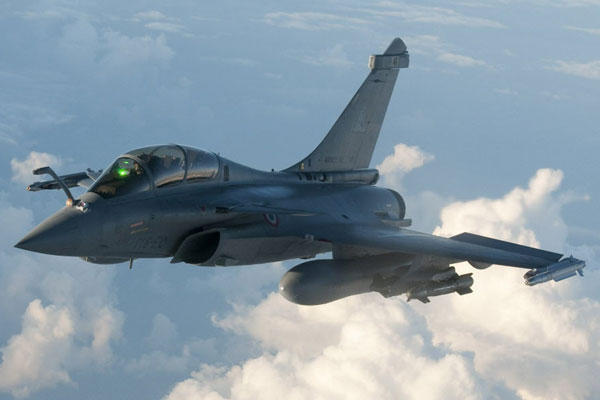
While much of the media coverage of the Libyan conflict has focused on the debate over a no-fly zone, the European and American military intervention in Libya is clearly much broader than than a no-fly zone would imply.  The initial targets and timing of French and American airstrikes make clear that allying with the Libyan opposition forces and protecting their positions in Benghazi are the primary goals of the intervention.

A story in the Christian Science Monitor examines the French role in the initial airstrikes.  Reports in Al Jazeera, The New York Times, the Guardian, and Le Monde reinforce this interpretation of the rationale for the military intervention.

Now that the United States and its allies have intervened to support the opposition forces (or rebels), policymakers need to identify the anti-Ghaddafi forces and discern their political aims.  Having spent years trying to decipher the shifting groups of participants in early seventeenth-century civil conflicts, I believe that this will be very difficult to do in Libya, especially without a significant U.S. diplomatic or military presence on the ground.  Civil conflicts that are not based on regional, ethnic, or religious affiliations often produce incredibly fragmented political and military groups with varying interests.  This promises to be a very complicated, and potentially lengthy, military intervention in Libya.

French historians will be interested in following this latest expression of French nationalism and militarism in North Africa.  France has a long history of colonial projects and neocolonial relationships in North African and the Mediterranean.  Nicolas Sarkozy resumed the French arms trade to Libya several years ago, permitting Gaddafi to purchase French missiles, aircraft, and military radio equipment.  French concerns about immigration from North Africa are clearly shaping Sarkozy’s policies and his government’s intervention in Libya, especially following news of more than 100,000 refugees already fleeing from the Libyan conflict.  While Libya’s oil reserves certainly figure in the French intervention in Libya, these other concerns are clearly operative, too.

Posted in Civil Conflict, Comparative Revolutions, French History, War, Culture, and Society | Leave a comment

Call for Proposals: Attending to Early Modern Women Conference

Call for Proposals

Attending to Early Modern Women: Remapping Routes and Spaces
June 21-June 23, 2012     Milwaukee, Wisconsin

Attending to Early Modern Women, which has been held seven times at the University of Maryland since 1990, is moving to the University of Wisconsin-Milwaukee, thanks to the generous support of the College of Letters and Science at UWM. The conference will retain its innovative format, using a workshop model for most of its sessions to promote dialogue, augmented by a plenary session on each of the four conference topics: communities, environments, exchanges, and pedagogies. It will be held at the UWM School of Continuing Education Conference Center in the heart of downtown Milwaukee, within easy walking distance of the lakeshore, the Milwaukee Art Museum, the Milwaukee Public Museum, and the Amtrak station.

Attendees will stay in the near-by and newly renovated Doubletree Hotel. The conference will run from Thursday June 21 through Saturday June 23, 2012, and attendees will also have the opportunity to participate in a special pre-conference seminar on Wednesday June 20 at the Center for Renaissance Studies at the Newberry Library in Chicago.

A detailed description of the conference and the call for proposals is now available at: www.atw2012.uwm.edu

Proposals for workshops that address the conference themes may now be submitted, to atw-12@uwm.edu. Deadline: August 31, 2011.

Please forward this call to colleagues and students who you think might be interested.

Posted in Conferences, Current Research, Early Modern Europe, Women and Gender History | Leave a comment

Bellicose Women: A “Gender Gap” in Policymaking?

The decision for the United States to go to war in Libya appears to have been made by female policymakers in the Obama administration.  An article in the Christian Science Monitor discerns a “gender gap” in foreign policy formulation in the White House, suggesting that bellicose women policymakers pushed for military intervention in Libya.

The notion that bellicose women can instigate military action connects nicely with my own research on women, gender, and violence.  When I present research on gender and violence during the French Wars of Religion, I often get questions and comments suggesting that women could not really have been seriously involved in warfare.  Many scholars and students seem to have bought into the popular myth that war is exclusively a masculine domain.

Recent historical research demonstrates that women have long been involved intimately in the practices of warfare, and not just as victims.  John A. Lynn’s Women, Armies, and Warfare in Early Modern Europe offers a fascinating portrait of women’s involvement in armed forces throughout the early modern period.  My own research shows that many women were active participants in religious and civil warfare in early modern France.

It is time to rethink the notion of warfare as a purely masculine sphere.

Posted in Gender and Warfare, History of Violence, War, Culture, and Society, Warfare in the Early Modern World | 1 Comment

Resource for Research on Historical Film

Students in HIST 390 Film and History: War in Film will be interested in Screening the Past, an e-journal on filmmaking that has numerous articles and film reviews dealing with historical films.

Posted in Historical Film, History in the Media, War in Film | Leave a comment

At War in Libya

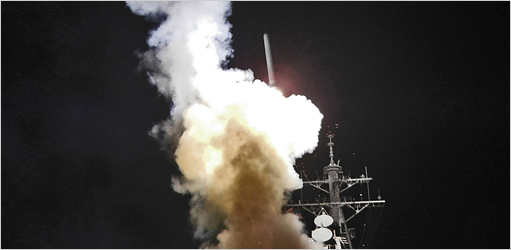
The United States has today entered into a new war in Libya.  President Obama’s decision to implement a no-fly zone in Libya entails cruise missile strikes and bombing to dismantle surface-to-air missile emplacements and Libyan ground forces close to Benghazi.  The New York Times and other news organizations now confirm that United States and French forces have begun bombardments in Libya.

The President has clearly sided with the Libyan opposition coalition, intervening in a widening civil conflict.  This military intervention will involve providing significant political support and committing the prestige of the United States to protect the opposition coalition’s integrity for an indeterminate period of time.  This is a very risky political and military strategy that will clearly require significant financial costs and increased stress on the already strained United States military system.

Numerous policy analysts have questioned the wisdom of a no-fly zone strategy in Libya, including Michael Lind, a fellow with the New America Foundation who wrote this piece in Salon.  Steve Clemmons, another fellow at the New America Foundation, critiqued the no-fly zone strategy in the BBC.  Meanwhile,  The Economist has offered its own assessment of the risks of a no-fly zone in Libya.

Can the United States effectively enter into a Libyan War while simultaneously waging  ongoing wars in Afghanistan and Iraq?

Posted in Civil Conflict, History of Violence, War, Culture, and Society | Leave a comment

Kings, Queens, and Courtiers: Art in Early Renaissance France

Renaissance France is present in Chicago!  A new exhibition, entitled “Kings, Queens, and Courtiers: Art in Early Renaissance France,” opened recently at the Art Institute of Chicago.

I visited the exhibition today with several of my graduate students and found it fascinating.  Students in my HIST 420 The Renaissance course at Northern Illinois University may want to visit this exhibition for extra credit.

See the exhibition website for “Kings, Queens, and Courtiers: Art in Early Renaissance France.”

Posted in Early Modern Europe, French History, History in the Media, Renaissance Art and History | Leave a comment

Revolutionary Waves

The ongoing Arab protests and revolutionary movements are simultaneously fascinating, inspiring, and confusing.

One of my students in HIST 423 French Revolution and Napoleon sent me this great question: “Do you know of a historical, sociological, or political theory that would attempt to explain why or how the political demonstrations that began in Tunis eventually spread throughout the Middle East? During the break I have been reading a variety of ‘comparative revolutionary studies literature,’ . . . but these works are focused on identifying the origins of revolutionary upheavals, or categorizing revolutionary phases, etc. I have not been able to find a theoretical framework, other than the ‘domino theory,’ that can be applied to the political situation in the Middle East, with respect the spread of demonstrations, or one that would predict, or explain the spread of a revolutionary movement from one region, or from one country to another.  Are there any books or articles you can refer me to?”

This is a great question, but a complex one!

Comparative revolutionary studies is a vast field, and there are a number of different theoretical approaches to comparing revolutionary movements. Many revolutionary theories focus on comparing “great” revolutions, such as the French Revolution of 1789 and the Russian Revolution of 1917, over time.  A good example of this approach is David Parker, ed., Revolutions and the Revolutionary Tradition in the West, 1560-1991 (London: Routledge, 2000).  Other comparative approaches consider successive revolutions within a single nation, as when a study examines the 1789, 1830, 1848, and 1871 revolutions in France.  Charles Tilly, The Contentious French (Cambridge, MA: Belknap Press, 1989), is an exemplary study of this kind. Some comparative revolutionary theories and histories do examine contemporaneous revolutionary movements, providing intriguing historical perspectives for considering the current Arab revolutions.  The remainder of this post introduces some of the key works in this field.

Classic Marxist studies see revolutions as responses to changes in economic modes of production, so revolutions should occur in waves across geographic areas affected by similar economic conditions.  Karl Marx himself analyzed the French Revolution and the Revolutions of 1848 through this method, and predicted a coming revolution of the proletariat.  Many other Marxist historians, political scientists, and sociologists have since adapted Marx’s methods to other cases of revolutions, especially the Russian Revolution of 1917 and the Chinese revolution of 1949.

Decolonization movements in India, southeast Asia, and Africa in the 1940s-1960s prompted a new round of comparative revolutionary studies.  Many of the decolonization struggles have been described principally as nationalist movements, but some see transnational forces such as Arab nationalism or pan-Africanism as crucial to decolonization. The Civil Rights movement in the United States is sometimes also set into decolonization frameworks of analysis.  The prolonged guerrilla and counter-insurgency warfare in Algeria and Indochina (Vietnam) brought sustained analysis of revolutionary movements in both areas.  These conflicts and revolutionary movements in Latin America led scholars such as Edward E. Rice to describe “wars of the third kind” as explaining similar dynamics in conflicts that were dominated by unconventional war (as opposed to conventional warfare or nuclear war).

Ted Robert Gurr and other theorists developed social and political models to explain revolutionary preconditions and processes, debated with Marxist scholars in the 1960s and 1970s.

In the 1960s and 1970s, R.R. Palmer examined the American, French, and other late eighteenth-century revolutions through the lens of an “Age of Democratic Revolutions,” by which he referred principally to the spreading of democratic ideals throughout Europe and the Atlantic World.

Charles Tilly’s model of revolutionary situations and revolutionary outcomes offers another method for studying revolutionary movements comparatively, although his framework is based on a state-by-state analysis.  Tilly has numerous books on revolutions (published from the late 1960s to the 2000s), but perhaps the best introduction to his work on revolutions is European Revolutions, 1492-1992 (Oxford: Blackwell, 1993).

Jack A. Goldstone (following Theda Skocpol) has produced an interesting theory of “state breakdowns” as explaining revolutions.  His theory is comparative, but (like Tilly) is largely based on analyzing individual states, then comparing results.  Goldstone does “waves of state breakdowns” as sweeping through Europe at certain historical moments in his Revolution and Rebellion in the Early Modern World (Berkeley: University of California Press, 1991).

The revolutions of 1989 led to an outpouring of writing on the revolutions.  There have been numerous comparative analyses, but often focused on the Eastern European Communist bloc as a linked unit, and thus based ultimately on the collapse of the Soviet Union.

The Chinese and Iranian revolutions have often been left out of comparative analyses, except by Asian and Middle Eastern specialists such as Jeffrey Wasserstrom and Farrokh Moshiri.  A comparative approach considering European and Asian examples of revolutionary movements is provided in Mark N. Katz, Revolutions and Revolutionary Waves (Palgrave Macmillan, 1997).

More recently, historians have examined the spread of human rights language through abolition movements, novels, and literature.  Some historians identify a series of cultural revolutions in the Atlantic World, seeing the Haitian Revolution as the most radical.  Others see global dimensions of the spread of the concept of human rights or modern political culture, even in India and beyond.  For an example of this line of study, see: Jeffrey N. Wasserstrom, Lynn Hunt, and Marilyn B. Young, eds., Human Rights and Revolutions (Lanham, MD: Rowman and Littlefield, 2000).

In recent years, the various “color” revolutionary movements of Eastern Europe and elsewhere in the 2000s have prompted some comparative study.

I will post my bibliography on comparative revolutions once I have a chance to update it.

Posted in Comparative Revolutions, French Revolution and Napoleon, History in the Media, History of Violence, The Past Alive: Teaching History | Leave a comment

The American Civil War Remembered in the South

History is in the news all this spring as the 150th anniversary of the beginning of the American Civil War approaches.  The New York Times is running an almost daily series of blog posts on the 150th anniversary, entitled Disunion, and numerous other news media are running stories.

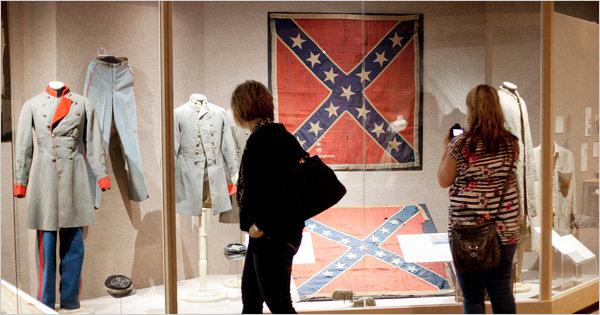
Today, there is a story about the construction of historical memory of the American Civil War in Southern museums.  This is a subject that has been well researched by academic historians and discussed by popular writers on the Civil War, but this article provides a nice introduction to the complex productions of historical memory of the war in Southern culture.

Students in my HIST 390 War in Film course have been grappling with these issues as we analyze American Civil War films such as Gone with the Wind and Glory.


Posted in Civil Conflict, Historical Film, History in the Media, The Past Alive: Teaching History | 1 Comment

New Special Adviser at the University of Texas

More news today of the growing politicization of university administrations across the United States.  While university faculty positions nationwide have remained almost stable over the past generation, administrative jobs have grown incredibly.  The Chronicle of Higher Education recently estimated the administrative expansion at 20 percent over the past 20 years!  This administrative growth includes numerous highly paid non-academic manager positions such as vice presidents, associate deans, assistant deans, and coordinators.

Today, there are reports of a newly created Special Adviser position (salary $200,000) at the University of Texas that has been given to a non-academic entrepreneurial adviser who runs his own political policy consultant group.

This story, reported in the New York Times, helps reveal why the constitution of university boards and administrative positions will determine the future of public higher education.

Posted in Education Policy | Leave a comment

Remembering Japanese Earthquake Victims

Remembering the victims of the recent Sendai earthquake and tsunami….

The tremendous human losses from this massive disaster are incredibly tragic.  No words can express our sorrow at such terrible devastation.

Even as we remember the victims, we may wish to reconsider whether or not this was a “natural disaster.”  Historians have recently begun to explore the history of disasters, including earthquakes, in comprehensive ways.  René Favier, professor of history in Grenoble, has been studying changing patterns of human responses to natural disasters. Other historians raise questions regarding the extent to which human settlement patterns,  environmental transformations, and poverty conditions often contribute to “natural” disasters.

Historian Gregory Smits provides an especially relevant perspective on the history of Japanese experiences of earthquakes in the early modern and modern periods.  His recent article is “Shaking Up Japan: Edo Society and the 1855 Catfish Picture Prints,” Journal of Social History 39 (Summer 2006): 1045-1078.

Here is the abstract for the article:

“Following the Ansei Edo Earthquake of 1855, Japanese print makers produced hundreds of varieties of catfish picture prints (namazu-e). These prints afforded the common people of Edo (soon to become Tokyo) an ideal vehicle for commenting on politics and society under the cover of discussing the recent earthquake. Some were sharply critical of the existing situation, and some adumbrated alternative political and social visions. One of these visions was of “Japan” as a natural community. Some prints portrayed the earthquake that shook Edo as having shaken all of Japan, and others incorporated events of the recent past into new narratives of world-renewal and change. The solar deity Amaterasu, who played a prominent role in national ideology after 1868, first came to widespread attention in Edo via these prints. In this and other ways, the catfish picture prints helped lay the psychological groundwork for the process of “making Japanese” that would begin in earnest after 1868. Furthermore, owing to a coincidence in which 1855 and 1867 were both years of special religious significance, it is likely that the folk memory of the Ansei Edo Earthquake helped condition popular expectations of upheaval and change during the Tokugawa bakufu’s final year.”

Earthquakes have histories, and we should move beyond mere recounting of statistics to understand their broader significance for human societies and the environment.


Posted in Environmental History, History in the Media | Leave a comment