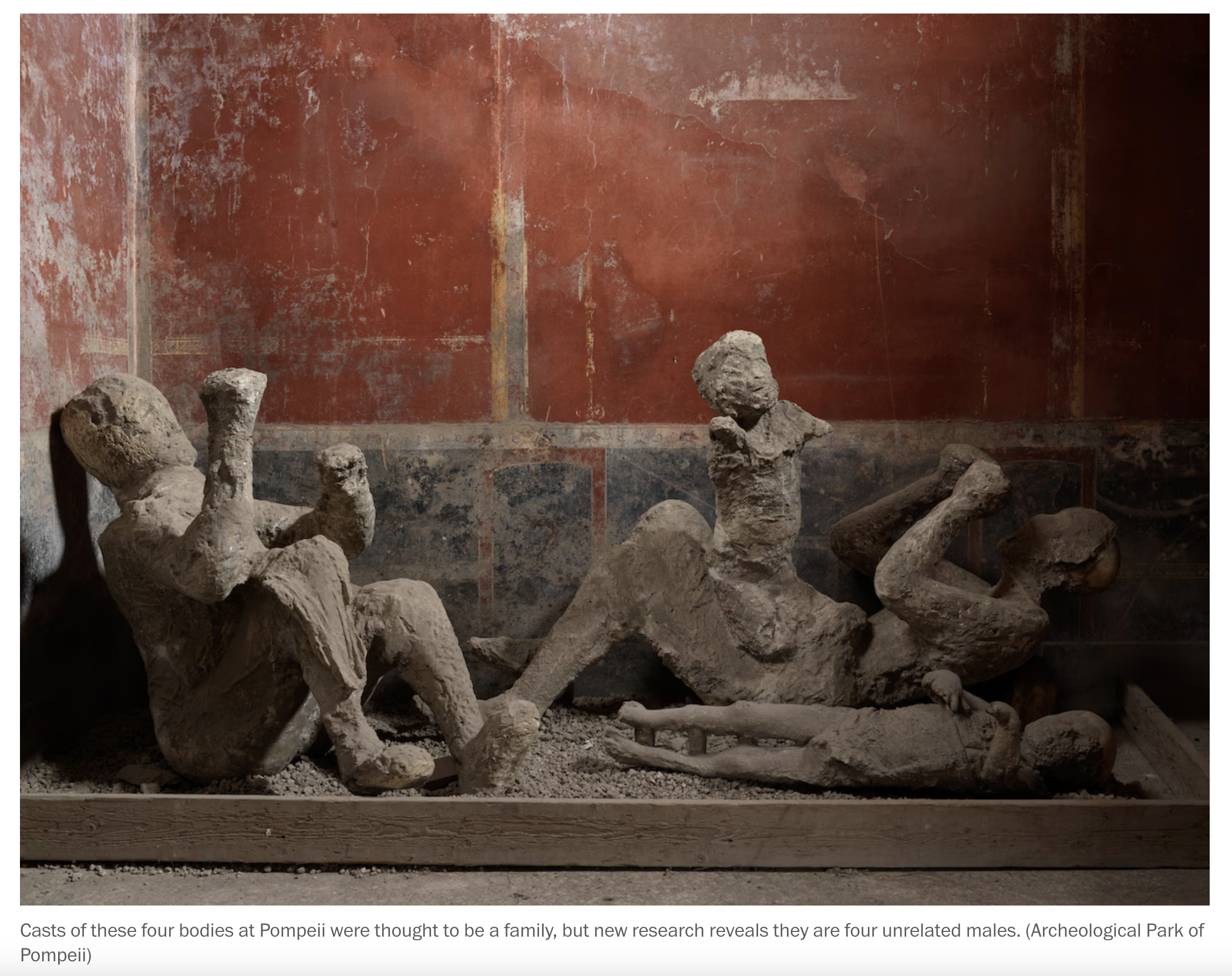
New DNA studies have been done the remains of residents of Pompeii who were killed in the disastrous eruption of Mount Vesuvius in 79 Common Era (CE). The findings challenge previous interpretations about the identities of many of the victims.
TheWashington Post reports that “Plaster casts of Pompeii’s victims preserve moments of human connection as the A.D. 79 eruption of Mount Vesuvius buried the city in ash. There’s a family of four — including a mother holding a child on her hip. Two sisters are caught in an eternal embrace. The poignant figures, frozen in time, humanize an ancient natural disaster.”
Source: The Washington Post.
However, “a provocative new study published Thursday in Current Biology reveals that long-standing interpretations of these scenes are wrong.”
A number of the identifications that had previously been made simply by reading death poses based on cultural or art history tropes, but the DNA evidence questions such identifications. “The long-presumed family buried at one house turn out to be four unrelated males. And one of the two sisters locked in a hug turns out to be a male,” according to The Washington Post.
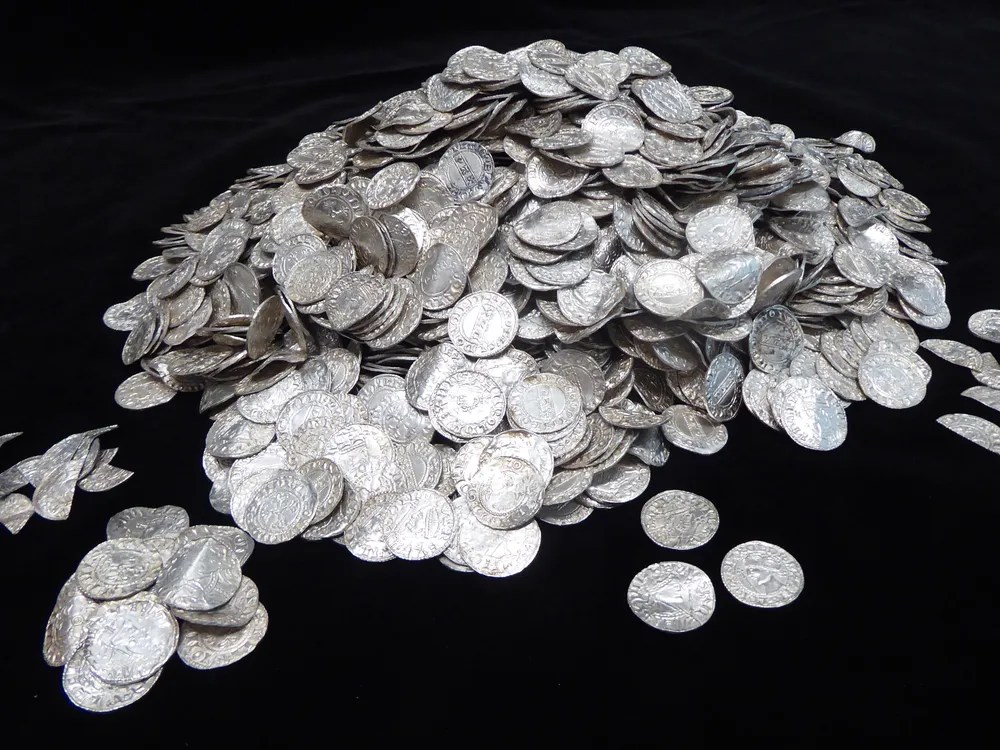
Metal detector enthusiasts recently discovered a hoard of coins from the era of the Norman Conquest of England in 1066-1068.
The New York Times reports that “the group huddled together in the farmer’s field, staring at the dozen or so medieval silver coins. They had found one, then two, and a third — Adam Staples knew, then, this was something special.”
Coins of William I the Conqueror, Edward the Confessor, and Harold II. Source: Smithsonian Magazine.
According to TheNew York Times, “Mr. Staples had gathered with six friends that day in 2019 to try out a new metal detector, part of a hobby in which he had indulged for years. But everyone realized, looking down at the pieces of old metal: This find could change their lives.”
Coins from the Chew Valley hoard. Source: Smithsonian Magazine.
“Five years later, the hoard of coins — known as the Chew Valley hoard, for the region of Somerset, England, in which they were found — has been confirmed as the most valuable treasure ever discovered in Britain. It was acquired by the South West Heritage Trust, an independent charity, for 4.3 million British pounds, or more than $5 million, which will be split among Mr. Staples, his friends, and the farmer.”
Northern Illinois University students in HIST 110 History of the Western World I will be interested in this new find.
The Newberry Library has digitized a major collection of early modern European and world maps printed in Italy.
“The Newberry has recently completed the digitization of over 750 maps printed in Italy during the sixteenth and seventeenth centuries. The Franco Novacco Map Collection, one of the strongest of its kind in the world, reflects Europeans’ evolving conceptions of the world during a time of widespread exploration and colonization.”
Gioseppe Rosaccio, Vniversale descritione di tvtto il mondo, 1647.
The high-resolution digitized images of these early modern maps will offer researchers the opportunity to examine the maps in greater detail than before.
Undergraduate and graduate students in History at Northern Illinois may be interested in utilizing these digitized maps in their research projects for courses in early modern European, Mediterranean world, Atlantic world, and global history.
For more information on the Franco Novacco Map Collection and the digitization project, see the Newberry Library website.
A “casual tip” led archaeologist Michael Frachetti to the discovery of “Tugunbulak, an enormous fortified city dating back to a medieval empire. He and his team would spend nearly a decade trying to map out the site, as well as the one he’d originally come to Uzbekistan to explore, known as Tashbulak.”
Frachetti is a Professor of Archaeology at Washington University in St. Louis and he has been leading a team of archaeologists working on urban sites in central Eurasia that were part of the caravan trading networks often referred to as the Silk Road.
The team has also used drones to produce aerial maps of these Eurasian cities on the Silk Road.
“The results of their research, published on Wednesday in the scientific journal Nature, describe the two sites as ‘the largest and most comprehensive urban plans of any medieval city’ in Central Asia situated at high altitude (defined here as about 6,500 feet above sea level).”
The size of the cities and the evidence of their robust commercial activity suggests that mountainous regions were integrated in the caravan trading networks of the Silk Road.
“The findings complicate the prevailing image of the Silk Road, which facilitated the exchange of goods and ideas between people from China to Venice between the second century B.C. and the 15th century A.D. Many experts had previously thought that the famous trade route passed only through the lowlands.”
Students in HIST 110 History of the Western World I at Northern Illinois University will be interested in this research.
The New York Times reports on the recent research on Eurasian cities and the Silk Road.
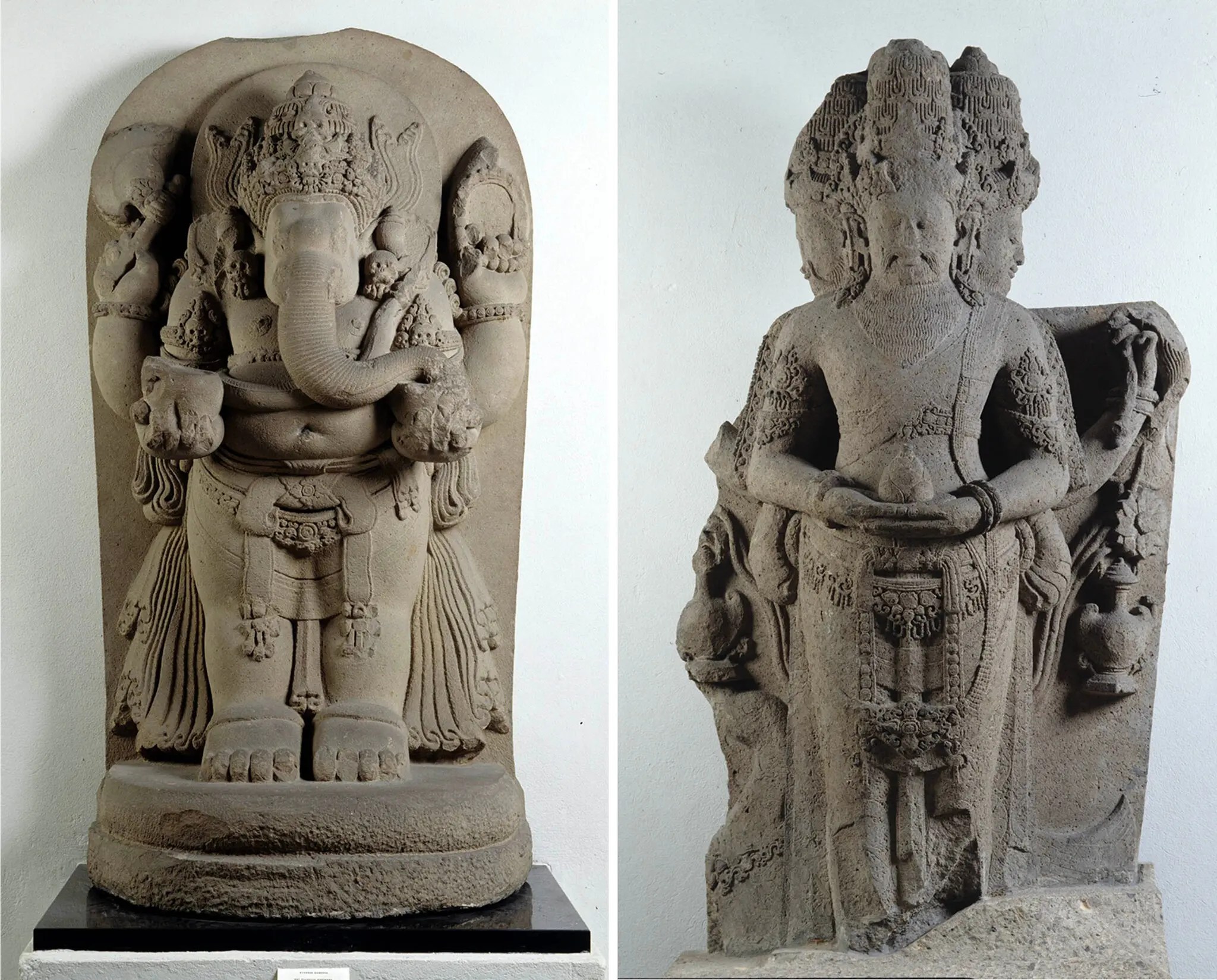
The Netherlands has returned numerous looted artifacts and art objects to Indonesia in a major repatriation. This move aims to make partial restitution for historical legacies of Dutch colonialism, imperialism, and slavery in Southeast Asia.
The New York Times reports that “the Dutch government returned centuries-old stone Buddhist statues, a bejeweled serpentine armband and other looted artifacts to its former colony Indonesia on Friday, a rare example of cultural objects taken during colonialism making their way back home.”
Statues of Ganesha and Brahma that were repatriated to Indonesia. Source: New York Times.
“The Netherlands returned 288 items in a ceremony at the World Museum in Amsterdam, where the artifacts had been held. The repatriation is only the second by the Dutch since a 2020 report by a government advisory committee recommended returning art and other objects taken during four centuries of the country’s colonial era.”
Michael Walzer, a noted scholar of just war theory and the conduct of war, has condemned the pager attacks in Lebanon as probable war crimes. His essay appears as an op-ed in the New York Times.
“The exploding pagers and walkie-talkies targeting members of Hezbollah in Lebanon were certainly an espionage and technological coup. Few people on the spot or reading about them from far away could fail to be amazed. But the explosions on Tuesday and Wednesday were also very likely war crimes — terrorist attacks by a state that has consistently condemned terrorist attacks on its own citizens.”
Pager explosion in a supermarket in Lebanon. Still image from a security camera video. BBC
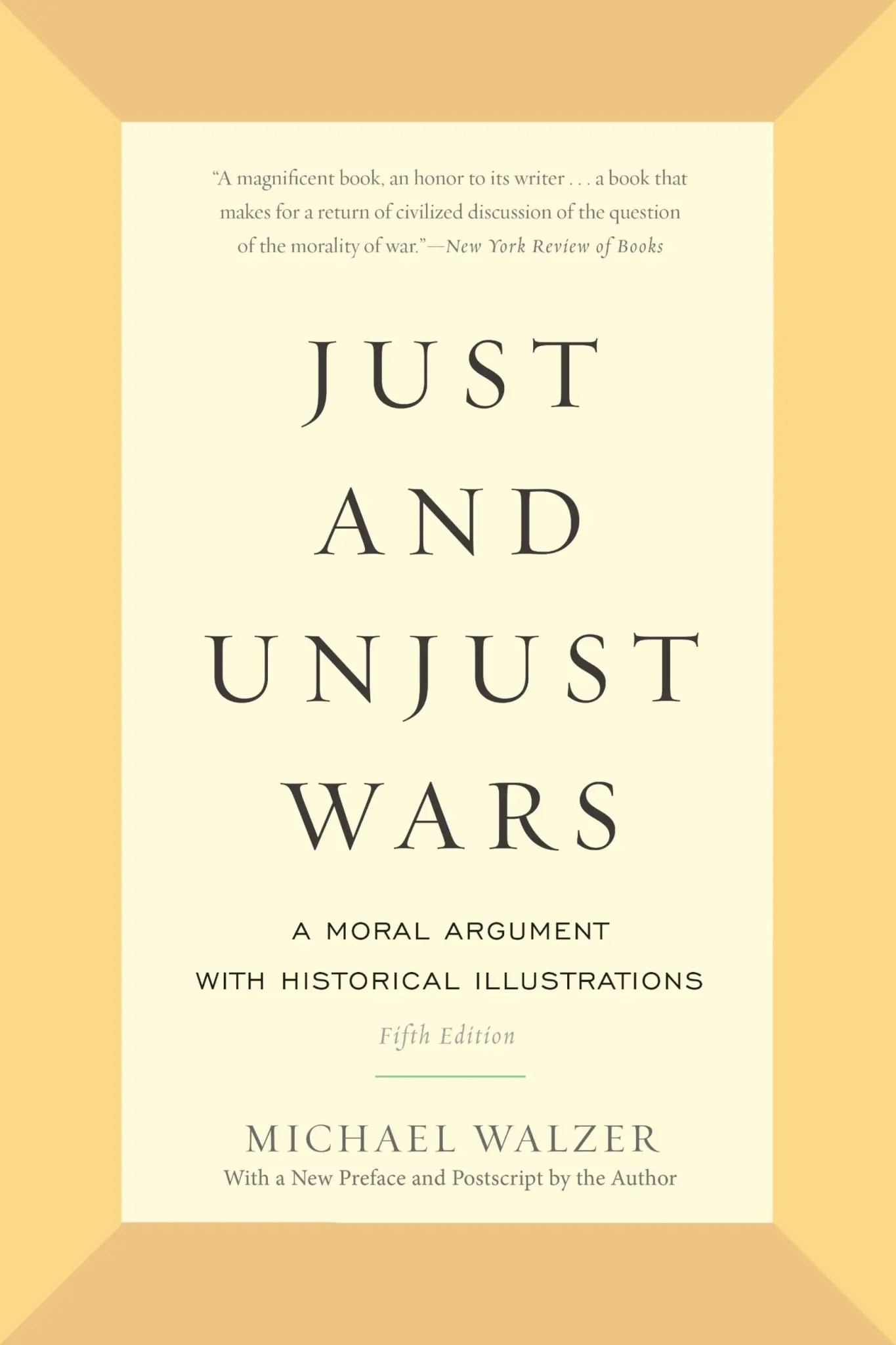
Michael Walzer is a professor emeritus of the Institute for Advanced Study, Princeton, who is best known for his Just and Unjust Wars: A Moral Argument with Historical Illustrations (1977), which is considered a modern classic in political philosophy.
Walzer has remained engaged in questions concerning the legitimate conduct of warfare throughout his scholarly career. He has published numerous works on religious politics, toleration, just war theory, and the conduct of war and continues to comment on conflicts in the contemporary world.
Michael Walzer’s op-ed is available on the New York Times website. Walzer appeared in a conversation on just war issues with the Council on Foreign Relations in 2017. The Institute for Advanced Study, Princeton, posted Walzer’s public lecture on “Terrorism and Just War” in 2007. Walzer’s Just and Unjust Wars is available from Basic Books.
The American History Association and high school history teaching are in the news once again as the so-called “Culture Wars” continue to rage across the nation. History and Social Sciences teachers and their curricula often find themselves in the crosshairs of political activists and protesters from diverse ideological perspectives.
The New York Times reports that “as printed textbooks increasingly gather dust in classroom bookshelves, a new and expansive survey published on Thursday finds that social studies teachers are turning to digital sources and primary documents from the nation’s past.”
According to the New York Times, “While the most popular curriculum providers are not ideologically skewed, the report warned about a trend of ‘moralistic cues’ in some left-leaning school districts, with lessons that seemed to direct students toward viewing American history in an ’emotional’ manner, as a string of injustices.”
This news article is based on a new report on American Lesson Plan: Teaching US History in Secondary Schools (2024), issued by the American Historical Association (AHA), the flagship academic association of professional historians in the United States.
According to the report summary, “American Lesson Plan: Teaching US History in Secondary Schools distills insights gathered during a two-year exploration of secondary history education to illuminate the three levels where decisions are made about what students learn in US history: the state, the district, and the teacher. Combining a 50-state appraisal of standards and legislation with a nine-state dive into local contexts, we commissioned a survey of over 3,000 middle and high school US history educators, conducted long-form interviews with over 200 teachers and administrators, and collected thousands of pages of instructional materials from small towns to sprawling suburbs to big cities.”
The report is available on the New York Times website. The full AHA report is available at the AHA website.
Massive and coordinated communication device attacks on Hezbollah members and civilians in Lebanon this week have killed at least 36 people and injured over 3,000. The attacks were carried out by detonating explosives hidden in pagers and hand-held radios in two waves of simultaneous explosions. Israeli military and/or security services are widely suspected to have orchestrated the attacks.
Many Lebanese civilians were injured and killed in the attacks, including a 9-year old girl who was killed in her family’s kitchen. A video of the explosion of a pager worn by a man shopping in a supermarket shows how everyday civilian sites across Lebanon have been turned into bombing sites. The massive scale and indiscriminate nature of the attacks have shocked Lebanese communities and disturbed outside observers.
Still image from video of pager explosion in a Lebanese supermarket. BBC.
News reports rightly describe the attacks as unprecedented, since this form of attack seems as novel and disturbing as the use of commercial airlines as flying bombs during the 11 September 2001 attacks on the World Trade Center and Pentagon. Indeed, the attacks could potentially be classified as acts of terrorism, despite the effective state of war between the state of Israel and Hezbollah.
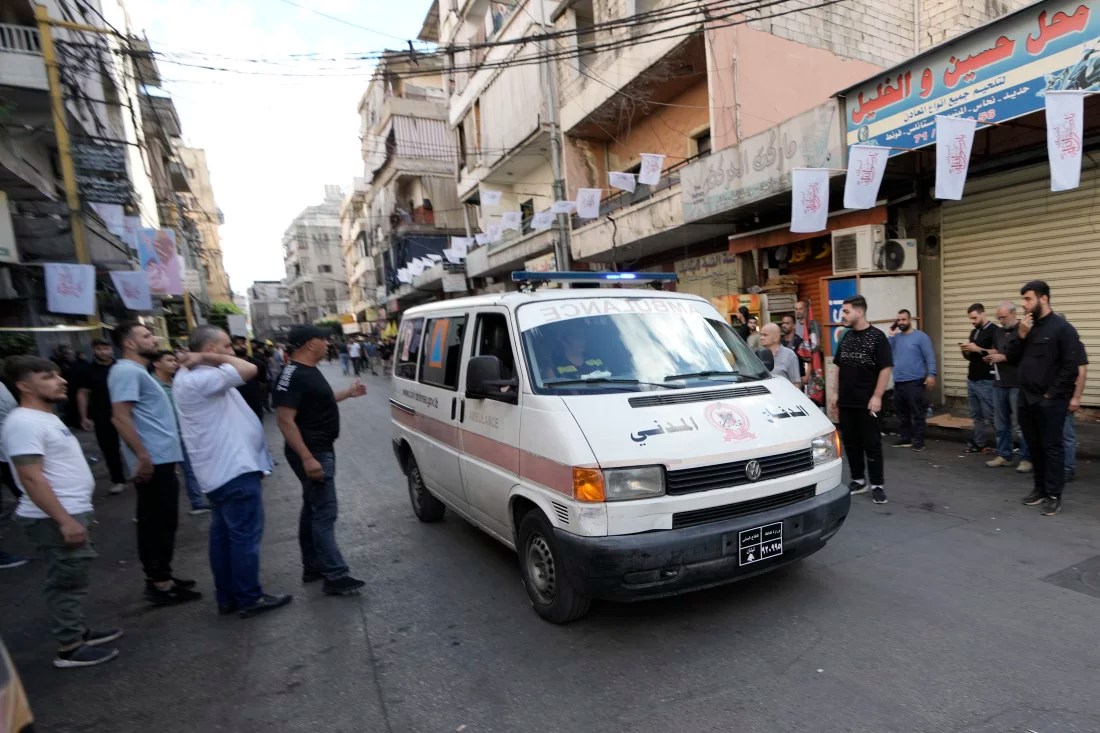
Ambulance responding to pager attacks in Beirut, Lebanon. AP.
International lawyers, political scientists, and historians of war, and violence studies scholars are already considering the pager attacks and their significance.
Legal expert Brian Finucane has written an initial analysis of the pager attacks in Lebanon, focusing on their legal implications. Finucane is a senior adviser with the U.S. Program at the International Crisis Group and a Non-Resident Senior Fellow at the Reiss Center on Law and Security at NYU School of Law. His article explores how various aspects of the attacks may be considered under the laws of war and international law.
Finucane argues that “the attacks raise concerns about civilian harm and whether further escalation in the hostilities between Israel and Hezbollah is likely to ensue. Alongside those concerns, the exploding pagers in Lebanon raise a number of factual and legal questions related to the law of armed conflict, or international humanitarian law (IHL), given that Israel and Hezbollah are engaged in an ongoing armed conflict.”
The legal issues related to the laws of war include questions of civilian targeting, proportionality, precautions, and prohibitions on weapons. Brian Finucane provides an overview of some of these issues in his analysis. Historians of war and violence studies scholars will certainly work to set these attacks into broader historical contexts of massacres, atrocities and war crimes.
Brian Finucane’s analysis appears in Just Security (18 September 2024). He was interviewed today (20 September 2024) on NPR. Axios reports using anonymous sources on Israel’s planning of the attacks. The BBC and other news organizations have posted the video of a pager exploding in a supermarket. The New York Times reports on the funeral of a 9-year old girl killed in the attacks.
Update: since the publication of this essay, Michael Walzer, a noted scholar of just war issues has published an op-ed on the pager attacks in the New York Times.
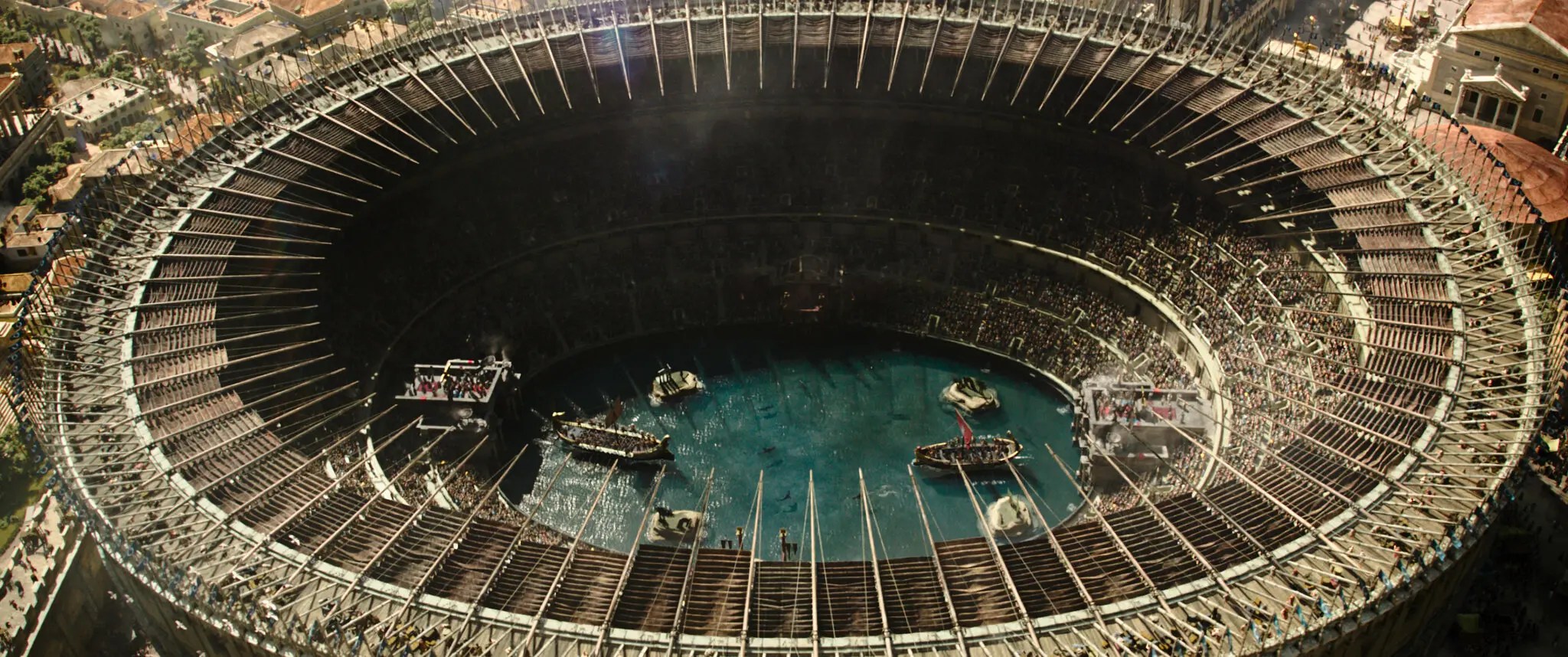
The Colosseum will soon be on the big screen once again. The feature film Gladiator II is set for release to movie theaters this fall.
According to the New York Times, “When ‘Gladiator’ was released in 2000, fans and critics applauded its visual effects and production design, from the towering Colosseum to the detailed costumes and prowling tigers.”
“More than two decades later, the architects of that film reassembled for a daunting task: building a sequel that captured what people loved about the first film’s visuals, while also finding fresh ways to surprise viewers.”
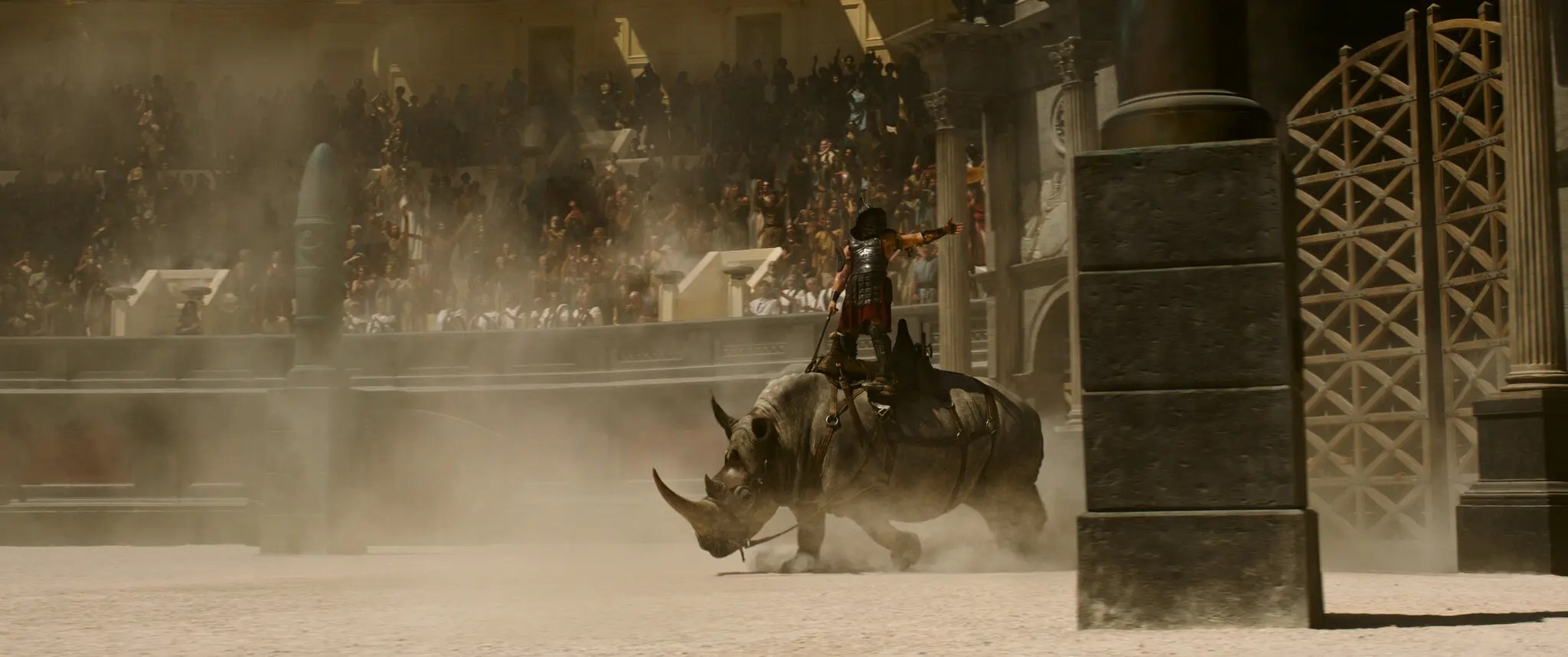
“‘Gladiator II’ (in theaters Nov. 22) includes familiar elements — tightly choreographed sword fighting and lofty speeches about the Roman Empire — but it adds combat scenes in the Colosseum that include a rhino in one sequence and sharks in another.”
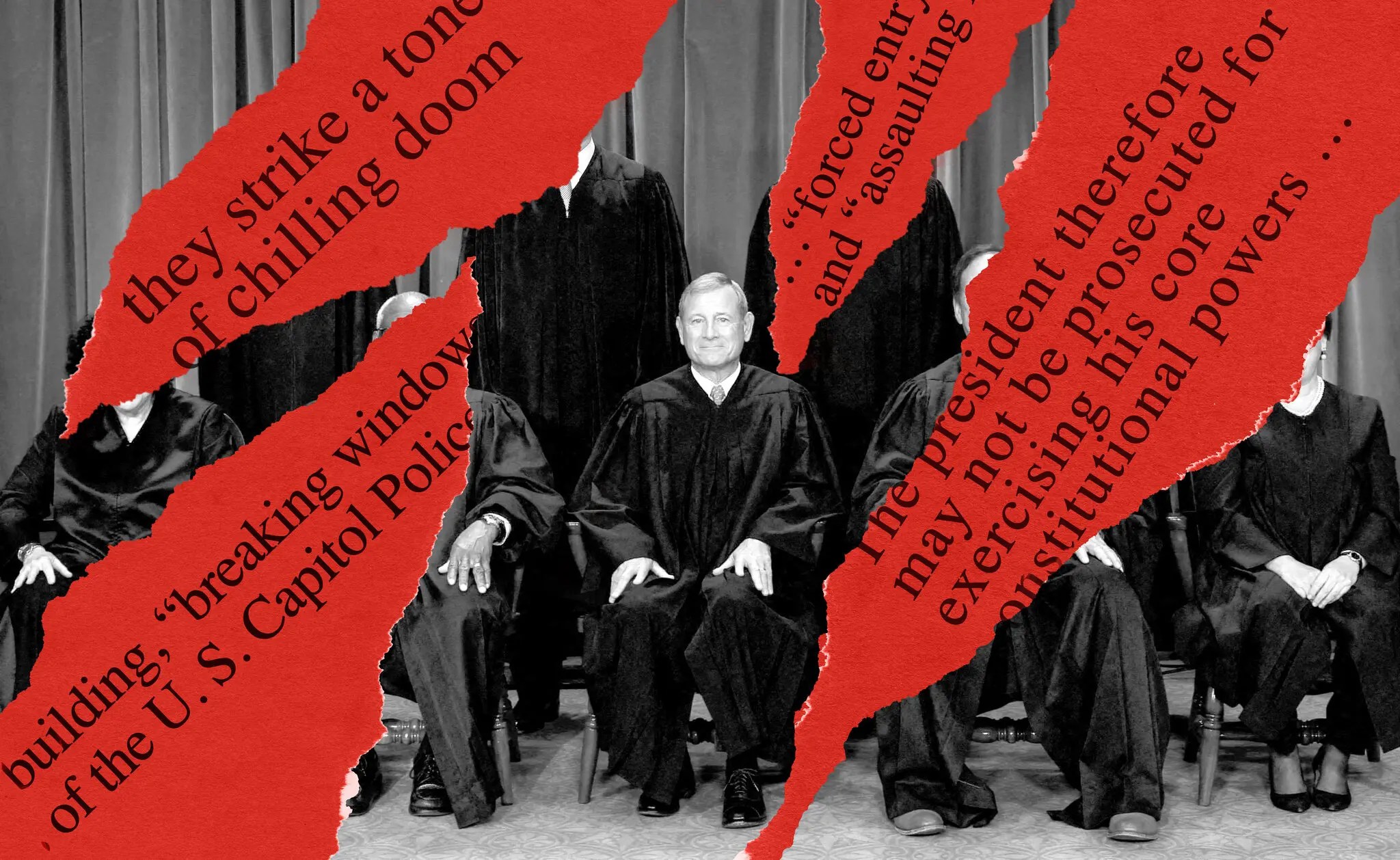
An investigative report in the New York Times finds that Chief Justice Roberts acted personally to steer the Supreme Court of the United States to find for former President Trump in three major cases related to the Storming of the U.S. Capitol on 6 January 2021. The Chief Justice’s actions seem motivated by a desire to protect the former president from prosecution relating to insurrection.
“In a momentous trio of Jan. 6-related cases last term, the court found itself more entangled in presidential politics than at any time since the 2000 election, even as it was contending with its own controversies related to that day. The chief justice responded by deploying his authority to steer rulings that benefited Mr. Trump, according to a New York Times examination that uncovered extensive new information about the court’s decision making.”
Chief Justice Roberts’ unusually aggressive maneuvers allowed him to accelerate the timeline for judicial consideration of the arguments and to determine the outcome of all three cases.
Details on the judicial procedure and negotiations surrounding these three cases have emerged from diverse sources. The New York Times reports: “This account draws on details from the justices’ private memos, documentation of the proceedings and interviews with court insiders, both conservative and liberal, who spoke on the condition of anonymity because deliberations are supposed to be kept secret.”
Judges, lawyers, and legal historians will undoubtedly be delving into the decisions themselves and the documents that the New York Times has unearthed.









 Brian Sandberg: Historical Perspectives