“She said she wanted to be a part of ‘staking claim’ to what God was doing. ‘This is a Jesus movement,’ Ms. Jackson said. ‘I believe God removed Donald for a time, so the church would wake up and have confidence in itself again to take our country back.'”
I am currently gathering news reports and articles for my graduate seminar on Religious Violence in Comparative Perspective, which I offer periodically at Northern Illinois University. The course utilizes a comparative approach to religious violence, examining cases of religious conflict from 1500 to today involving many different religious systems in world history.
I always like to end the seminar with a discussion of cases of religious politics and religious violence in today’s world, focused on a series of news reports, magazine articles, and academic essays.
In this recent article, The New York Times reports on religion in American right-wing politics:
The New York Times reports on “The Growing Religious Fervor in the American Right: ‘This is a Jesus Movement'”
Are you interested to learn about new research in History? Have you considered pursuing historical studies and engaging in original historical research? Have you ever wondered what it is like to be a professional historian?
Here is an opportunity to learn about the practice of History from M.A. students and Ph.D. candidates who are pursuing original historical research on diverse periods of American and World History….
The NIU History Graduate Student Association (HGSA) Conference will be held thisFriday 1 April 2022.
All Northern Illinois University students and members of the public interested in History are invited to attend this online conference by tuning into a single panel session or the entire conference.
Graduate students in History from Northern Illinois University, University of Michigan at Ann Arbor, Rutgers University, Villanova University, Fresno State University, and Shiv Nadar University (New Delhi) will be presenting their research.
Professor James Sweet, Professor of History at the University of Wisconsin-Madison and Recent President of the American Historical Association, will deliver the keynote lecture on “Mutiny on the Black Prince: Slavery, Piracy, and the Limits of Liberty in the Revolutionary Atlantic World” at 2:30 PM.
Due to ongoing concerns with Covid-19, the conference was again moved to an online format. The conference will be conducted entirely via Zoom.
The European University Institute (EUI), a higher education institute sponsored by the European Union, is creating a special admission procedure for Ukrainian students and researchers wanting to pursue studies and/or research at the European University Institute.
The EUI seeks to assist Ukrainian refugees whose studies and/or research has been disrupted by the Ukraine War.
Here is the announcement from the European University Institute:
The military invasion of a sovereign European state is deeply shocking for a higher education institute such as the EUI, which is predicated on transcending national borders and promoting dialogue between cultures.
The EUI Community resolutely stands with the people of Ukraine at this tragic time and is working to assist those in need of protection.
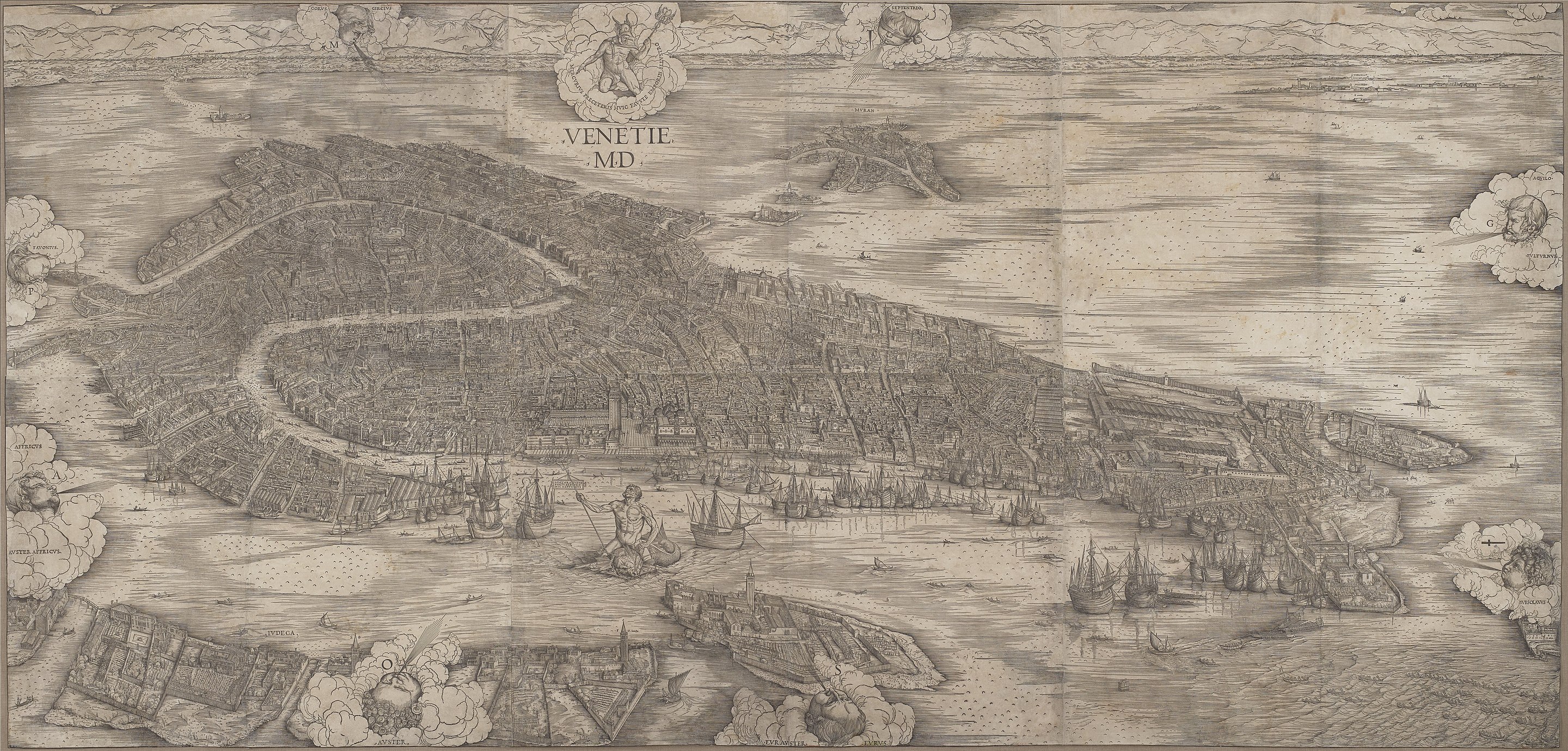
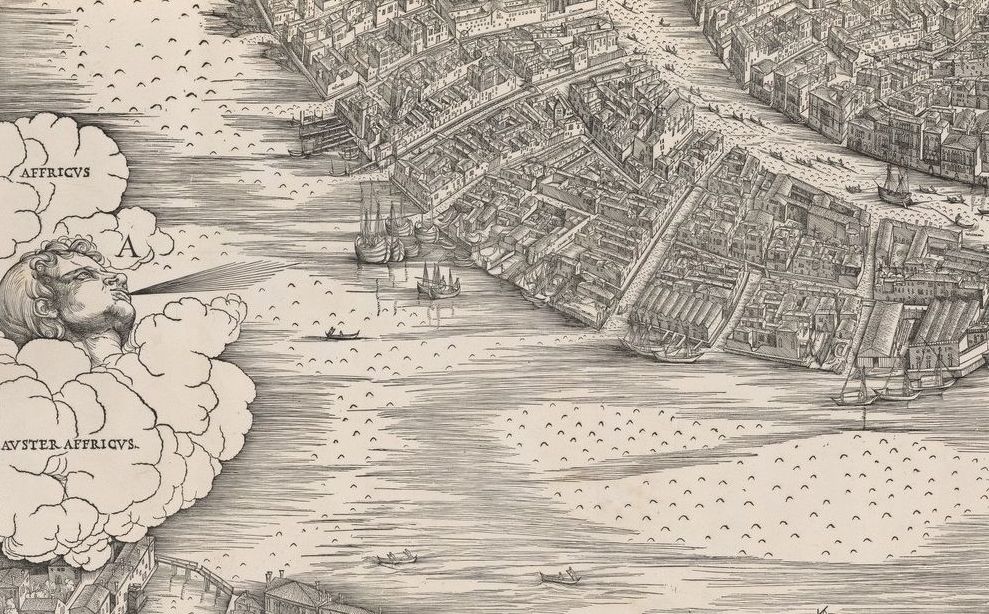
The Bibliothèque Nationale de France’s Gallica platform is celebrating early modern Venice with a digitized version of its copy of Jacopo de’ Barbari’s Venetie MD (1500).
This monumental printed city view of Venice has been closely studied using many different historical approaches.
Now, using the digitized version on Gallica, viewers can easily zoom in on all of its remarkable details using this online platform.
This is just one of many Digital Humanities projects bringing historical documents and resources to researchers, students, and citizens in new ways.
Northern Illinois Students in my courses on HIST 110 History of the Western World I, HIST 420 The Renaissance, HIST 422 Early Modern Europe, and HIST 458 Mediterranean World will be interested in this digital tool.
High School instructors who are teaching units on the Renaissance may be interested in this digital tool.
Access to the digitized copy of Jacopo de’ Barbari’s Venetie MD is available on Gallica through its blog and platform.
I am happy to report that my book review of Kiril Petkov’s translation of Giovanni Pietro Contarini’s account of the Lepanto campaign has been published by the Mediterranean Seminar Review.
Contarini, Giovanni Pietro. From Cyprus to Lepanto. Trans. Kiril Petkov. New York, NY: Italica Press, 2019. ISBN-13:978-1599103815. Xxvi+162pp. 3 b/w images. $35.00 (Hardcover); $17.00 (Paperback); $9.99 (Kindle).
As I explain in my book review, “The armadas of the Holy League and the Ottoman Empire fought an epic battle in the Gulf of Lepanto on 7 October 1571, involving over 450 warships with at least 150,000 crew members— representing one of the largest naval battles in world history. This dramatic naval engagement during the Ottoman-Venetian War of 1570-1573 is often interpreted as an important Christian victory that slowed the expansion of the Ottoman Empire in the Mediterranean.”
My review focuses on the significance of Contarini’s accont: “This book provides an English translation of the first edition of Giovanni Pietro Contarini’s History of the Events, Which Occurred from the Beginning of the War Brought against the Venetians by Selim the Ottoman, to the Day of the Great and Victorious Battle against the Turks, which was written in Italian and published in Venice in 1572. Contarini dedicated his work to Giovanni Grimani (1506-1593), Patriarch of Aquileia, and provides a Venetian perspective on the Ottoman- Venetian War and the Lepanto campaign. The book was widely disseminated and seems to have been very successful, since it was reprinted twice and then translated into Latin and German. Petkov explores the hybrid nature of the text, which borrows from other contemporary accounts of the sieges of Nicosia and Famagusta and the battle of Lepanto (xviii-xix). Petkov refers to Contarini’s History of the Events as “a ‘chronohistory,’ a carefully compiled factual narrative governed by a distinct philosophical agenda” (xxi). …”
A new historical exhibition on “The raids of February 22 and 23, 1941” investigates the fates of Dutch Jews who were rounded up by Nazi forces during the German occupation of the Netherlands during the Second World War.
The exhibition focuses particularly on the Dutch Jews who were victims of one of the first Nazi roundups of Jews in the Netherlands on 22-23 February 1941.
Photo: NIOD / Jon van der Maas Collection
The New York Times provides background on the roundups: “In February 1941, nine months after the German Reich invaded and occupied the Netherlands, the first pogroms began on Dutch soil. Local Nazi party members posted bills in shop and cafe windows that read ‘Jews Not Wanted.’ Then they trolled the Jewish Quarter, breaking windows and shouting jeers. Young Jewish men and boys prepared to protect their neighborhood. When Dutch Nazis returned a few days later, the Jews fought back. Street fights went on for days resulting in many casualties, including the death of one Dutch Nazi, Hendrik Koot. In retaliation, the Green Police — German Nazi officers in long green coats and high boots — randomly grabbed about 400 Jewish men off the streets during a two-day sweep, ultimately forcing them into trucks and driving off into the night.”
The exhibition examines the fates of each of the 400 Dutch Jews who were abducted, providing new insights on the early phases of the Holocaust.
Dutch historian Wally de Lang conducted extensive historical research on the Nazi roundups and organized the exhibition in conjunction with the Amsterdam City Archives.
The exhibition is being held at the Amsterdam City Archives. An accompanying book and website provide global access to the historical research.
The historical memory of the Algerian War (1954-1962) looms large in French politics.
Commemorations this weekend of the 60th anniversary of the end of the Algerian War and the establishment of Algerian independence in 1962 come in the midst of intense campaigning for the French Presidential Election.
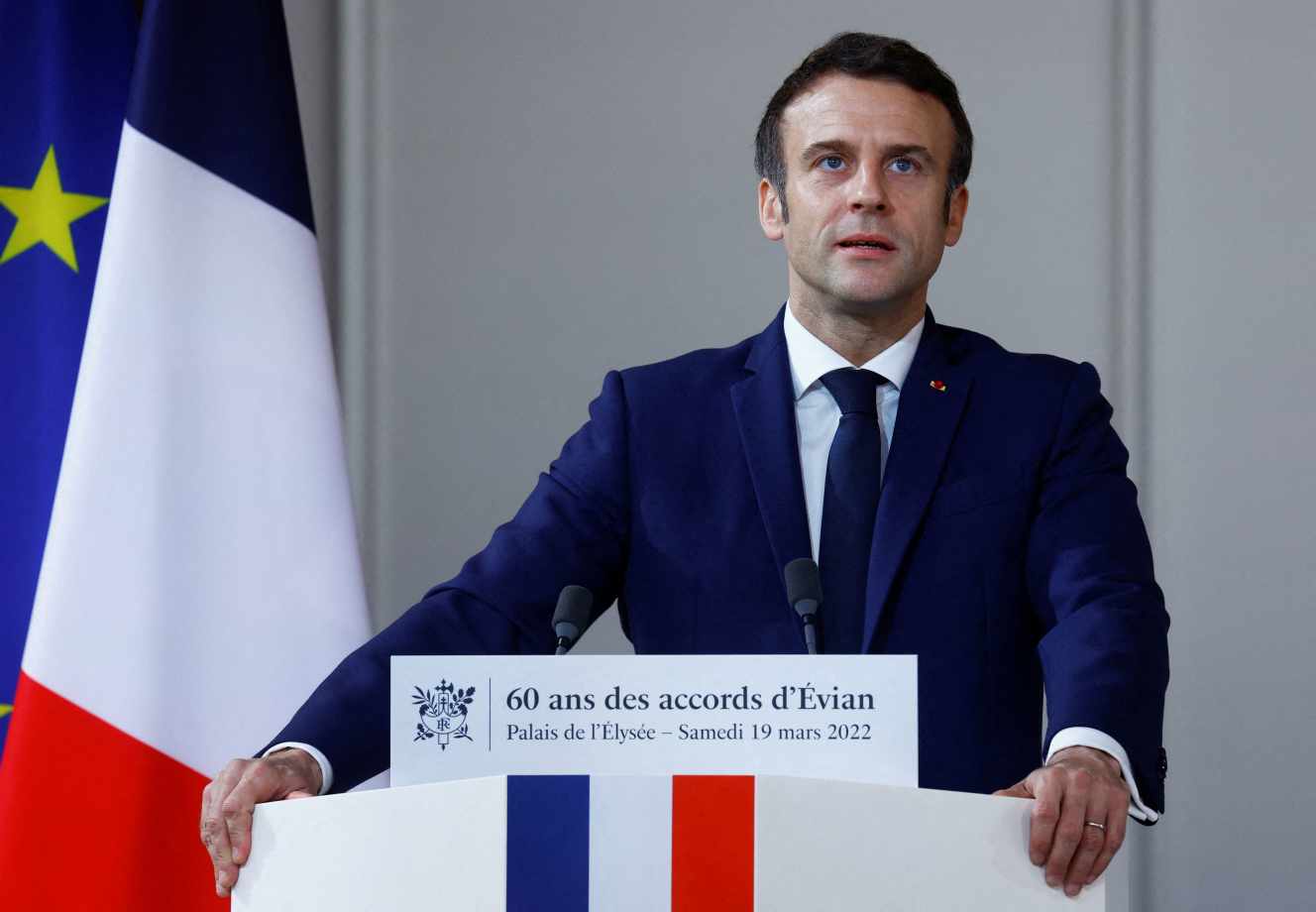
The New York Times reports that “While President Emmanuel Macron of France has tried over the past year to address the painful memories of his country’s colonial history in Algeria, the long shadows of that past — provoked by such messages — have increasingly pervaded the campaigns of right-wing candidates in next month’s presidential elections.”
President Emmanuel Macron 19 March 2022. Photo: GONZALO FUENTES / POOL / AFP.
Far-right candidates Éric Zemmour and Marine Le Pen have both denounced Macron’s efforts, employing racist language against Algerian and other North African immigrants.
Historians such as Benjamin Stora and Sylvie Thénault, who have studied the Algerian War closely, have weighed in on the commemorations of Algerian Independence and historical memories of Algerian War in the current French Presidential Election. Historian Malika Rahal conducted an in-depth interview with Le Monde on the legacies of the Algerian War.
Protest in Algiers, August 1962. Photo by Fernand PARIZOT / AFP.
Le Monde provides a series of reports on the 60th anniversary of the Évian Accords (1962) that ended the Algerian War.
The New York Times offers an analysis in English of the commemorations of the end of the Algerian War and Algerian Independence.
The Russian invasion of Ukraine has already had an enormous impact on European politics and society. Poland and other Eastern European nations are rightly nervous and have bolstered their defenses, supported by NATO. Germany has radically increased its defense spending and has begun providing direct military support to Ukraine. The entire European Union is grappling with massive shifts in military spending and security policies.
The Ukraine War has also significantly affected the current French Presidential Elections, as French presidential candidates prepare for the first round elections on 10 April 2022. The top two candidates from the first round election will then advance to a second round runoff, which will be held on 24 April 2022.
Last night, the French television channel TF1 held a live televised forum on La France Face à la Guerre, which offered French citizens a series of fast-paced interviews with the eight leading presidential candidates from across the political spectrum.
The program was essentially a pseudo-debate focused on the Ukraine War, immigration issues, economic and social policies, and retirement reforms.
Meanwhile, professors and researchers of French History, French Studies, and Political Scientists are closely following the ongoing French Presidential campaign.
At Northern Illinois University, Professor Emma Kuby and I both conduct research on French History and incorporate contemporary French culture into our teaching of HIST 311 Early Modern France, HIST 312 Modern France, HIST 339 French Overseas Empire, HIST 423 French Revolution and Napoleon, and other courses.
For more information on French History and the Undergraduate and Graduate Programs in History at Northern Illinois University, see the NIU Catalog and the NIU Department of History website.
Research centers and institutes at other universities are organizing discussions and programs on the French Presidential Elections. The Modern French History Seminar at the Institute of Historical Research (IHR), based at the University of London, will be hosting a roundtable on the French Presidential Elections.
Here is the announcement from the IHR’s Modern French History Seminar:
IHR Modern French History seminar will gather on Zoom on Monday 21 March, 17:30 (London time) for a roundtable on the French Presidential Elections.
We will be delighted to welcome:
Helen Drake (Loughborough), Marc Lazar (Sciences Po), Rainbow Murray (QMUL), William Rispin (independent researcher), and Andrew Smith (Chichester). Julian Jackson will chair the session.
Please register via the IHR website to join us for the live discussion. You will receive the zoom codes in your registration confirmation email.
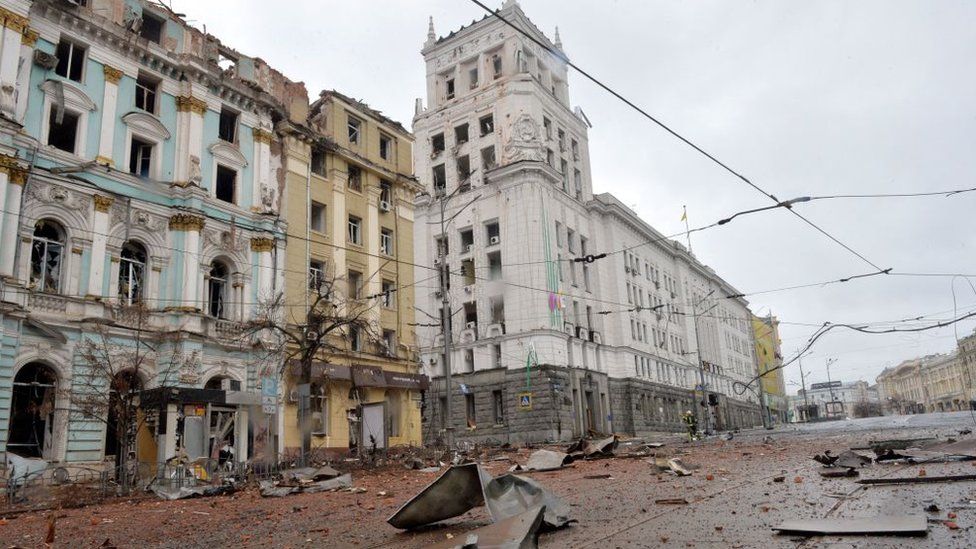
The Russian invasion of Ukraine has proceeded at a relatively slow pace, as Russian troops face stiff resistance in suburban and urban areas, especially in the outskirts of Kharkiv, the second largest city in Ukraine.
Historians of siege warfare recognize the developing patterns of encirclement and blockade, coupled with heavy aerial and artillery bombardments. Russians forces seem to be intensifying their efforts to take Kharkiv and they may be preparing to launch a major assault and engage in close urban combat. The Russian 1st Tank Army has not yet encircled Kharkiv, but is engaging Ukrainian forces on a broad front stretching for many miles north and east of the city.
Buildings damaged by Russian shelling in Kharkiv, Ukraine. Photo: Getty/BBC
Although siege warfare is often dismissed as “positional warfare,” sieges are often very dynamic, involving complex maneuvers, concentrated firepower, and massive logistical efforts. The seemingly slow pace of sieges can be misleading, since multidimensional siege operations often evolve much more rapidly than observers realize. Siege warfare can involve many different dimensions: blockade, encirclement, starvation tactics, entrenchment, approach, bombardment, mining, sniper harassment, infiltration, sortie, psychological warfare, and direct assault. The methods of siege warfare can be employed in varying degrees and do not always follow a script, making them unpredictable.
The Russian operations around Kharkiv are incredibly complicated and difficult to discern, despite satellite imagery and reports from the ground. The Institute for the Study of War (ISW) has been reporting on the fighting around Izyum, southeast of Kharkiv. The ISW’s analyses have raised the possibility that Russian forces may be seeking to blockade Kharkiv and bypass it, rather than preparing to assault the city.
BBC correspondent Quentin Sommerville recently ventured beyond the front lines to report on the fighting in Kharkiv. Sommerville and his cameraman, Darren Conway, filed a haunting video report on the BBC website.
On siege warfare, see Anke Fischer-Kattner and Jamel Ostwald, eds., The World of the Siege: Representations of Early Modern Positional Warfare, (Leiden: Brill, 2019). doi: https://doi.org/10.1163/9789004395695
Many historians are closely observing the Ukraine War and commenting on different historical dynamics and patterns that are potentially shaping the conflict.
At my university, Northern Illinois University, the College of Liberal Arts and Sciences is currently organizing a Teach-In on the Ukraine War, including two members of the Department of History. Universities around the world are organizing similar roundtable discussions to serve their student audiences and local communities.
Ukrainian refugee, Irpin, Ukraine. Photo: Reuters
Historians are also active in writing about the Ukraine War, based on their research specializations in Ukrainian History, Russian History, Eastern European History, Military History, International History, Violence Studies, War Studies, Strategic Studies, Refugee Studies, and related fields.
Mark Fitzpatrick, Professor of International History at Flinders University (Australia), has written an article for The Conversation on historical responses to the Ukraine War.
Mary Elisa Sarotte, Professor of Historical Studies at Johns Hopkins University and a specialist on Cold War History, wrote an opinion piece for The New York Times, arguing that the current situation represents the onset of a new Cold War.
Lev Golinkin, a Ukrainian memoir writer, suggests in an opinion piece for The New York Times that Russian forces aim to erase Ukrainian history in the current war.
Historian Miles Pattenden, Senior Research Fellow at Australian Catholic University, argues in the Sydney Morning Herald that a relative lack of knowledge of European history has produced misunderstandings of the historical contexts for the Ukraine crisis and has also contributed to strategic miscalculations leading to the Ukraine War.
Several historians have weighed in on the possible ways that the Ukraine War may eventually be resolved in an article for the Boston Globe.
The New York Times and The Guardian have both published reading lists of historical works on Ukrainian History, Russian History, and conflict in Ukraine.








 Brian Sandberg: Historical Perspectives