Je suis enseignant Rallies in France

Tens of thousands of French citizens are rallying today in memory of Samuel Paty, a history and geography teacher, who was brutally murdered on Friday near the collège (middle school) where he taught.
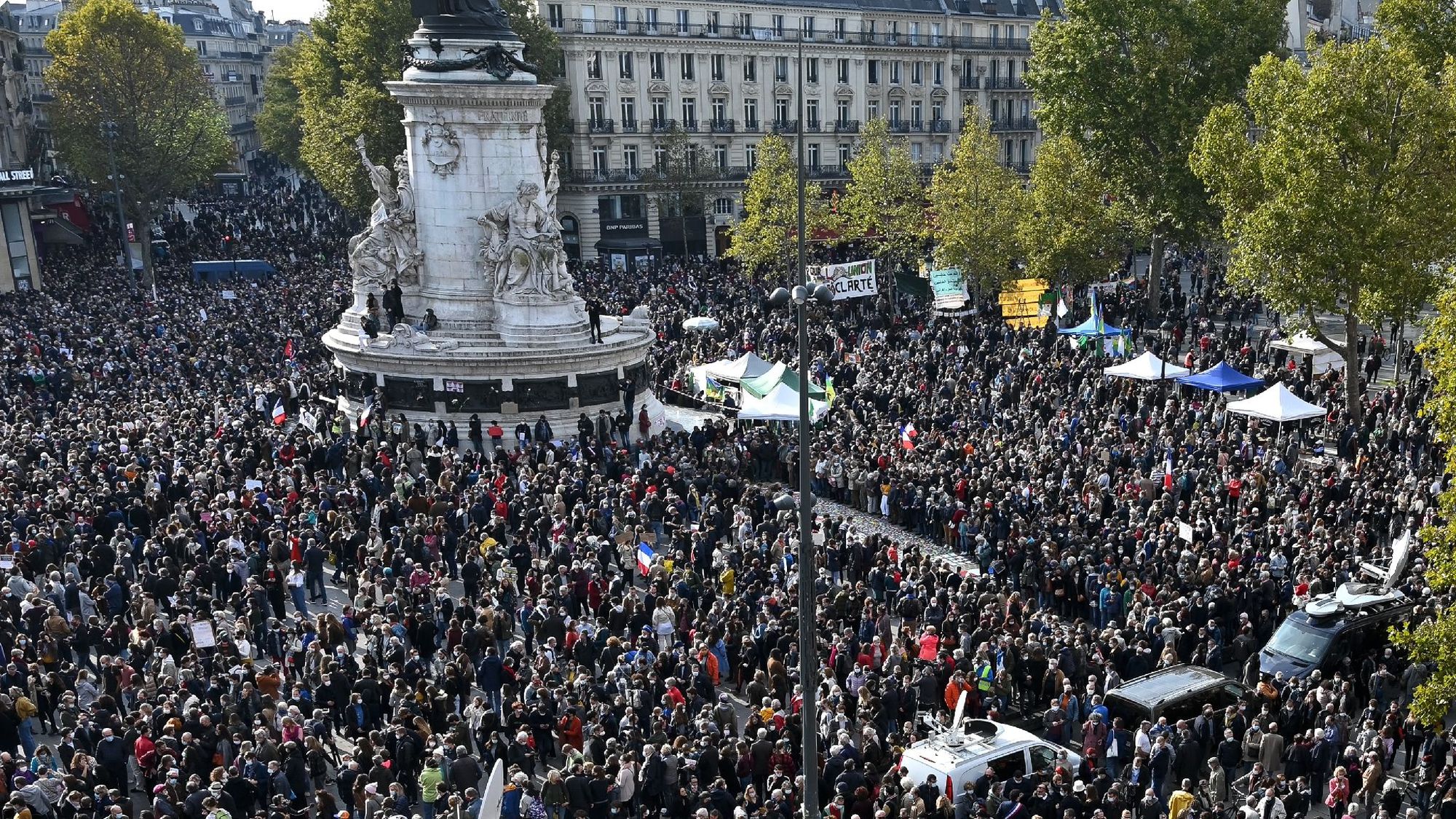
Rally in memory of Samuel Paty in the place de la République in Paris. Photo: L’Express.

A large crowd gathered in the place de la République in Paris to condemn the horrific act of violence against a teacher. Protesters carried signs specifically supporting teachers: “Je suis enseignant” (I am a teacher), “Je suis prof” (I am a professor or teacher), and “Nous, profs, enseignons la liberté d’expression et ça va continuer” (We teachers teach freedom of speech and this will continue), and “L’école pleure mais n’a pas peur” (Schools cry but don’t fear).
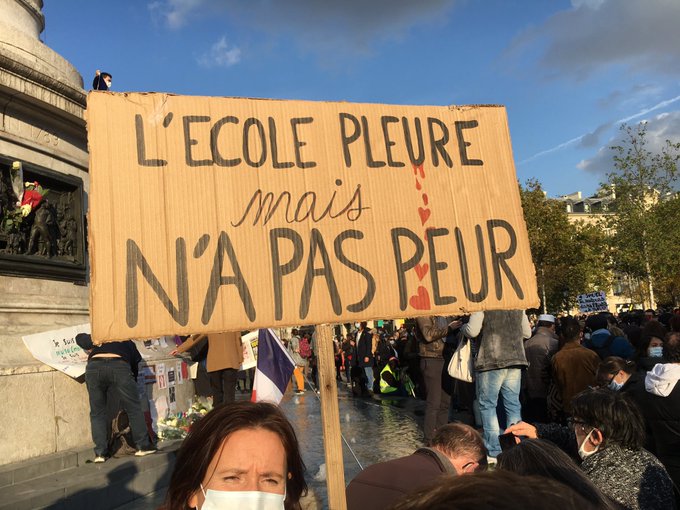
Protesters in Paris. Photo: Le Monde.

Other signs had broader expressions of support: “Je défend la liberté d’expression” (I defend freedom of speech), “Freedom of speech” (in English), and “Ils ne décapiteront pas la République” (They will not behead the Republic).

Prime Minister Jean Castex and the Mayor of Paris Anne Hidalgo both addressed the crowd, and Castex tweeted a message: “Vous ne nous faites pas peur. Nous n’avons pas peur. Vous ne nous diviserez pas. Nous sommes la France !

Many French people have expressed worries about French public education and the freedom of speech being under attack. French teachers and teachers’ unions have complained about unsafe working conditions in some neighborhoods over the past decade.
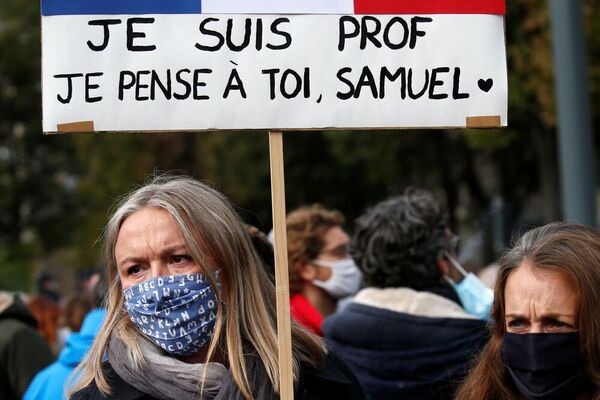
A woman protesting in Lille. Photo: Le Monde.

This attack comes in the midst of renewed trauma in France over the Charlie Hebdo Attacks in January 2015 and the current trial of individuals who allegedly provided material support to the militants who committed the killings at the Charlie Hebdo offices. Charlie Hebdo had long been known for its satirical cartoons and controversial anti-religious stances, but Islamist extremists had accused the magazine of blasphemy for publishing cartoons of Muhammad.

Samuel Paty apparently became a target of Islamist militants after showing some of the Charlie Hebdo cartoons of Muhammad during a class discussion of freedom of expression.

On a personal note, the rallies today are a sad reminder of the massive rallies in France in January 2015, when I was doing research in Paris and participated in the protests in memory of the slain editors, writers, and editors of Charlie Hebdo.

Le Monde, L’Express, and the BBC report on the rallies in Paris and across France.
Posted in Academic Freedom, Atrocities, European History, European Union, French History, History of Race and Racism, History of Violence, Humanities Education, Idea of Europe, Political Culture, Religious History, Religious Politics, Religious Violence | Leave a comment

Attack on History Teacher near Paris

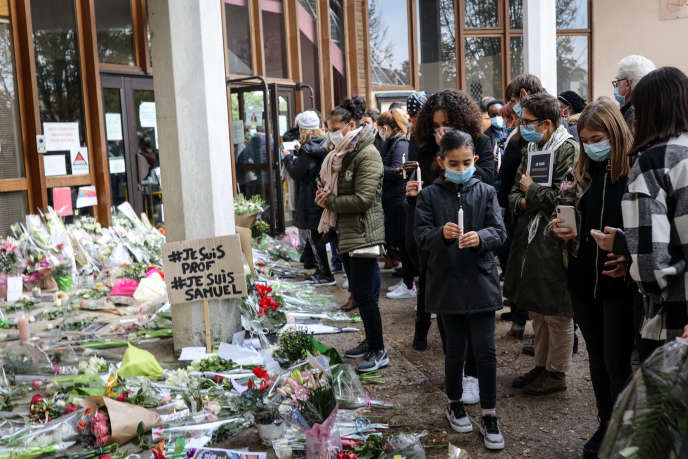
I was deeply saddened to hear of yesterday’s horrific attack on Samuel Paty, a history and geography teacher in Conflans-Sainte-Honorine, near Paris, who was brutally killed and beheaded by an 18-year-old militant after leaving the collège (middle school) where he taught.

Photo: Le Monde

Samuel Paty was reportedly targeted because of his use of Charlie Hebdo cartoons of the Prophet Muhammad in a recent class concerning the freedom of expression.

The republishing of the cartoons recently by Charlie Hebdo at the beginning of an highly publicized trial of individuals accused of assisting the militants who committed the massacre at the Charlie Hebdo office in January 2015, was deliberately provocative and has raised once again issues of freedom of expression, laïcité (secularism), justice, anti-Islamic sentiment, and racism in contemporary France.

This latest attack specifically targeted a history teacher and raises many additional questions about the status of historians, teachers, and educators in France. This act of violence also represents a direct attack on public education and academic freedom.

I would like to express my condolences to the family, colleagues, and students of Samuel Paty. I deplore the brutal violence that has been directed against him in an attempt to threaten historians and teachers across France.

Le Monde and France 24 report on the attack. L’Express provides additional reporting. France 3 reports on Samuel Paty. The Guardian reports on the violence in English.

Posted in Academic Freedom, European History, European Union, French History, History of Race and Racism, History of Violence, Humanities Education, Idea of Europe, Paris History, Political Culture, Religious History, Religious Politics, Religious Violence | Leave a comment

Things of Darkness and Early Modern Critical Race Studies

The Center for Renaissance Studies at the Newberry Library is hosting a series of discussions on Race in Dialogue, which focuses on critical race studies in the humanities.

Graduate students in HIST 522 Early Modern Europe at Northern Illinois University will be particularly interested in the first discussion in the series on Kim F. Hall’s Things of Darkness.

Here is the announcement from the Center for Renaissance Studies:

Things of Darkness: Economies of Race and Gender in Early Modern England at 25

Friday, November 13, 2020
12-1 pm CDT

CRS is pleased to announce the first session of Race in Dialogue, a new series of virtual conversations on premodern critical race studies and Indigenous studies.  

The first session features Professors Kim F. Hall (Barnard College) and Noémie Ndiaye (University of Chicago) in conversation about the legacy of Hall’s Things of Darkness: Economies of Race and Gender in Early Modern England, a foundational text in premodern critical race studies that celebrates its 25th anniversary in 2020.

This is free and open to all, but space may be limited and registration in advance is required. For more information, including the link to the online registration form, please visit our website here: https://www.newberry.org/11132020-race-dialogue

If you have any questions, please send an email to renaissance@newberry.org. 

Posted in Cultural History, Early Modern Europe, Early Modern World, European History, Graduate Work in History, History of Race and Racism, History of Violence, Lectures and Seminars, Reformation History, Renaissance Art and History, Women and Gender History, World History | Tagged , , | Leave a comment

Expanding the Renaissance

The Renaissance Society of America is organizing an online graduate student workshop on Expanding the Renaissance. The workshop is being organized by the RSA Graduate Student Advisory Committee, which has issued a call for papers. The workshop will held virtually as a series of 5-minute “lightning talks.”

Graduate students in Renaissance studies and early modern history at Northern Illinois University are encouraged to submit a proposal to participate in this workshop.

Here is the full call for papers from the Renaissance Society of America:

The Renaissance Society of America’s Graduate Student Advisory Committee is pleased to launch the Online Graduate Student Lightning Talk Series with its inaugural session on “Expanding the Renaissance,” taking place 3 December 2020. Submissions are due 30 October 2020.


As scholars and students of Renaissance Studies, we recognize that we, as the RSA Statement in Support of Social Justice states, “have structured a Western European world view that has excluded or abused people of color.” In acknowledgement of this and other elements of exclusion in Renaissance Studies, the RSA Student Community seeks to expand our understanding of the Renaissance (1300–1700) by hosting lightning talks that address topics, sources, or methodologies that are commonly excluded or overlooked from mainstream narratives.


Lightning talks are concise oral presentations of five minutes, which may or may not include visual aids. Presentations could be based on:

An argument from your work (BA/MA thesis, dissertation, or article)

  • Initial findings from side projects, or work in progress
  • Archival findings
  • Pedagogical questions
  • Field/experience-based observations, and/or
  • Anything that stimulates discussion.

The talks will be followed by a brief discussion and Q&A. Graduate students of all stages are invited to apply. Please submit your name, proposed title, and a short description (max. 150 words) via the RSA Online Graduate Student Lightning Talk Series Application Form by Friday, October 30. Students will be notified of accepted submissions on Friday, November 13. The first online lightning talks session will take place on Thursday, December 3 at 12:00 p.m. ET.


For more information, please contact the RSA Graduate Student Advisory Committee.

Organizers:

The RSA Graduate Student Advisory Committee

Celine Camps, Columbia University

Samantha Chang, University of Toronto

Barbara Dietlinger, University of Chicago

Thomas Franke, UC Santa Barbara

Posted in Conferences, Cultural History, Early Modern Europe, Early Modern World, European History, Graduate Work in History, Reformation History, Renaissance Art and History, World History | Tagged , , , , , , | Leave a comment

War and Society Paper Prizes

Are you writing a paper dealing with the history of war and society during academic year 2020-20201? If so, you may be eligible to submit your paper for consideration for a Best Paper Prize from the War and Society Program at Chapman University.

Students are urged to contact their professors about whether or not your paper might be a good candidate for submission to this competition.

Northern Illinois University students in HIST 422/522 Early Modern Europe should contact Professor Sandberg via e-mail to inquire about their projects.

Here is the announcement from the War and Society Program at Chapman University:

The War and Society Program at Chapman University invites submissions for the best papers in the field of War and Society (broadly defined to include themes such as race and the military, foreign relations, the home front, soldiers’ stories, memory and commemoration, and other related topics) written between August 2020 and May 2021 by either undergraduate or masters-level students. Papers may focus on the U.S. experience or global perspectives.


The prize selection committee, which includes national and international scholars, will give preference to those papers that employ substantial primary research along with multidisciplinary approaches.


Two prizes will be awarded:


The Undergraduate Paper Prize: Submission should come as a PDF, no more than 20 pages (exclusive of endnotes) with a short letter of support (no more than one page) from a faculty member who supervised the paper.

The Graduate Paper Prize for MA Students: Submission should be journal article length not to exceed 30 pages (exclusive of endnotes) with a short letter of support (no more than one page) from a faculty member who supervised the paper.


The prize in each category is one award of $1000, with a subsequent prize for honorable mention of $250 each in each category. The submission deadline is June 15, 2021. The competition is open to students from all institutions.

Posted in Early Modern Europe, Early Modern World, Graduate Work in History, Grants and Fellowships, History of Violence, Undergraduate Work in History, War and Society, War, Culture, and Society, Warfare in the Early Modern World | Leave a comment

Conference on Illinois History

The annual Conference on Illinois History is currently being held at the Abraham Lincoln Presidential Library and Museum in Springfield, Illinois from 5-9 October 2020.

Due to the Covid-19 pandemic, the conference is a virtual event this year, allowing interested students and members of the public to access the conference sessions online.

The full program and registration instructions for the Conference on Illinois History are available at the conference website.

The Conference on Illinois History also offers Continuing Professional Development Units (CPDUs) for teachers.

Graduate and undergraduate students at Northern Illinois University may be interested in this virtual conference.

Posted in Careers in History, Conferences, History in the Media, Humanities Education, Illinois History and Society, The Past Alive: Teaching History | Leave a comment

Artemisia Gentileschi Exhibition in London

A major exhibition on Artemisia Gentileschi’s paintings just opened at the National Gallery in London.

The New York Times reports: “The National Gallery opted for a one-word title for its new blockbuster show: ‘Artemisia.’ The name of the exhibition, which opened on Saturday and runs through Jan. 24, 2021, has a pop star ring, befitting the most celebrated female artist of the 17th century.”

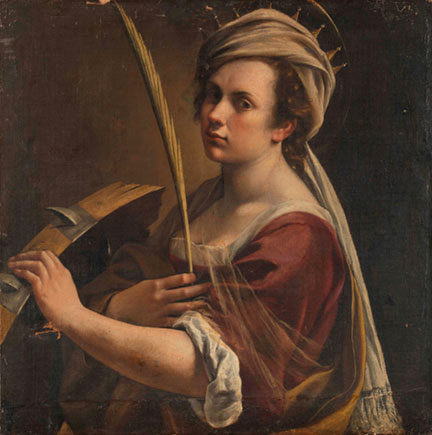
Gentileschi’s “Self Portrait as Saint Catherine of Alexandria” is the centerpiece of the current exhibition.

According to The New York Times, “In 2018, the National Gallery acquired its first work by Gentileschi, ‘Self Portrait as Saint Catherine of Alexandria,’ making her only the eighth female artist in a collection that has work by more than 700 men. The curatorial team recognized the opportunity to stage a major monographic show, which would resonate with the #MeToo movement and help counter the gender imbalance of the collection.”

Northern Illinois University students in HIST 422 Early Modern Europe and in Renaissance studies will be interested in this exhibition.

For more information on the remarkable career of Artemisia Gentileschi, see:

Sheila Barker, ed., Artemisia Gentileschi in a Changing Light (Turnhout: Harvey Miller/Brepols, 2017). [Book description at Brepols.]

Sheila Barker, ed., Women Artists in Early Modern Italy. Careers, Fame, and Collectors (Turnhout: Harvey Miller/Brepols, 2016). [Book description at Brepols.]

Jane Fortune, ed. Invisible Women: Forgotten Artists of Florence (Florence: Florentine Press, 2009).

Fedrika J. Jacobs, Defining the Renaissance ‘Virtuosa’: Women Artists and the Language of Art History and Criticism (Cambridge: Cambridge University Press, 1997).

Paola Tinagli, Paola Tinagli Baxter, Mary Rogers, Paulo Tinagli, eds., Women in Italian Renaissance Art: Gender, Representation and Identity (Manchester: Manchester University Press, 1997).

The New York Times reports on the opening of the Artemesia exhibition on Saturday 3 October 2020.

Posted in Art History, Early Modern Europe, Early Modern World, European History, Museums and Historical Memory, Women and Gender History | Leave a comment

Black Lives Matter Mural at NIU

The Black Lives Matter movement is bringing awareness of racial issues to the campus of Northern Illinois University and the DeKalb community.

Northern Illinois University’s Center for Black Studies recently suffered a vandalism attack, in which someone spray-painted a racist slogan on its building. See my previous post on Racist Vandalism on Campus.

Black Lives Matter activists responded creatively to this attack with an anti-racist mural painting project on campus. On Thursday, 1 October 2020, the Center for Black Studies and the College of Visual and Performing Arts organized an event called “Art and Soul,” to paint a bold mural stating “Black Lives Matter” on Castle Drive. According to Northern Public Radio, “Participants with masks on took turns painting the street while listening to live music performed throughout the affair.”

Photo: Northern Public Radio

Northern Public Radio reports on the mural painting project and the Black Lives Matter movement at Northern Illinois University. A post on Black Lives Matter at Northern Illinois University discussed the “Art and Soul” event.

Posted in History of Race and Racism, History of Violence, Human Rights, Illinois History and Society, Northern Illinois University, Political Culture | Tagged , , , , , | Leave a comment

Black Lives Matter at Northern Illinois University

Northern Illinois University students, faculty, and staff are actively involved in the Black Lives Matter movement in Illinois.

The Center for Black Studies at Northern Illinois University is responding with creativity and activism to a recent racist vandalism attack on its building [see my previous post on Racist Vandalism on Campus].

The Center for Black Studies and the College of Visual and Performing Arts are hosting “Art and Soul,” a Black Lives Matter activist event today, Thursday 1 October 2020, on campus.

NIU undergraduate and graduate students in History are invited to participate in this event.

The Daily Chronicle reports on the “Art and Soul” event.

Here is the official announcement for this event:

“Art and Soul” BLM Street Painting Event

The Center for Black Studies and the College of Visual and Performing Arts are hosting an art for social justice event, “Art and Soul.”  The event will be held on Thursday, October 1, from 1 – 4 p.m. at the main entrance of the university on Castle Drive. The Huskie Buses will be re-routed from noon, Thursday, October 1 until Friday morning.

The entire community is invited to join together to help paint “Black Lives Matter” on Castle Drive.  Paint, rollers, and brushes will be supplied.

Participants will be limited to 50 at any one time, but you may join in throughout the afternoon to make your mark and show your commitment to social justice.

All safety measures will be followed.  Masks must be worn, and some will be available at the event.  Wipes will be used to clean the brush handles and rollers after each use.  Safety protocols will be facilitated by members of the Center for Black Studies and students in the College of Visual and Performing Arts.

In addition to the group painting, there will be performances and speakers throughout the event, including singers, jazz ensembles, percussion ensembles, dance improvisation, and readings from a variety of texts.

“The paint used is water-based and non-toxic,” said Paul Kassel, Dean of the College of Visual and Performing Arts. “It is expected to last through the rest of the fall semester. Though the image may fade, our commitment to social justice and to a strong Huskie community will remain vivid and strong. We believe that one answer to a hateful act is an act of affirmation of our values. It is in that spirit that this event is being held—to testify and signify to all that NIU holds an unshakeable belief that Black Lives Matter.”

For more information, email the College of Visual and Performing Arts’ Donee Spizzirri at dspizzirri@niu.edu.

Posted in Culture, History of Violence, Human Rights, Humanities Education, Northern Illinois University, Political Culture, The Past Alive: Teaching History | Leave a comment

New Research on Vikings

DNA studies are revealing new information on complicated ethnic backgrounds of Viking warriors and traders in medieval Europe.

A research team led by a professor at the University of Copenhagen has analyzed the genomes of 443 bodies buried in Viking graves in northern Europe and Greenland from the 700s to the 1100s.

The New York Times reports that the team “found considerable genetic variety in the ancient remains, indicating migration of Southern Europeans, before the Viking Age, to the area of Denmark, which undermines any idea of a single Nordic genetic identity. Some of the earliest inhabitants of Britain, the Picts, were buried as Vikings, for example.”

The New York Times reports on the new DNA research on Vikings. History.com has published an article on an archaeological find of two Viking boat graves at Gamla Uppsala, Sweden.

Northern Illinois University students in HIST 110 History of the Western World I may be interested in this new research on Vikings.


Posted in Cultural History, European History, History of Medicine, History of Science, History of the Western World, History of Violence, Maritime History, Material Culture, Medieval History, Museums and Historical Memory, War and Society, War, Culture, and Society, World History | Leave a comment