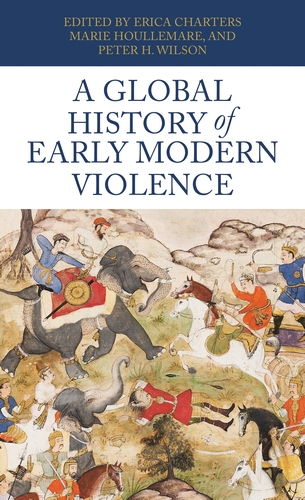
A new book on A Global History of Early Modern Violence, edited by Erica Charters, Marie Houllemare, and Peter H. Wilson, has been published by Manchester University Press.
The book description at Manchester University Press’s website reads: “This is the first extensive analysis of large-scale violence and the methods of its restraint in the early modern world. Using examples from Asia, Africa, the Americas and Europe, it questions the established narrative that violence was only curbed through the rise of western-style nation states and civil societies. Global history allows us to reframe and challenge traditional models for the history of violence and to rethink categories and units of analysis through comparisons. By decentring Europe and exploring alternative patterns of violence, the contributors to this volume articulate the significance of violence in narratives of state- and empire-building, as well as in their failure and decline, while also providing new means of tracing the transition from the early modern to modernity.”
This collective volume grew out of a conference on early modern violence at All Souls College, Oxford University in the summer of 2017.
I was pleased to have the opportunity to participate in the conference and to publish a chapter in the collective volume.
My essay in the volume is: Brian Sandberg, “Ravages and Depredations: Raiding War and Globalization in the Early Modern World,” in A Global History of Early Modern Violence, ed. Erica Charters, Marie Houllemare, and Peter H. Wilson (Manchester: Manchester University Press, 2020), 88-102.
An international conference on Centering Race in History: Antiquity to the Present was held online last week, co-sponsored by the Department of History and Civilization of the European University Institute, the International Centre on Racism at Edge Hill University, and Monitor Racism magazine.
The conference offered longue durée and comparative perspectives on the history of race and racism from antiquity to today. Presentations explored the history of race in ancient, medieval, early modern, modern, and contemporary contexts.
I was pleased to participate in the conference and to give a research presentation on race, violence, and slavery in the early modern Mediterranean world in a session on Early Modern Europe. My presentation, entitled “Against ‘Barbarous Dogs’ and ‘Rascals’: Race, Religion, and Empire in the Early Modern Mediterranean World,” focused on French and Francophone sources on race and violence in the early modern Mediterranean. All of the papers in the session worked well together and produced an interesting discussion.
I thought that the entire conference was very stimulating and produced some intriguing interchanges in some of the sessions.
The Centering Race in History conference program is available on the Monitor Racismwebsite.
The Center for Renaissance Studies at the Newberry Library recently launched a new online resource for transcriptions and translations of early modern sources.
Northern Illinois University students in HIST 420 The Renaissance and HIST 422 Early Modern Europe will be interested in this resource.
Here is the announcement from the Center for Renaissance Studies:
CRS is pleased to promote an exciting resource for instructors of French or Spanish languages, early American history, or Native American and Indigenous studies.
Newberry Transcribe, the Newberry’s interactive transcription resource, has recently added hundreds of pages of pre-1800 French, Spanish, and English-language manuscripts for crowdsourced transcription and translation, all of which are ideal for the classroom. These resources present excellent opportunities for instructors to introduce digital humanities into the classroom, and for students to work with primary sources and experience authentic tasks. To view the documents, select “pre-1800” in the “Select a Decade” dropdown menu on the Newberry Transcribe homepage, or copy and paste this link: https://publications.newberry.org/transcribe/#/?date=1799
If you have any questions about the site, or if you would like a Newberry subject specialist and/or digital librarian to make a virtual visit to your class, send an email to renaissance@newberry.org or contact the Newberry’s Digital Initiatives and Services department at dis@newberry.org.
A new Netflix series, entitled Barbarians, depicts warfare between the Roman Empire and Germanic peoples, culminating in the Battle of Teutoburg Forest.
According to The New York Times, “German nationalists, including the Nazis, have used the battle as an ideological rallying point — a supposed foundational moment for German civilization and proof of their superior pedigree and fighting skills. To this day, the battle, and the tribes’ leader in the fight, Arminius, remain sources of inspiration for far-right extremists, who regularly make pilgrimages to related sites.”
The filmmakers claim that Barbarians counters far-right depictions of German history and offers a different perspective on ancient history. The New York Times reports that “Arne Nolting, a writer and showrunner of the series, explained via Zoom last week that part of his inspiration for making a show about the Battle of Teutoburg Forest was a desire to reclaim a pivotal moment in European history from the far right. ‘We didn’t want to be scared away and leave the subject to those forces we detest,’ he said.”
The battle of Teutoburg Forest and the history of the ancient Germanic peoples have been repeatedly politicized and used by different political movements in modern Germany. Historians who study German Nationalism, Unification, and Nazism have demonstrated the close connections between political ideologies and historical narratives in German history. The New York Times recounts that “The battle has been a political flash point since the 19th century, when modern-day Germany was a fractured mosaic of smaller states. Nationalists embraced Arminius as a symbol of German identity in their push for unification. In 1875, four years after the German Empire’s founding, officials unveiled a colossal statue of Arminius in the Teutoburg Forest.”
The Nazis thoroughly repackaged ancient, medieval, early modern, and modern history—creating a powerful and dangerous narrative of Germanic purity and eventual dominance in the face of supposed contamination and betrayal. The New York Times emphasizes that “Under the Third Reich, the Nazi ideologue Alfred Rosenberg depicted Arminius as part of a ‘line of German ancestry’ leading to Adolf Hitler, and schoolbooks of the period claimed that he had saved ‘the purity of German blood.'”
The echoes of the Nazi narrative of German history can be seen in modern far-right movements’ depictions of Germany and its history. The New York Times reports that “In 2009, the far-right extremist National Democratic Party of Germany organized a “remembrance march” commemorating the battle, under the slogan ‘2,000 years of fighting against foreign infiltration.'”
It will interesting to see how the German public, historians, and international film critics respond to Barbarians.
The New York Times has already published a report on Barbarians. The new Netflix seriescoincides with an exhibition on “The Germanic Tribes” at the James Simon Gallery on the Museum Island in Berlin.
Northern Illinois University students in HIST 110 History of the Western World I and HIST 390 Film and History will be interested in this article and in the new series.
The European University Institute in Fiesole, Italy, is offering fully funded doctoral fellowships for students wishing to pursue Ph.D. studies in European history.
The European University Institute (EUI) is located on a majestic hill overlooking Firenze (Florence), Italy, an inspiring historic setting for studying medieval, Renaissance, and early modern history. The EUI is a major higher education institution of the European Union, with professors, postdoctoral fellows, and graduate students from all EU member states.
I held a Jean Monnet Postdoctoral Fellowship in the Department of History and Civilization at the European University Institute after completing my Ph.D. dissertation and I can highly recommend the History program at the EUI.
Here is the European University Institute’s announcement:
The call for applications for the European University Institute fully-funded four-year Ph.D. programme will be launched on 1 November 2020. The EUI Department of History and Civilization offers exceptional opportunities to study global connections within early modern and modern European history.
We are also organising a series of live interactive webinars in which prospective applicants will be able to find out more about the History and Civilization Ph.D. programme, by talking directly to our faculty and researchers. After a short introduction to the EUI and the Department, participants will be able to discuss and ask questions regarding the Ph.D., life at the EUI, living in Florence and more.
29 October at 11:00 CET with Professors Giorgio Riello and Lucy Riall (in English and Italian)
4 Novemberat 15:00 CET with Professor Regina Grafe(in Spanish and English)
25 Novemberat 15:00 CET with Professor Glenda Sluga(in Polish and English)
14 December at 15:00 CET with Professors Giancarlo Casale, Pieter M. Judson and Corinna Unger (in English and German)
Contact For any questions about the webinar series, please contact Fabrizio Borchi, fabrizio.borchi@eui.eu
For any questions about the doctoralprogramme, grants, requirements, and/or application and selection procedures, please contact the EUI Admissions Office,applyres@eui.eu.
A new online resource for Islamic art history has just been launched online.
Northern Illinois University students in my HIST 110 History of the Western World I course are studying the expansion of Islam at this point in the semester and may want to explore this new online resource. Other NIU students in my upper-division course, HIST 422 Early Modern Europe, may find useful visual sources through this platform.
I also teach an upper-division course on HIST 458 Mediterranean World, 1450-1750and graduate seminars on Early Globalization, and Religious Violence in Comparative Perspective, and this resource will certainly help support the teaching of those courses.
Here is the announcement from Khamseen: Islamic Art History Online:
New Resource: Khamseen: Islamic Art History Online
Announcing the launch of the Khamseen: Islamic Art History Online website, accessible here on October 20th, 2020. Khamseen: Islamic Art History Online is a free and open-access online platform of digital resources to aid the teaching of Islamic art, architecture, and visual culture. It is sponsored by the Digital Islamic Studies Curriculum (DISC) at the University of Michigan through the support of The Andrew W. Mellon Foundation.
Khamseen currently offers a collection of short-form video presentations on a range of topics in the scholarly discipline of Islamic art history. These presentations are intended to support educators, particularly those who face limited access to institutional and archival resources, and to bring new voices, perspectives, methodologies, artworks, and objects into classrooms. Besides catering to undergraduate and graduate students, the materials provided here are also intended to help educate and inspire interested audiences outside of academia. Through this platform, we seek to take the study of Islamic art out to the world, reaching a truly international level of engagement and learning thanks to the possibilities of integrated digital technologies.
The Center for Renaissance Studies at the Newberry Library is hosting a virtual discussion of scientific instruments and scientific knowledge in the Renaissance.
Here is the announcement from the Center for Renaissance Studies:
Astrolabes and Armillary Spheres:
Scientific Instruments and Prints in the Renaissance
Susan Dackerman (Stanford University) and Pedro Raposo (Adler Planetarium)
Friday, October 30, 2020 12-1 pm CDT
During the Renaissance, the development of new scientific tools and their promotion through print media altered navigation, inspired exploration, and enabled European colonialism.
In this virtual conversation, Renaissance print scholar Susan Dackerman (Stanford University) and historian of science Pedro Raposo (Adler Planetarium) will discuss the workings of early modern scientific instruments and their depiction on paper. Our new exhibition on Renaissance invention features sixteenth and seventeenth-century loans from the Adler Planetarium including an intricate German clock, a shipwrecked Portuguese mariner’s astrolabe, and a movable model of the Ptolemaic cosmos known as an armillary sphere.
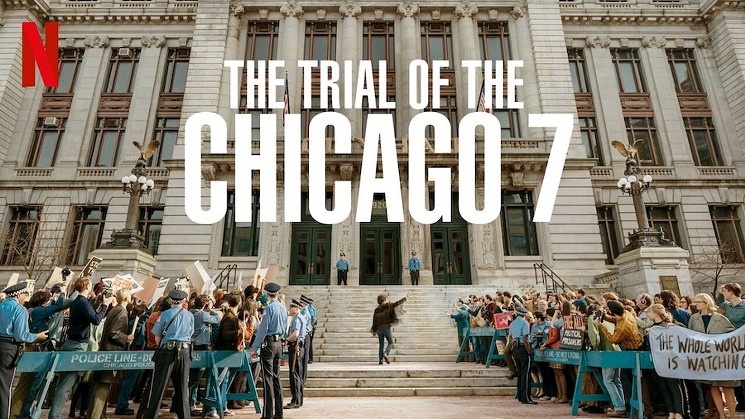
I saw the new Aaron Sorkin film, The Trial of the Chicago 7, on Netflix over the weekend and would like to recommend the film to any students interested in historical film.
Photo: Promotional poster for The Trial of the Chicago 7.
I periodically teach HIST 390 History and Film at Northern Illinois University on the theme of War in Film, and the course includes a section on the Vietnam War in film and television. The Department of History at Northern Illinois regularly offers HIST 390 History and Film, taught by different professors on various themes.
There are lots of reviews, articles, and interviews about The Trial of the Chicago 7 already available online. NPR’s Fresh Air reviewed the film this weekend. Esquire published an article on the historical background. Mashable has an article on separating fact from fiction in the film.
Photo: Anti-War protesters confronting the Chicago Police in The Trial of the Chicago 7.
Northern Illinois University students will be interested in some of the local connections with the Anti-War Protests, the 1968 Chicago National Convention, and the Trial of the Chicago Seven.
The 125 Key Moments website at Northern Illinois University provides an account of an anti-war protest on campus in 1969.
The website also discusses the May 1970 anti-war protests at Northern Illinois University in the wake of the Kent State Massacre.
I can suggest a local response to The Trial of the Chicago 7, written by Marjorie Fritz-Birch, whose mother served as a juror in the trial of the Chicago Seven. The article indicates that “Fritz-Birch, then an anti-war college student, attended an appearance of Chicago Seven defendant Rennie Davis at Northern Illinois University.”
Photo: Courtroom scene from The Trial of the Chicago 7.
John H. Collins (Professor of History, Northern Illinois University) wrote a letter to the editors of The New York Times in 1970, in response to the expected convictions of the Chicago Seven defendants (which came two days later on 18 February 1970).
Here is the text of Collins’s letter:
Fate has presented President Nixon with a magnificent opportunity. With a stroke of the pen he can defuse the student revolt, pre‐empt the most effective arguments of the New Left and destroy the plausibility of charges of proto‐fascism now openly leveled at his Administration.
To Pardon the ‘Seven’
To the Editor:
He can do all this without any sacrifice of his own principles. Let him issue full and free pardons to the “Chicago Seven” and their lawyers. The offenses are Federal offenses.
For months these men have displayed themselves before the American public in all their honorable idealism and indignation, and in all their calculated contumacity, fanaticism and vulgarity. They no longer represent, if they ever did, that clear and present danger which alone could justify their suppression.
In jail they will be martyrs, fueling the militant protest, serving as exhibit “A” in every radical propagandist’s case. Pardoned they will stand, in the words of Jefferson, as monuments to the safety with which error of opinion may be tolerated so long as reason is left free to combat it.
Will Mr. Nixon seize this chance? Or will he wait until “Free the Seven” demonstrations have been mounted all over the country, and his hands are tied by the political necessity of not seeming to yield to organized pressure?
JOHN H. COLLINS Professor of History Northern Illinois University DeKalb, III., Feb. 16, 1970
Numerous interviews with the main protagonists of the Chicago Seven trial are available, especially from the anniversary commemorations of the 1968 Riots at the Democratic National Convention. I can signal a POV interview with Tom Hayden and a Media Burn interview with Abbie Hoffman.
A number of French academic societies have issued statements condemning the killing of Samuel Paty, a history teacher who was brutally murdered by an Islamist militant on Friday.
Paty was apparently targeted for showing cartoons of Muhammad, which had been published by the controversial satirical magazine Charlie Hebdo, to his students in a class on freedom of speech at the collège (middle school) where he taught history and geography.
Flowers left in memory of Samuel Paty at the school where he taught, collège du Bois d’Aulne at Conflans-Sainte-Honorine. Photo: Reuters.
The Société des Professeurs d’Histoire Ancienne de l’Université, Société des Historiens Médiévistes de l’Enseignement Supérieur Public, Association des Historiens Modernistes des Universités françaises, and the Association des Historiens Contemporanéistes de l’Enseignement Supérieur et de la Recherche have issued a joint statement condemning the attack on Samuel Paty:
Les quatre Sociétés d’enseignant·es historien·nes du Supérieur (SoPHAU, SHMESP, AHMUF, AHCESR) expriment toute l’horreur qu’elles ressentent après l’assassinat de leur collègue professeur dans un collège de Conflans Sainte-Honorine. Cet acte de fanatisme fait tragiquement mesurer tout le prix que doivent attacher l’Etat et la société française à l’enseignement des savoirs critiques. Nous exprimons aux proches, aux collègues et aux élèves du professeur défunt nos condoléances. Plus largement, nous adressons un message de soutien à nos collègues enseignants du primaire et du secondaire, premiers acteurs de la transmission des principes de la laïcité, premiers engagés sur le terrain de la diffusion des connaissances et premiers exposés aux ravages de l’obscurantisme. Nous exprimons notre détermination à ne rien céder, à leurs côtés, dans ce combat fondamental pour la défense de la liberté d’expression et de la tolérance.
Sylvie Pittia, Présidente de la Société des Professeurs d’Histoire Ancienne de l’Université
Dominique Valérian, Président de la Société des Historiens Médiévistes de l’Enseignement Supérieur Public
Nicolas Le Roux, Président de l’Association des Historiens Modernistes des Universités françaises
Clément Thibaud, Président de l’Association des Historiens Contemporanéistes de l’Enseignement Supérieur et de la Recherche
In the wake of the horrific murder of history teacher Samuel Paty, historians are grappling with how to teach students and the public about the history of violence in France.
Paty taught history and geography at a collège (middle school) in a suburb near Paris and was killed in a brutal knife attack by a militant on Friday.
Photo: History teacher Samuel Paty.
Professor Jean-Clément Martin (Professeur émérite d’Histoire, Université Paris 1, and Ancien directeur de l’Institut d’Histoire de la Révolution Française) has written an essay dedicated to Samuel Paty on the complexities of teaching the many violent episodes in French history.
Martin observes that “La mort abominable est un choc pour la communauté nationale. Pour la communauté des enseignants d’histoire elle a une dimension particulière : parce que notre collègue a été tué pour avoir présenté des caricatures et avoir appelé à la liberté d’opinion à propos de croyances et de violences, nous nous devons, nous lui devons, de réfléchir ensemble sur la façon dont nous enseignons les épisodes violents de l’histoire de France.”
Martin calls for a “rélexion pédagogique sur ces événements sans recourir aux idéologies et aux polémiques. …”
The politicization of some of the massive protests over the weekend in remembrance of Samuel Paty disturbed some observers. Martin notes “mon insatisfaction devant les hommages qui ont été rendus hier dans le pays.”
Martin criticizes those who seek to defend French values of freedom of speech by presenting a sanitized version of French history as a bastion of freedom and non-violent toleration. He argues that “il faut alors abandonner des idées convenues, en commençant par ne pas dire que la France est le pays des Lumières ou des Droits de l’homme. …”
The appropriate response, according to Martin, is to engage in a reflection on the long history of violence within France, from the Saint Bartholomew’s Day Massacre in 1572, to the September Massacres of 1792, to the execution of Louis XVI, to the Vendée Civil War, and beyond. Martin is a historian who published extensively on the French Revolution and the Vendée Civil War, so his examples naturally focus on the period of the French Revolutionary Wars.
In the face of violence, Martin presents a defense of historical methodology: “Revenons aux fondamentaux de l’enseignement de l’histoire, établir les faits, refuser les idées reçues et participer aux combats pour la vérité historique, qui ce qu’elle est, fragile, modeste mais fondée sur l’essentiel : la libre discussion en pratiquant le recours à la logique et à la vérification, le respect des opinions en exigeant leur totale transparence.“
He concludes: “C’est pour avoir exercé cette tâche souvent si mal comprise que Samuel Paty est mort, c’est en continuant cette pratique que nous lui rendrons justice et que nous pourrons garantir notre propre existence.”
Jean-Clément Martin’s essay is published online at Mediapart.





 Brian Sandberg: Historical Perspectives