Early Modern Domestic Space

A lecture on “Illuminating Early Modern Domestic Spaces”

by

Professor Ann Smart Martin

Stanley and Polly Stone Professor

Director, Material Culture Program and Department of Art History

University of Wisconsin, Madison

Wednesday, April 9, 2014 at 5:30 PM

DePaul Art Museum

935 W. Fullerton Ave.

Chicago, Illinois

(just west of the Red Line stop at Fullerton)

Professor Martin specializes in American material culture and early American decorative arts.  Her publications include Buying into the World of Goods: Early Consumers in Backcountry Virginia (Baltimore: Johns Hopkins University Press, 2008) and American Material Culture: The Shape of the Field (Knoxville: University of Tennessee Press, 1997), co-edited with J. Ritchie Garrison.

For more information, please contact Prof. Paul Jaskot at pjaskot@depaul.edu

Posted in Art History, Early Modern Europe, Early Modern World, Lectures and Seminars, Renaissance Art and History | Leave a comment

Wreckage, Waste, and Globalization

The continuing search for Malaysian Airlines flight MH370 is complicated by the immense size of the search area and its distance from sea lanes and major ports, as well as the nature of the Indian Ocean.

IndianOcean-waste

The currents and turbulence of the Indian Ocean presents challenges in sighting and tracking potential aircraft wreckage. Satellite photos showing possible pieces of an airplane could be instead showing flotsam from previous wrecks and storms, or simply waste produced by globalization and circulated through transoceanic currents.

SearchVectors

According to the BBC, “the satellite photos [of potential objects] cover a zone where the Indian Ocean meets the Southern Ocean, encircling Antarctica. There is a risk … that waste in this area could have come from any of the world’s major oceans – all of which border Antarctica. In that case, the flecks in the pictures may just be the floating detritus of globalisation, such as some of the thousands of shipping containers thought to be lost at sea every year.”


The frustrating search for the missing Malaysian Airlines aircraft highlights the growing problems of the globalization of waste and marine debris. Plastic pollution is perhaps the best known type of marine debris, due to scientific research and frequent media reports on the “Great Pacific Garbage Patch.”

NOAA-marinedebris

Environmental historians, maritime historians, marine archaeologists, and historians of globalization have been working on tracing the historical development of pollution, wreckage, and waste in the world’s seas and oceans over the past several centuries.

The BBC reports on the continuing search. See NOAA’s website on the “Great Pacific Garbage Patch,” and its project on Marine Debris.


Posted in Globalization, Information Management, Maritime History, Mediterranean World | Leave a comment

When Robots Can Kill

Robotic technology is advancing rapidly, raising questions about decision-making processes in shooting to kill.

TalonMAARS

Although robotics have many applications, much of the research on robots is funded by military services and defense contractors. This raises serious ethical questions for university researchers working on robotics projects, especially as tracking and firing systems become automatic.

Peter Singer (Brookings Institute) argues: “Too often scientists try and kid themselves. … [They] act like just because I work on this system that is not directly a weapon system I have nothing to do with war.” Singer is the author of Wired for War: The Robotics Revolution and Conflict in the 21st Century (Penguin, 2009).

The robotics technologies are new, but many of the ethical questions of distance, target identification, and decision-making in the act of killing have long histories. For one perspective on such questions, see Paul Virilio, War and Cinema: The Logistics of Perception (London: Verso, 1989).

NPR reports on military robots and robotics competitions.

Posted in Arms Control, History of Science, History of Violence, Laws of War, War, Culture, and Society | Leave a comment

Museum Summer Internships

The Missouri History Museum is accepting applications from students who are interested in oral history internships (paid positions) with our Exhibitions and Research department. Two interns will be selected and will report to the Director of Exhibitions and Research.

The Missouri History Museum is developing a new space devoted to first-hand accounts of our area’s history. A major feature of The Story Center, which will open in 2016, is a theater that will be used to play films created from excerpts of longer oral histories. During the first year, a series of films will be created called “Show Me Stories.” These films will feature stories from a wide range of fascinating people. To help create these films, we need two interns capable of both conducting long-form interviews and editing those interviews into shorter presentations that will be engaging for a wide audience. These interns will help identify potential interviewees, will conduct interviews along with a videographer, and will work with the videographer and other staff to edit excerpts of the interviews into completed films. Each intern will conduct at least six oral histories over the course of the summer and will create at least two films based on these interviews.

The work schedule is flexible, with hours typically between 9:00 a.m. and 5:00 p.m., Monday through Friday. A minimum of 25 hours of work per week is required. This internship will run from May to August 2014, and the final schedule will be determined with the supervisor.

Undergraduate and graduate student will be considered.  The ideal candidate will major in American Studies, History, Communication, Journalism, or other related fields. Candidates for the position should have both interviewing and editing experience

The Missouri History Museum is a nonprofit organization dedicated to deepening the understanding of past choices, present circumstances and future possibilities; strengthening the bond of community and facilitating solutions to common problems.

To apply, the applicant must provide a cover letter, and the completed intern application found at http://www.mohistory.org/employment. Please submit these documents by email, as well as writing samples of your work, and references to:

Vicki Kaffenberger, Director of Volunteer and Interns Services

vak@mohistory.org

For more information, see H-Net.


Posted in Jobs and Positions, Museums and Historical Memory, Undergraduate Work in History | Leave a comment

Undergraduate Research at NIU

The 5th annual Undergraduate Research and Artistry Day at Northern Illinois University will be held on Tuesday, April 22, 2014 in Holmes Student Center, Duke Ellington Ballroom from 9:00am-3:30pm.

Any undergraduate student who has participated in a faculty-mentored research or artistry project is eligible to showcase his/her work at the fifth annual Undergraduate Research and Artistry Day.  This includes independent study, capstone projects, URAP, EURA, UARAP, USOAR, URA, SROP, Research Rookies or any other related research/artistry projects. Undergraduate students include currently enrolled NIU undergraduates and community college students planning to transfer to NIU.

Prizes will be awarded in two categories (STEM & SSHA).

In addition, one research advisor/mentor will be honored with the Faculty Mentor of the Year award.

Online registration opens Monday, January 13, 2014.  Abstracts (250 words or less) are due by Friday, March 7, 2014.

Two poster design workshops will be held to assist students with designing their posters for the day. These will be held on Tuesday, March 4th from 1:00 – 2:00 p.m., and Wednesday, March 26th from 10:00 – 11:00 a.m. in the Holmes Student Center, room 305.

NIU majors and minors in History have usually done multiple research papers based on archival, printed, and/or historiographical sources. History students should consider submitting a paper for consideration in the Undergraduate Research and Artistry Day competition.

Posted in Archival Research, Lectures and Seminars, Northern Illinois University, Undergraduate Work in History | Leave a comment

Rising Cost of Not Attending College

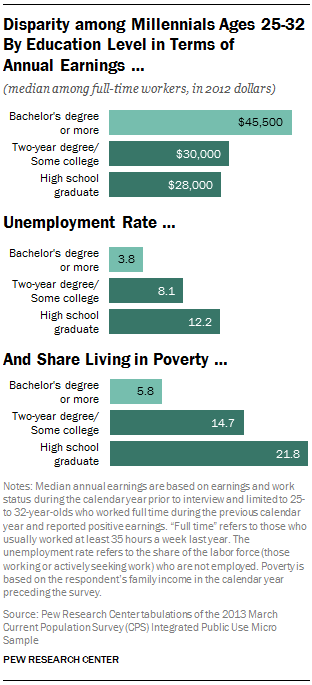
A new research survey by the Pew Research Center demonstrates the rising costs of not attending college. “On virtually every measure of economic well-being and career attainment—from personal earnings to job satisfaction to the share employed full time—young college graduates are outperforming their peers with less education.”

Pew-RisingCost

This may sound surprising to Americans who regularly follow news media in the United States. Popular news organizations, spurred by conservative politicians and right-wing radio shows, have been repeatedly questioning the value of higher education. Numerous articles on the rising cost of college tuition have been published in print and online newspapers and magazines over the past year or so.

According to the Pew Research Center, “the economic analysis finds that Millennial college graduates ages 25 to 32 who are working full time earn more annually—about $17,500 more—than employed young adults holding only a high school diploma.”

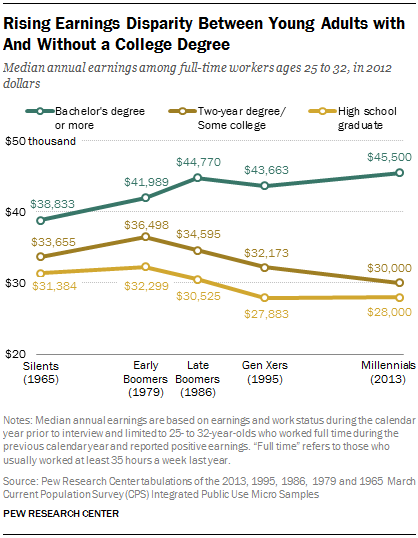
The Pew findings also indicate a growing gap between those with and without a college degree:

RisingEarnings

Also, note that despite the Obama Administration’s continual championing of community colleges, that there is little difference in the salaries of high school and community college graduates.

See the Pew Research Center website for additional findings from this survey.

Posted in Careers in History, Education Policy, Humanities Education, Undergraduate Work in History | Leave a comment

The Ethics of War

The Ethics of War

briansandberg's avatarCluster for the Study of Religious Violence

War is often perceived as completely unethical, yet the people who engage in warfare always have ethical systems and cultural frameworks that shape their military practices and individual behaviors.

Classic texts on warfare from Thucydides to Clausewitz grapple with ethical issues, and many modern historians of war, culture, and society raise ethical questions in their work.

GeneralLatiff-classroom

The New York Times has published an article showcasing Professor Robert H. Latiff’s Philosophy course on the “The Ethics of Emerging Weapons Technologies,” at the University of Notre Dame. Latiff was a major general in the United States Air Force who retired in 2006. The Notre Dame website indicates that Latiff earned a Ph.D. in Material Science at the University of Notre Dame and is currently teaching there as an Adjunct Professor at the Reilly Center for Science, Technology, and Values.

According to the New York Times, “Dr. Latiff has written forcefully of his…

View original post 104 more words

Posted in Uncategorized | Leave a comment

Pre-doctoral Position in Policy Studies

Pre-doctoral Position in Policy Studies

briansandberg's avatarCluster for the Study of Religious Violence

Pre-Doctoral Research Fellowship
Foreign Policy Program

The Foreign Policy Program at the Brookings Institution invites applications for the award of one or two full-time resident fellowships for policy-oriented doctoral research for the 2014-2015 academic year. The fellowships are designed for candidates whose dissertation topics and career goals are directly related to the major interests of the Foreign Policy program: war and peace issues; shifting power balances; global order and human security. Awards will go to individuals whose research are near completion and will benefit from access to Foreign Policy scholars and the Washington policy-making community afforded by the Brookings Institution’s location in the nation’s capital.

Program Information

Pre-Doctoral Research Fellows are invited to participate in conferences and seminars hosted by Brookings during their stay and will have access to the research resources available to resident staff members. Pre-Doctoral Research Fellows are also encouraged to present their work-in-progress to Brookings scholars…

View original post 280 more words

Posted in Graduate Work in History, Grants and Fellowships, Jobs and Positions, Strategy and International Politics, War, Culture, and Society | Tagged | Leave a comment

High School History Teacher Position

History Teacher – Part-Time – High School

The University of Chicago

About The Unit: The Laboratory Schools is among the largest independent schools in the country with a history dating to 1896 under the auspices of John Dewey and the University of Chicago. Located on the U of C campus, the Schools serve children (N-12) from metropolitan Chicago with approximately 60% of the students coming from families affiliated with the University. The University environment attracts a rich and diverse student body and parents who value and support a quality educational program.

Unit Job Summary: The History Department is responsible for the history education of students in grades 9 – 12. The courses taught by the History Department include African-American, American, Early World, European, Modern World, World History, and several quarter long elective classes. The History Department is seeking an individual with a preferred background in Modern European History, Modern and Early World History but who is also willing to teach in other areas of History and the Social Sciences. The individual will work alone in his or her courses and also will collaborate with other members of the History Department, members of other departments, and faculty of the University at large.

Teachers are expected to work the required number of days as stipulate din the Faculty Association contract and the required number of days as stipulated in the Faculty Association contract. All teachers are expected to perform in accordance with the terms and conditions of the Collective Bargaining Agreement.

Anticipated start date for this position is 9/1/2014. To be considered for this position, please apply on or before February 28, 2014 by Noon.

Unit Education: Bachelor’s degree required, preferably in History or closely related field.

Master’s degree in History preferred.

Unit Experience: Two years of teaching experience preferred.
Experience teaching Modern European History and Modern and Early World History preferred.

Unit Job Function Competencies: Knowledge of instructional methodologies required.
Ability to develop curricula, lesson plans and assessment tools required.
Analytical skills required.
Problem-solving skills required.
Decision-making skills required.
Attention to detail required.
Organizational skills required.
Computational skills required.
Creativity required.
Flexibility required.
Verbal and written communication skills
Interpersonal skills required.
Ability to work independently and as part of a team required.
Ability to manage stressful situations required.
Ability to maintain confidentiality required.
Ability to work on multiple projects simultaneously, set priorities, and meet deadlines required.
Ability to maintain up-to-date teaching techniques to provide students required.
Lifelong learner preferred.

Individual whose principal teaching style is the student inquiry approach and student-led discussion preferred.

For the job listing see Inside Higher Ed online. Recent BAs and MAs in History from Northern Illinois University may be interested in applying for this position.

Posted in Careers in History, Graduate Work in History, Jobs and Positions, Northern Illinois University, Undergraduate Work in History | Leave a comment

Study Abroad Funding

briansandberg's avatarCluster for the Study of Religious Violence

Northern Illinois University’s Study Abroad Office is holding a meeting to assist students in finding funding to support their international studies.

“How to Find Money to Study Abroad”

Thursday, February 7th

5-6 p.m.

DuSable 206

For additional information, see the NIU Study Abroad website.

There are several options for earn History credit through NIU Study Abroad Programs.


View original post

Posted in Graduate Work in History, Grants and Fellowships, Northern Illinois University, Undergraduate Work in History | Leave a comment