Early Modern Religious Orders

The Newberry Library in Chicago hosted a conference on Early Modern Religious: Comparative Contexts this weekend.

JeromeEpistola

The conference offered comparative perspectives on monks, friars, nuns, and lay people who were involved in Catholic religious orders in early modern European, Mediterranean, Latin American, Asian, and Oceanian contexts. The conference participants emphasized that the history of religious orders needs to involve gendered perspectives that compare monks’ and nuns’ experiences. A number of the papers also stressed viewing cloisters as having permeable boundaries that allowed for many forms of interaction between religious communities and lay communities in the outside world.

Barbara Diefendorf and Megan Armstrong presented fascinating papers on early modern French Capuchins and Franciscans in southern France and the Mediterranean.

The conference program is available online at the Newberry Library website.

Posted in Conferences, Early Modern Europe, Early Modern World, European History, European Wars of Religion, French History, Mediterranean World, Reformation History, Religious History, Renaissance Art and History, Women and Gender History | Leave a comment

Sexual Violence in the U.S. Armed Forces

Sexual violence in the United States Armed Forces has become a major problem. Numerous studies and public scandals have highlighted incidents of rape and sexual harassment, which have often gone unpunished.

Women who report sexual harassment and rape claim that they are often ignored or marginalized by their commanders.

women-vets-assault1

NPR reports on the culture of impunity for rapists in the U.S. military.

Students and scholars working on gender and violence issues and on women and warfare will be interested in this report and related stories.

Posted in Gender and Warfare, History of Violence, Human Rights, War, Culture, and Society, Women and Gender History | Leave a comment

Massive Spending Cuts on Higher Education

State governments across the U.S. have made massive spending cuts on higher education since the financial crisis of 2008.

HigherEdSpendingCuts

The spending cuts by states are one of the key reasons for increasing tuition rates at  American public universities. Other factors certainly play a role in tuition hikes, but the de-funding of public education by state governments forces public universities either to slash services or to raise tuition.

Jordan Weissmann reports on the spending cuts to higher education in an article in The Atlantic.

Posted in Education Policy, Humanities Education | Leave a comment

10th Anniversary of the Invasion of Iraq

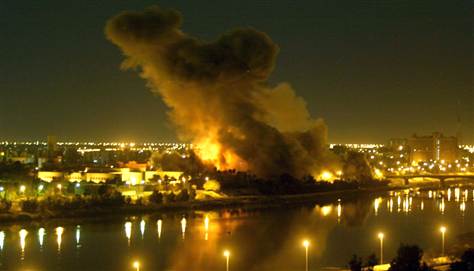
This week marks the 10th anniversary of the U.S. invasion of Iraq and the beginning of the Iraq War (2003-2011).

Baghdad-bombing2003

The BBC has published a special report on “Iraq: 10 Years On.”  Le Monde offers a video documentary on the anniversary.  Al Jazeera provides extensive reporting on the 10th anniversary of the beginning of the Iraq War.

NPR reports on comparisons between the historical memories of Vietnam War and the Iraq War.

The New York Times offers a series of op-eds reflecting on the meaning of the invasion and the prolonged Iraq War that followed. John A. Nagl’s op-ed, entitled “What America Learned in Iraq,” provides a military perspective from the officer (now retired) who authored the United States Army’s counter-insurgency policy.

The Iraqi people continue to suffer from civil violence and it can be argued that the Iraq War is still ongoing today. The Iraq Body Count project continues to monitor reports of attacks in Iraq and to record fatalities on its website.

Students of the history of war, culture, and society will be interested in the extensive flood of publications surrounding the 10th anniversary of the outbreak of the Iraq War. Graduate students working on issues of historical memory will want to explore the cultural processes of commemorating the Iraq War.


Posted in History of Violence, Museums and Historical Memory, Strategy and International Politics, War, Culture, and Society | Leave a comment

Jane Goodall Plagiarism Accusations

World-famous primatologist Jane Goodall has been accused of committing plagiarism in her new book, Seeds of Hope: Wisdom and Wonder From the World of Plants.

Goodall’s book apparently uses passages from various internet sites, including Wikipedia, without quotations or attribution.

Goodall is the latest celebrity author to be accused of plagiarism, following the incidents by Fareed Zacharia, Doris Kearns Goodwin, and Stephen Ambrose. Plagiarism cases vary, ranging from sloppy miscitations to careless appropriations to deliberate lifting of entire passages.

It is not yet clear how serious the Goodall case really is.  Also, Goodall has reportedly collaborated with Gail Hudson, a freelance editor, in the writing of this book and some of her other works.

A Washington Post report by Steven Levingston, the non-fiction book editor at the paper, makes the accusations against Goodall.

Posted in Academic Publishing, History of Science, Writing Methods | Leave a comment

Women Already in Combat

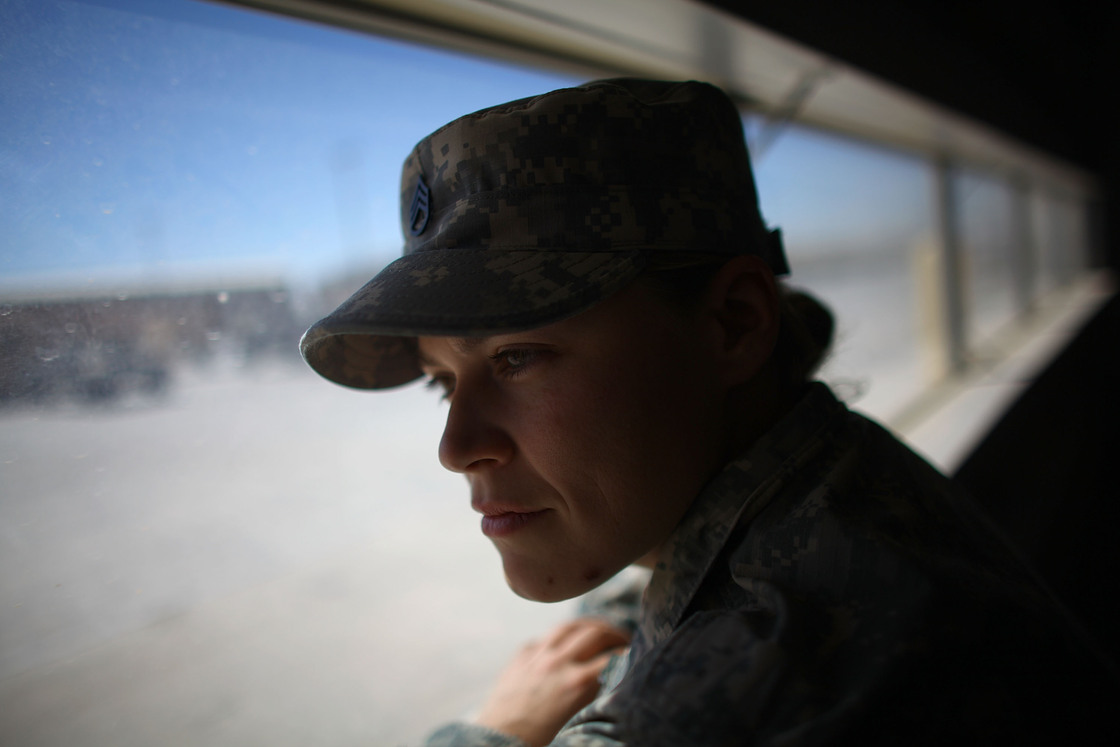
American women are already serving in combat. Although news analysts and commentators continue to debate the merits of placing women in combat roles, many women soldiers and veterans have been dealing with the realities of combat duty for quite some time.

women_fet5

The recent change in U.S. Department of Defense policy now allows women to participate fully in combat missions, effectively approving the existing situation for a number of women serving in the Iraq War and Afghan War over the past decade. One of the rationales for changing the policy was to provide service women with equal access to combat pay and benefits.

NPR reports on the experiences of American women in combat. The New York Times offers accounts of American servicewomen whose careers were affected by the previous ban on women in combat.

Posted in Gender and Warfare, History of Violence, Human Rights, Strategy and International Politics, War, Culture, and Society, Women and Gender History | 2 Comments

Overhyping MOOCs

Education media is abuzz with news about MOOCs (Massive Open Online Courses). The Chronicle of Higher Education has repeatedly touted the supposed benefits of MOOCs in successive stories for several years now, as have other education and technology publications online.  The mainstream television and radio media have now picked up on Coursera’s rapid expansion.

Rarely do any of these media outlets examine the content of MOOCs critically. Instead, they routinely present any criticism of MOOC courses as resulting from professorial conservatism or technological ignorance.

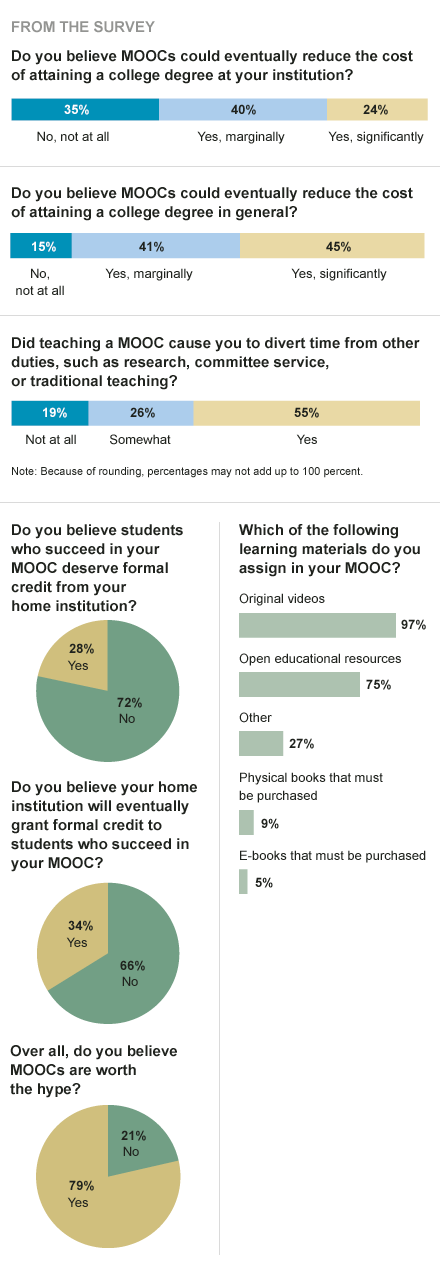
The Chronicle of Higher Education has just published an article based on their survey of 103 professors who actually teach MOOCs. The online survey asked 184 MOOC professors (103 responded) a series of questions about their courses and instructional methods.

The most stunning finding of the survey was that 72 percent of MOOC professors believed that the students who passed their courses did not deserved credit at their own colleges and universities.

MOOCsurvey-credit

Unsurprisingly, the Chronicle of Higher Education buries this key finding toward the end of the article. “As far as awarding formal credit is concerned, most professors do not think their MOOCs are ready for prime time. Asked if students who succeed in their MOOCs deserve to get course credit from their home institutions, 72 percent said no.” Considering that the survey only questioned active MOOC professors who are proponents of online courses, this is a telling sign of the serious limitations of MOOCs within American university education.

The survey also shows that “the average pass rate was 7.5 percent”—a miserable completion rate that would not be acceptable on any college or university campus. The Chronicle of Higher Education places this statistic in a section on “Cutting College Costs,” implying that MOOCs have a potential to significantly reduce tuition costs and transform the United States higher-education system.
MOOCsurvey

Another intriguing result from the survey was that “Professors who responded to The Chronicle survey reported a variety of motivations for diving into MOOCs. The most frequently cited reason was altruism—a desire to increase access to higher education worldwide.”

The global aspirations of many of the MOOC professors clash with the U.S. media’s presentation of the supposed benefits of MOOCs for American undergraduate students. The majority of MOOC courses offer practical (and basic) education in science, mathematics, and engineering, which may be more useful to individuals around the world who are living in areas that lack fully developed higher-education systems.

I would argue that the Chronicle of Higher Education and other educational media are overhyping the potential of MOOCs and greatly exaggerating their relevance for American undergraduate students.

See the full story at the Chronicle of Higher Education online.

Posted in Digital Humanities, Education Policy, Globalization, Humanities Education, Uncategorized | Leave a comment

Domestic Violence and Gun Rights

Gun rights advocates are challenging the legal protections granted to victims of domestic violence. Women who have been physically abused and threatened often seek protective orders (restraining orders) from city and county courts. In some states, those restraining orders may involve the abuser surrendering firearms.

In a series of cases, the National Rifle Association is now challenging judicial orders stripping gun rights from domestic abusers. Gun advocates are also lobbying to prevent the passage of tougher laws in states that do not currently require abusers to surrender their firearms.

facingprotectiveorders

The New York Times reports: “Intimate partner homicides account for nearly half the women killed every year, according to federal statistics. More than half of these women are killed with a firearm. And a significant percentage were likely to have obtained protection orders against their eventual killers.”

A study of murders and attempted murders of women in 10 U.S. cities published in Criminal Justice Review found that approximately 20 percent of the women had requested protective orders shortly before being attacked.

Advocates for abused women argue that judges should be able to order domestic abusers to temporarily surrender their firearms as part of protective orders, at least during a “cooling off” period during the implementation of the protective order and, if relevant, during divorce proceedings.

According to the New York Times, “in the mid-1990s, Wisconsin became one of the first states to require the surrender of firearms with full protective orders.” But, the National Rifle Association has since lobbied—often successfully—to prevent other states from adopting such legislation.

See the New York Times for the full story. Scholars and students researching gender and violence issues will want to consider the findings of the studies cited in the article.

Posted in Arms Control, History of Violence, Human Rights, Women and Gender History | Leave a comment

Graves of Black Death Victims Unearthed

The graves of twelve suspected victims of the Black Death have been unearthed in London. Workers excavating on a tunnel for an extension of the London Underground system discovered the human remains and brought in archaeologists to investigate.

Plague victims' skeletons are unearthed during the constructions of the Crossrail link in London

This excavation is one in a series of recent discoveries of plague burial sites in Europe, allowing for DNA testing and forensic examination of plague victims. The new evidence may be able to confirm that the Black Death was indeed bubonic plague, as has long been suspected. Over the past twenty years, some scholars have theorized that the pandemic may have been caused by a filovirus rather than bacteria.

The Guardian reports on the excavations.

NIU students in medieval history and Western Civilization courses may want to follow this developing story.

Posted in Early Modern Europe, Early Modern World, European History, History of Medicine, History of Science | Leave a comment

Habemus Papam

White smoke billowing from the chimney above the Sistine Chapel today (14 March 2013) indicated that a new pope has been elected: “Habemus Papam!”

francis132way

Cardinal Jorge Bergoglio, archbishop of Buenos Aires, has been elected pope and has taken the title of Francis. Bergoglio is a Jesuit who has now become the first pope ever from Latin America.

The election of a Latin American pope in some ways represents a historic shift in the Catholic Church, the majority of whose members now reside in the “Global South” of Latin America, Africa, and Asia—rather than in Europe and North America.

NPR reports on the election, quoting historian Thomas X. Noble of Notre Dame University. BBC also reports on the election.

Update: Criticisms of the new pope have emerged, stemming from Bergoglio’s work as a Jesuit in Argentina during the Dirty War of the 1970s. An Argentine journalist accuses Bergoglio of complicity in the abduction and interrogation of two Jesuits by the Argentine military, according to the BBC. The journalist, Horacio Verbitsky, was interviewed recently by Democracy Now.

The Vatican officially denies the allegations, as the BBC reports. An article in the Washington Post considers Bergoglio’s actions during the Dirty War. An article in HNN cautions against judging Bergoglio’s actions harshly based on the evidence unearthed so far.

Additional criticisms of the new pope have surfaced regarding his handling of sexual abuse cases involving pedophile priests in the archdiocese of Buenos Aires. The Washington Post reports on this story.

On 19 March, Pope Francis was officially inaugurated in an open-air mass in the Vatican City. The Washington Post reports that “The Catholic Church officially inaugurated Pope Francis as its first Latin American and Jesuit pontiff on Tuesday morning. More than 150,000 faithful, joined by leaders from much of the secular and spiritual world, watched as the humble and hopeful Argentine was vested with the trappings of authority at an open-air Mass in St. Peter’s Square.”

Latin Americanists, scholars of human rights issues, and historians of civil conflict will want to investigate these allegations and the broader context of the Dirty War.

Posted in Civil Conflict, Civilians and Refugees in War, European History, History of Violence, Human Rights, Italian History, Political Culture, Religious History | Leave a comment