A Van Dyck Painting Rediscovered Online

An Anthony Van Dyck portrait has been identified in an online database. The previously unidentified painting was in storage at a museum in the United Kingdom, but a digital image of the portrait was recently added to an online database, where an art historian recognized it.

Van Dyck-rediscovered

The painting has been identified as a portrait of Olivia Boteler Porter, who was a lady-in-waiting to Queen Henrietta Maria, wife of King Charles I of England.

The BBC reports on the discovery.


Posted in Art History, Digital Humanities, Early Modern Europe, European History, History in the Media, Noble Culture and History of Elites, Reformation History, Women and Gender History | Leave a comment

Sephardic Jews Invited to Return to Spain

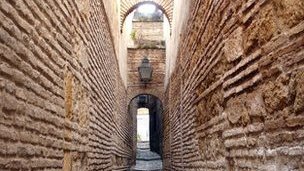
More than 500 years after the infamous 1492 expulsion of Jews from the kingdom of Spain, the modern Spanish government is preparing to invite Jews to return to the country. “In November [2012],” according to the BBC, “Spain’s justice minister Alberto Ruiz-Gallardon announced a plan to give descendants of Spain’s original Jewish community – known as Sephardic Jews – a fast-track to a Spanish passport and Spanish citizenship.” Tens of thousands of Jews converted to Christianity as conversos after the 1492 expulsion order, while others fled from Spain.

JewsinSpain

The BBC indicates that “the proposed new law, if passed, is expected to allow all new citizens of Sephardic origin to keep their existing passports.”

Commentators have proposed various theories on political motives for this proposal and its timing, suggesting the Spanish government’s possible desire to initiate a rapprochement with Israel.

Although many Muslims and moriscos (Muslim converts to Christianity) were also expelled from Spain in the fifteenth through early seventeenth centuries, no attempt to reach out to their descendents has been made.

The BBC reports on this story.

NIU students in HIST 414 European Wars of Religion, HIST 420 The Renaissance, and HIST 458 Mediterranean World, 1450-1750 will be interested in this article. Graduate students working on religious violence and intolerance issues will want to follow this story.

Posted in Civilians and Refugees in War, Early Modern Europe, Early Modern World, Empires and Imperialism, European History, European Union, European Wars of Religion, History of Violence, Human Rights, Mediterranean World, Political Culture, Religious History, Religious Violence, Renaissance Art and History | 1 Comment

Innovation in Italian Politics?

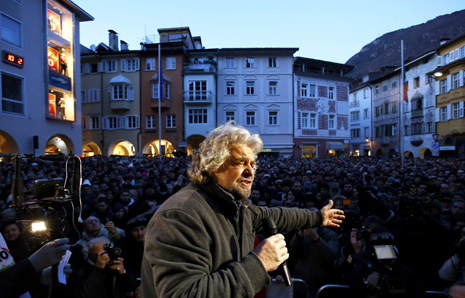
The recent elections in Italy surprised many Italians and have dumbfounded observers around the world. The center-left coalition led by Luigi Bersani seemed poised to win the elections, but did not come out as a clear winner. The resurgence of Silvio Berlusconi is especially shocking to people familiar with Italy but living outside of the country. Beppe Grillo’s Cinque Stelle movement has surged forward, gaining a whopping 25.6 percent of the vote. In Italy’s multiparty parliamentary system, this represents the largest vote for any single political party. But Grillo is not joining any coalitions, leaving the fate of the next government uncertain.

Comedian Turned Politician Beppe Grillo Addresses Supporters At Rally

Commentators in the United States and the United Kingdom often like to poke fun at Italian politics, often with good reason.

But, an article by Alexander Stille in the current New Yorker questions: “Maybe Italy’s Politicians Aren’t Crazier Than Ours.” Stille examines Italian politics as a laboratory for political innovations (good and bad) that later spread internationally.

Posted in European History, European Union, Italian History, Political Culture | Leave a comment

Georges Vigarello Seminars at the Louvre

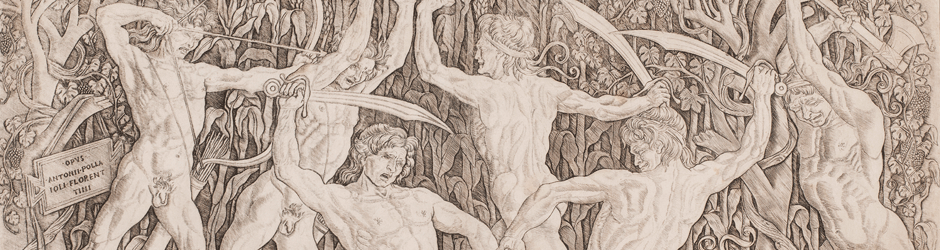
Philosopher and historian Georges Vigarello is presenting a series of seminars at the Louvre on Le corps et le mouvement (XVe-XXe).

pollaiuolo-gladiateurs

The seminars will be held on 25 March, 4 April, 11 April, 18 April, and 22 April in the Auditorium at the Louvre.

For more information, see the seminar program at the Louvre website.

Posted in Art History, Conferences, European History, French History, History of Medicine, Lectures and Seminars, Paris History, Renaissance Art and History | Leave a comment

Drones and Changing Conceptions of Airspace

Drones have already significantly transformed the conduct of military operations in Afghanistan, Pakistan, and other areas. Now, drones are beginning to change conceptions of airspace.

Yesterday (4 March 2013), an Alitalia pilot on approach to New York’s JFK airport reported seeing a drone at 1500 feet near his aircraft. The Alitalia plane successfully landed and airport continued to operate normally, but the sighting of a drone in the airspace of a major international airport triggered serious concerns about the potential of drones to disrupt air traffic.

This incident is currently being investigated.

NPR reports on the incident.

Readers interested in drones should consult P. W. Singer, Wired for War: The Robotics Revolution and Conflict in the Twenty-First Century (New York: Penguin Press, 2009).

Posted in Arms Control, History of Violence, Human Rights, Political Culture, Strategy and International Politics, Terrorism, War, Culture, and Society | Leave a comment

Historians Discuss Papal Resignation

Historians at the University of California at Santa Barbara are holding a public panel discussion of the papal resignation.

Here is the announcement from the UCSB website:

UCSB Historians To Examine Pope Benedict XVI’s Resignation

Public invited to panel discussion on Tuesday, March 5th.

(Santa Barbara, Calif.) — The announcement by Pope Benedict XVI that he will resign his office at the end of the month stunned the Catholic world. The last time a pope resigned was nearly 600 years ago, when Gregory XII stepped down in 1415 to end the schism that had produced numerous popes and anti-popes, some of whom resigned simultaneously.

In a panel discussion titled “When Popes Resign — What Will Happen When There Are Two Living Popes?” a group of historians from UC Santa Barbara will discuss the ramifications of Pope Benedict’s decision to leave office, and the issues surrounding his departure.

Sponsored by the UCSB History Associates, the panel discussion will take place at 7:30 p.m. on Tuesday, March 5, at the University Club, 1332 Santa Barbara Street. The cost is $8 for members and $10 for all others. Reservations are suggested and may be made by calling (805) 893-4388 or by sending a check, made payable to the UCSB History Associates, to the Department of History, University of California, Santa Barbara, CA 93106.

Participating scholars include Elizabeth DePalma Digeser, professor and chair of history and a specialist in Ancient Rome; Edward D. English, adjunct associate professor of history and executive director of the Medieval Studies Program; Carol Lansing, professor of history and a specialist in Medieval Europe; and Stefania Tutino, professor of history and a specialist in Reformation Europe.

Click here for more information about the panel discussion.

To view the complete story click here.


Posted in European History, Italian History, Lectures and Seminars, Political Culture, Reformation History, Religious History, Renaissance Art and History | Leave a comment

Procedures for the Papal Conclave

As cardinals prepare to elect a new pope in the Vatican, observers may want a refresher on the procedures for a papal conclave.

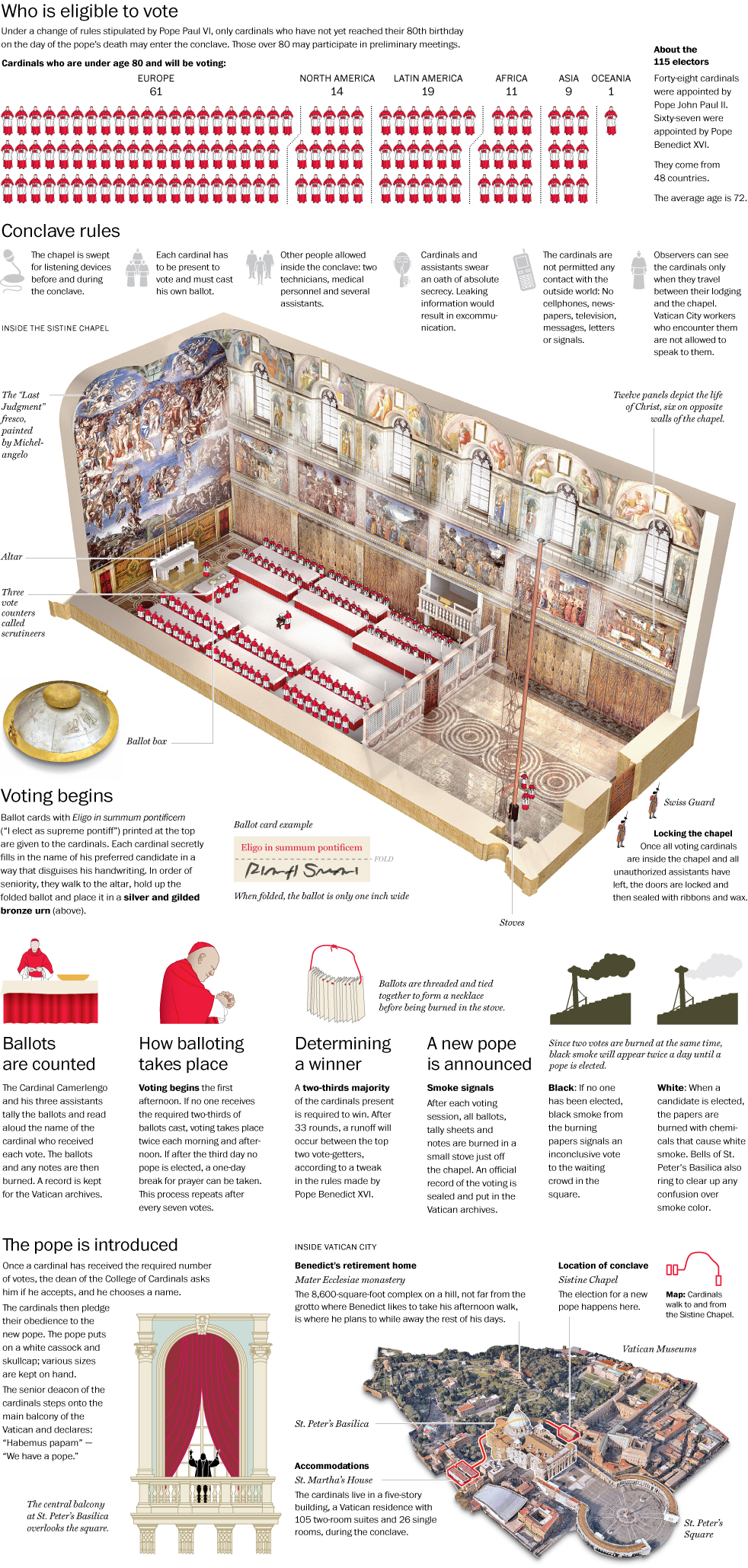
The Washington Post reports on the preparations for the upcoming papal conclave and provides the following graphic explaining rules and procedures for the conclave:

conclave-graphic

The BBC offers an insider’s view of the conclave process by Cardinal Cormac Murphy-O’Connor, who participated in the conclave that elected Benedict XVI but is too old to vote in the upcoming conclave.

NIU students in HIST 414 European Wars of Religion and HIST 420 The Renaissance will be interested in following the conclave process and noting comparisons with the Renaissance papacy.

Posted in Early Modern Europe, European History, European Wars of Religion, Italian History, Political Culture, Reformation History, Religious History, Renaissance Art and History | Leave a comment

Sequestration and Cuts in Education

How will the sequestration affect education in the United States?  Teachers, professors, and administrators are scrambling to assess the fall-out of the major cuts that will be implemented in educational institutions across the United States.

Federal spending cuts will directly affect many high-school students, college students, professors, and research scientists whose financial and research funding is provided by federal programs.

College and university students will begin to notice cuts when the new fiscal year begins in July 2013. “Although the Pell Grant program is exempt from cuts for the first year of sequestration,” reports the Chronicle of Higher Education, “programs like the Supplemental Educational Opportunity Grant and Federal Work-Study would be cut by millions of dollars, eliminating more than 100,000 students from participation.” These cuts are predicted to affect would-be college students over the next decade, perhaps preventing many from attending college.

Educational institutions at all levels of American society will feel the impact of the sequestration, since federal funding indirectly assists city, county, and state education.

Federal research funding through the National Science Foundation, National Endowment for the Humanities, and National Endowment for the Arts will also be cut, seriously hampering new research studies and initiatives in all disciplines.

The sequestration will result in deep cuts that will limit students’ access to education and restrict professors’ ability to conduct new research. The cuts will only further erode the already weakened position of the United States in the competition for global leadership in education.

An article in the Chronicle of Higher Education attempts to gauge the key areas of educational budgets that may be affected.

Posted in Education Policy, Humanities Education, Political Culture | Leave a comment

Holding Your Own Conclave

As cardinals gather in the Vatican to elect a new pope, other people are holding their own conclaves.

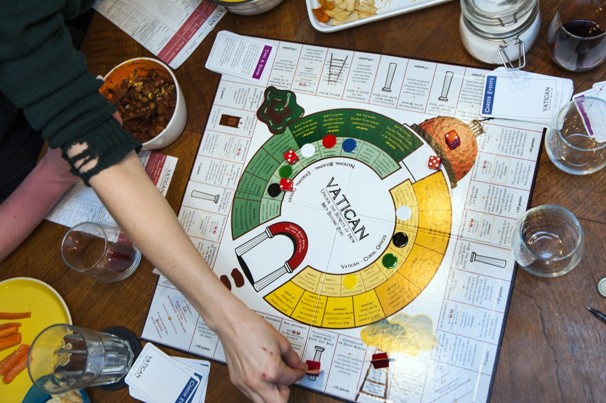
Vaticanboardgame

The board game “Vatican: Unlock the Secrets of How Men Become Pope” provides a fun way to learn about the process of electing popes. The game was designed by Stephen Haliczer, Professor Emeritus of History at Northern Illinois University.

The Washington Post reports on the game Vatican and a group of Catholic women who recently played the game. These women are part of a movement, known as Call to Action or the Women’s Ordination Conference, which is pushing for female Catholic priests and religious leaders. “We’ve been figuring out,” one of the women said, “how to get pink smoke to Rome.”

womenplayVatican

Harper’s Magazine excerpted some of the game’s cards in 2008.

NIU History students will be interested to track the success of this board game, which was produced by one of their own professors. High school and college teachers of History, Political Science, and Religious Studies may be interested in using this board game as a teaching tool.

Now, if you can get your hands on a copy of Vatican, you can hold your own conclave.

Posted in European History, History in the Media, Humanities Education, Italian History, Political Culture, Religious History, The Past Alive: Teaching History, Uncategorized, Women and Gender History | Leave a comment

Pope Benedict XVI Resigns

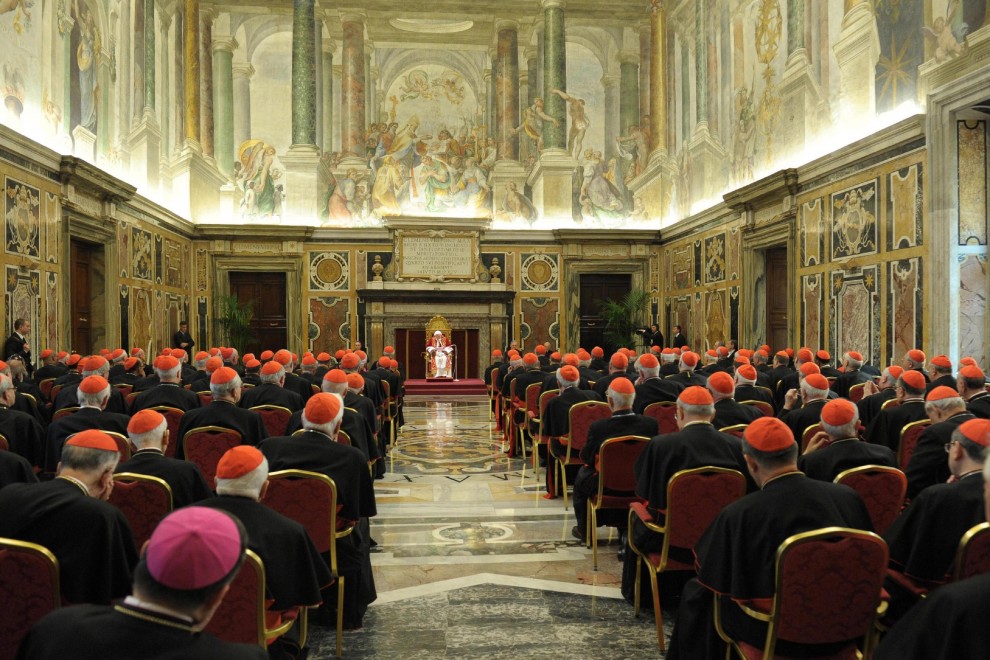
Pope Benedict XVI officially resigned yesterday, becoming the first pope to resign since 1415. Benedict addressed the cardinals for a final time, charging them with electing his replacement: “May the College of Cardinals work like an orchestra, where diversity — an expression of the universal church — always works toward a higher and harmonious agreement.”

Papeecardinali-dimissioni

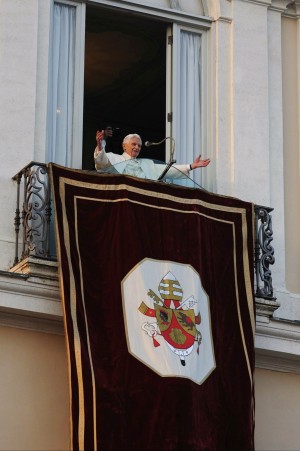
The pope appeared at the window of the Vatican Palace to greet the throng of Catholic faithful gathered below in the square, chanting “Viva il Papa!” Benedict XVI told the crowd that “I am simply a pilgrim beginning the last leg of his pilgrimage on this Earth.”

Papa-ultimosaluto

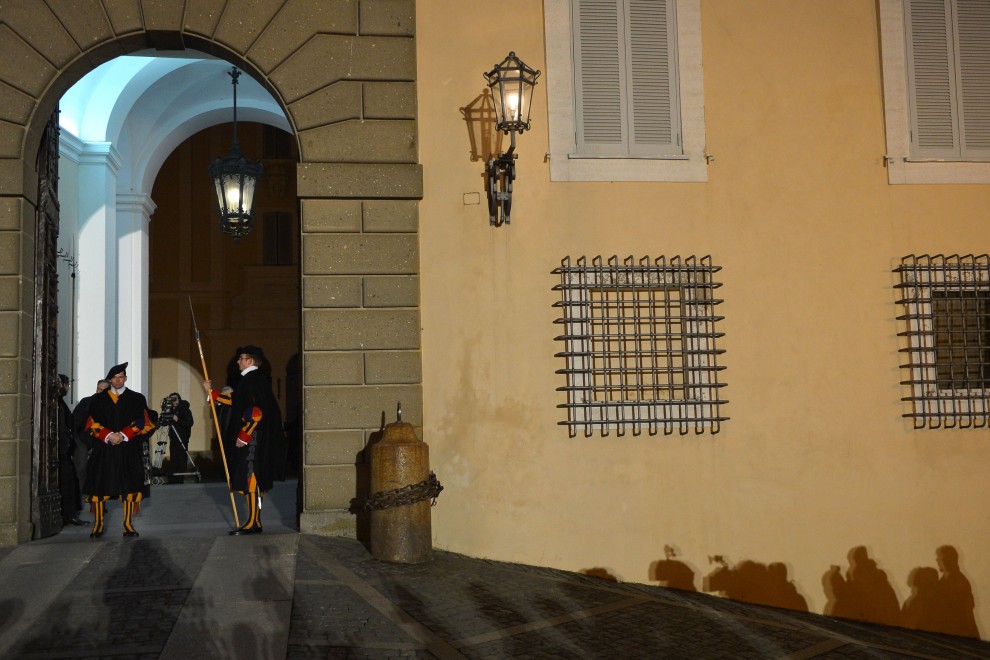
Benedict XVI, now Pope Emeritus, then departed the Vatican for the nearby Papal retreat of Castel Gandolfo. Soldiers of the Swiss Guard closed the gates after Benedict XVI entered his retirement.

GuardieSvizzere

According to the Washington Post, “Benedict’s decision to live at the Vatican in retirement, be called ’emeritus pope’ and ‘Your Holiness’ rather than revert back to ‘Joseph Ratzinger’ and wear the white cassock associated with the papacy has deepened concerns about the shadow he might cast over the next papacy.”

The Washington Post reports on Benedict XVI’s resignation. La Repubblica reports on the resignation in Italian and has numerous photo galleries of Benedict XVI’s final day as pope, as does Corriere della Sera. NPR reports on the resignation in the context of a broader identity crisis in the contemporary Catholic Church.

Benedict XVI’s decision to resign is being seen by some analysts as part of a long-planned and carefully orchestrated strategy.

twopopes2

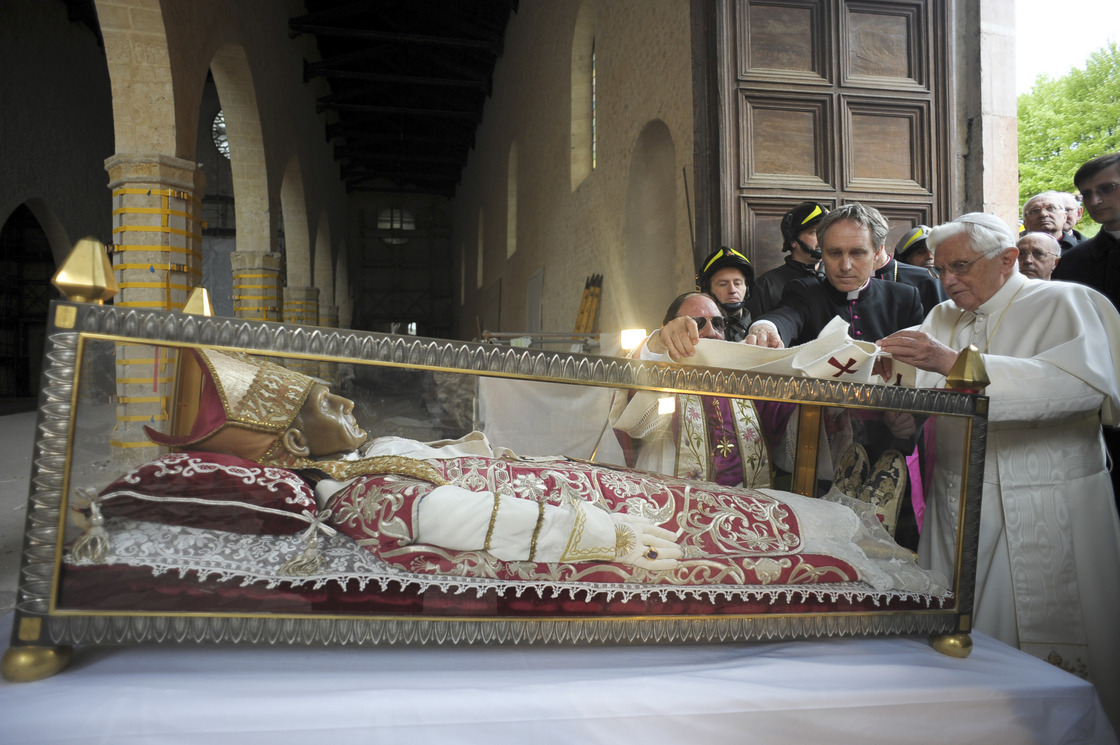
Benedict XVI’s veneration of Pope Celestine V, who retired in 1294, seems to point to a crafted policy of Papal retirement. NPR reports on comparisons between Celestine V and Benedict XVI’s retirements.

Posted in Early Modern Europe, European History, Italian History, Renaissance Art and History | Leave a comment