Atrocities in Vietnam

The United States military forces committed widespread atrocities during the Vietnam War, according to documents unearthed in the National Archives by journalist Nick Turse. The evidence of numerous mass killings of Vietnamese civilians reveals that the infamous My Lai Massacre was neither an accident nor an aberration, but rather a normal part of the American practice of warfare in Vietnam.

turse-anythingthatmoves

Turse has published his findings in new book entitled, Kill Anything that Moves: The Real American War in Vietnam (Metropolitan Books, 2013). For a bio of Turse, see his own website.

Kill Anything that Moves is receiving considerable media attention in the United States. NPR recently interviewed Turse about the book. Salon reports on Turse’s findings.  Bill Moyers recently conducted a video interview with Turse about the book.

The LA Times previously published a series of articles by Turse based on his research for the book.

Alfred W. McCoy, Professor of History at the University of Wisconsin at Madison and a leading scholar of Southeast Asian History, reviews Turse’s book at HNN.

I have not yet had a chance to review Turse’s book, but hope to do so soon.

Posted in Archival Research, Civil Conflict, Civilians and Refugees in War, Empires and Imperialism, History of Violence, Strategy and International Politics, War, Culture, and Society | Leave a comment

Stephanie Coontz Lecture at NIU

Stephanie Coontz, a leading gender historian, will be presenting at Northern Illinois University today.

Coontz will offer a  seminar on “How to Talk to the Media About Your Scholarship (and Get Them to Listen).” The seminar will be held in the Capitol Room South of the Holmes Student Center from 10:00-11:15 a.m.

Coontz will also offer a lecture on “50 Years After the Feminine Mystique: How Far Have We Come?”  This lecture is scheduled for 6 p.m. the Visual Art Building, room 100.

NIU History students are encouraged to attend these events, which are free and open to the public.


Posted in Careers in History, Graduate Work in History, Humanities Education, Lectures and Seminars, Northern Illinois University, Undergraduate Work in History, Women and Gender History | Leave a comment

Betting on the New Pope

Pope Benedict XVI’s surprise announcement that he will resign and go into retirement stunned the Catholic world. Some Catholics have been protesting Benedict XVI’s decision, claiming that popes can never step down, while other believers have been flocking to the Vatican to witness this pope’s final public prayers. Meanwhile, cardinals from around the world are preparing to gather in the Vatican for a conclave to elect a new pope.

Catholics are not the only people curious about who will be elected as the next pope, however. Many papal followers are betting on who the next pope will be. And, there are  lots of options in betting.

papalconclave2013-betting

Betting sites like Intrade allow people to bet on the nationality of the new pope, individual papal candidates, and the number of ballots it will take to elect the new pope.

Of course, betting on papal elections is nothing new. Since at least the early sixteenth century, betting agencies have published odds on papal elections. Renaissance Romans also placed bets on who would be created cardinal during promotions.

For more on early modern papal conclaves, see: John M. Hunt, “The Conclave from the ‘Outside In’: Rumor, Speculation, and Disorder in Rome during Early Modern Papal Elections,” Journal of Early Modern History 16 (2012): 355-382.

On bidding and gambling in Renaissance Italy, see: Evelyn Welch, Shopping in the Renaissance: Consumer Cultures in Italy, 1400-1600 (New Haven, CT: Yale University Press, 2005), 185-209.

Thanks to NIU graduate student Alex Revzan for the Intrade link. NIU students in HIST 420 The Renaissance will want to track the upcoming conclave to learn more about papal elections. NIU students may also be interested to know that Stephen Haliczer, Professor Emeritus of History at Northern Illinois University, created a board game entitled Vatican on the papal electoral process.

Posted in Early Modern Europe, European History, Italian History, Mediterranean World, Political Culture, Reformation History, Renaissance Art and History, Uncategorized | Leave a comment

Renaissance Italian Bank in Trouble

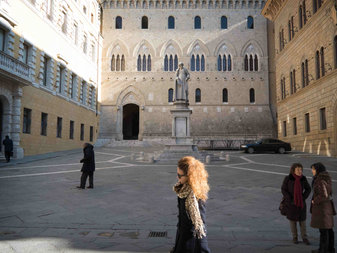
Monte dei Paschi di Siena is in deep financial trouble. “To howls across Italy,” the New York Times reports, “the government has hastily arranged a €3.9 billion, or $5.1 billion, bailout. The widening scandal, which hit at a time of growing economic distress in Italy, has boiled over into an issue in nationwide elections to be held Sunday and Monday.”

MontediPaschidiSiena

The bank was founded in 1472 and is considered the oldest existing bank in the world. A New York Times article emphasizes that “since the days of the Medici in Florence, to the north, the banking house of Monte dei Paschi has rained wealth on the people of Siena. For 541 years, it has endured war, plague and panic, and it stands today as the world’s oldest bank.”

The New York Times reports on the difficulties at Monte dei Paschi di Siena. The Economist and BBC both recently reported on Monte dei Paschi di Siena’s risky investments.

NIU students in HIST 420 The Renaissance will want to track this developing story.

Posted in Early Modern Europe, Early Modern World, European History, European Union, Globalization, Italian History, Political Culture, Renaissance Art and History | Leave a comment

Anglocentric History in the United Kingdom

A controversy has erupted in the United Kingdom over new History curriculum proposals. Conservative politicians are pushing for new national curriculum that would emphasize certain aspects of British history.

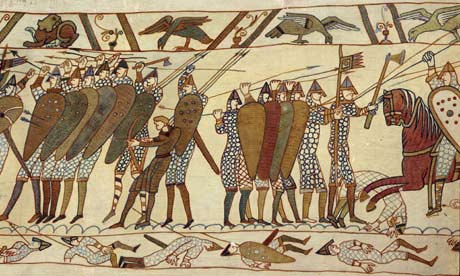
Foot Soldiers

Many historians have criticized the new proposals as politically motivated attempts to instill a particular version of Anglocentric history.

Conservative popular historian Niall Ferguson has written in defense of the proposed new curriculum in the Guardian.

The Guardian also publishes historians’ comments on the controversy.

The controversy seems to center around the teaching of certain events in medieval and early modern English history that have often been viewed through a Whig interpretation of history.

Thanks to my colleague Sean Farrell, Associate Professor of History at Northern Illinois University, for sharing this piece.

Posted in Early Modern Europe, Education Policy, European History, European Union, Historiography and Social Theory, Humanities Education, Political Culture | 2 Comments

Stephanie Coontz on Gender Equality

Historian Stephanie Coontz published an important op-ed yesterday in the New York Times on “Why Gender Equality Stalled.”

This op-ed is one of a series of new pieces celebrating or reassessing the 50th anniversary of Betty Friedan’s The Feminine Mystique, a foundational work of the feminist movement that has significantly influenced the development of women and gender history.

paidmaternalleave

One of the factors that Coontz considers is paid maternity and paternity leave, arguing that the United States is far behind the curve on establishing leave policies.

Northern Illinois University students will be interested in this op-ed, since Stephanie Coontz will soon be visiting NIU’s campus as a speaker for the Women’s Studies Program.

Posted in Human Rights, Humanities Education, Women and Gender History | Leave a comment

High School Teaching and Incoming College Students

An American high school teacher has issued a stern warning to college and university professors: brace yourselves.

Kenneth Bernstein—a recently retired high school teacher of government in the Washington, DC, area—paints a bleak portrait of the incoming college students who are products of the No Child Left Behind program in the United States.

academe-cover

Bernstein begins: “You are a college professor.  I have just retired as a high school teacher. I have some bad news for you. In case you do not already see what is happening, I want to warn you of what to expect from the students who will be arriving in your classroom, even if you teach in a highly selective institution.”

After walking the reader through the details of No Child Left Behind’s requirements and of the demands of teaching to its requirements, Bernstein concludes: “Now you are seeing the results in the students arriving at your institutions. They may be very bright. But we have not been able to prepare them for the kind of intellectual work that you have every right to expect of them. It is for this that I apologize, even as I know in my heart that there was little more I could have done. Which is one reason I am no longer in the classroom.”

Academe, a publication of the American Association of University Professors (AAUP), published Bernstein’s essay as “Warnings from the Trenches.” The Washington Post republished his essay online.

NIU students in the Teacher Certification programs in History and other disciplines will want to read this essay, which has already gone viral in the Facebook and blogosphere worlds.

Posted in Careers in History, Education Policy, Humanities Education, Undergraduate Work in History | Leave a comment

The Role of Dissertation Research

An article, provocatively entitled “The Dissertation Can No Longer Be Defended,” in the Chronicle of Higher Education discusses new digital models for dissemination of dissertation research. Stacey Patton, the author, begins her article by stating: “The dissertation is broken, many scholars agree. So now what?”

dissertationcannolongerbedefended

This statement displays the author’s bias in dismissing the relevance of dissertations. Do “many scholars” really agree that “the dissertation is broken”?  If so, where is the evidence of this?

The author sets up an absurd dichotomy between a “21st century” dissertation and a “traditional” dissertation (which is presented as backward). I would instead argue that approaches to doctoral research are incredibly complex and are always changing.

Faculty members are in a unique position to assess cutting-edge (21st century) research questions and methods and to direct doctoral research. Many faculty members, such as myself, embrace digital technologies as having important roles in doctoral research, but that hardly means that dissertations are outdated.

Faculty doctoral advisors—not reporters or university administrators—have the skills and experiences needed to determine how doctoral research should best be disseminated.

Although the author of “The Dissertation Can No Longer Be Defended” has received a Ph.D., she seems to misunderstand broader dimensions of doctoral research, as well as the academic job and publishing markets. Almost all of her quotes seem to have come from interviews with critics of a “traditional” dissertation and proponents of digital institutions. Programs that have not embraced digital dissertations are presented as “behind the curve.”

When  Anthony Grafton (Professor of History at Princeton University) is quoted, the reporter marginalizes him by minimizing the significance of his argument. The reporter writes: “Meanwhile, some scholars say the traditional approaches to the dissertation aren’t necessarily in need of overhaul at all, even if digital and other nontraditional formats may be preferable for some projects.” Grafton is not just “some scholar,” but a recent President of the American Historical Association, a highly published Renaissance historian, and an influential scholar who has actually directed many doctorates.

Toward the end of the article, the reporter off-handedly remarks that “Many other professors say that until the tenure process no longer requires the publication of book-length works, scholars in the pipeline will continue to follow the traditional formula for writing dissertations.” This point is, of course, at the heart of the matter.

Doctoral research is intended to prepare graduate students for their professional research responsibilities, which involves conducting new research and publishing research findings in articles, collective volumes, monographs, and other formats. The role of doctoral research, as I see it, is to advance knowledge and contribute to addressing human problems through systematic scholarly research. Only active research scholars in each discipline can determine the standards for relevant and quality research methods and findings. This is the reason for using doctoral mentoring and peer review processes, which are always evolving and never “traditional.”

This article seems to be typical of much of the reporting for the Chronicle of Higher Education: pro-technology, pro-administration, anti-faculty, anti-humanities, simplistic, and one-sided.

Posted in Academic Publishing, Careers in History, Digital Humanities, Education Policy, Graduate Work in History, Humanities Education | 3 Comments

Pope Benedict XVI Announces Resignation

Pope Benedict XVI has surprised Italians and the world with an announcement that he plans to resign the Papal throne and go into retirement at the end of the month. Benedict XVI is 85 years old and says that he is too tired to continue the duties of leading the Catholic Church.

BenedictXVI

Benedict XVI is not the first pope to retire. Pope Gregory XII resigned in 1415 during a period of conflict in the Church known as the Great Schism (1378-1417). A provision in canon law provides for the possibility of a legitimate papal resignation.

La Repubblica and the BBC report on the surprise announcement. NPR provides an audio report, including an interview with NPR’s Silvia Poggioli.

An English translation of the text of Pope Benedict XVI’s announcement is available on NPR’s website.

Silvia Poggioli provides an excellent report on Pope Benedict XVI’s legacy on NPR. The French newspaper Le Monde offers a retrospective on Benedict XVI, focusing on the many scandals he faced as pope. The Washington Post delves into the VatiLeaks scandal and corruption in Papal administration. Le Monde and Corriere della Sera report on criticism of the resignation by Catholic clergy and lay people.

Charles Keenan, a doctoral student in History at Northwestern University, offers historical context on previous papal resignations in an article on HNN.

For context on Gregory XII’s resignation and the history of the Great Schism, see:

Alison Williams Lewin, “‘Cum Status Ecclesie Noster Sit’: Florence and the Council of Pisa (1409),” Church History 62 (June 1993): 178-189.

Gene A. Brucker, “‘The Horseshoe Nail’: Structure and Contingency in Medieval and Renaissance Italy,” Renaissance Quarterly 54 (Spring 2001): 1-19.

For a history of papal elections, see:

Frédéric J. Baumgartner, Behind Locked Doors: A History of the Papal Elections (Palgrave Macmillan, 2003).

NIU students in HIST 420 The Renaissance and graduate students in Mediterranean World history will be interested in tracking this story and the upcoming conclave to elect a new pope.

Posted in Early Modern Europe, European History, European Union, History in the Media, Italian History, Mediterranean World, Renaissance Art and History, Uncategorized | Leave a comment

Unemployment in Italy

Italy has been plagued by severe unemployment for years, especially for young Italians who are just graduating from high school and university. Italians routinely lament the fuga dei cervelli (brain drain) as young, talented citizens emigrate to find better professional opportunities abroad.

italy-youthunemployment

New statistics underline the depth of the problem of youth unemployment in Greece, Spain, and Italy. See the report in the BBC.

Posted in Education Policy, European History, European Union, Italian History | Leave a comment