The Civil War in America

The Library of Congress has organized a new exhibition on “The Civil War in America,” which includes diaries and other writings by participants in and observers of the American Civil War of 1861-1865.

One of the objects featured in the exhibition is a manuscript diary by LeRoy Gresham, a teenager from Macon, Georgia, who recorded his observations on the Civil War. When he received news of the fall of Fort Sumter, he wrote: “War! Thou demon that ravishes fair countries, stay thy mad career.” LeRoy went on to chronicle his life as an invalid, news of the war, and Sherman’s march, leaving historians with a fascinating window on life during the Civil War.

The Library of Congress has information on its “The Civil Wars in America” exhibition.

The Washington Post reviews the exhibition online.

Posted in Civil Conflict, History in the Media, War, Culture, and Society | Leave a comment

Armistice Day in France

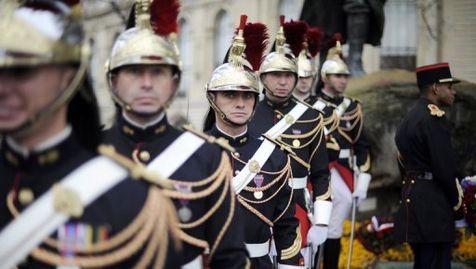
This past Sunday was Armistice Day, marking the end of the First World War in 1918. France celebrates 11 November each year with a series of ceremonies commemorating the dead of La Grande Guerre, as the First World War is often known. This commemoration is arguably much more important in France than it has ever been in the United States, where it is now celebrated as Veteran’s Day, since France suffered many more deaths, in addition to the occupation of parts of northern France and the devastation of the Western Front.

This year’s celebration of 11 November is different, however. Last year, the Nicolas Sarkozy government decided to expand the celebrations « en hommage à tous les morts pour la France ». So, the ceremonies will now commemorate all French veterans killed in any wars, not just the fallen of La Grand Guerre. The new François Hollande government has chosen to continue with this new model and celebrated 11 November with the expanded symbolic format more similar to the American Veteran’s Day.

Libération and Le Monde report on the 11 November ceremonies.  Some commentators and politicians have criticized the new ceremonies as obscuring the importance of the First World War and its horrifying legacy of trench combat and attrition warfare.

In addition to the controversy surrounding this year’s ceremonies, questions have been raised about amnesties for French soldiers who were executed during the war, especially during the army mutinies of 1917. Some individual soldiers’ cases have been reviewed, leading to rehabilitations, but some want a general amnesty for all French soldiers. Le Monde reports on one of the soldiers.

The French Armistice Day commemoration reminds us how important it is for historians of war and society to look beyond the history of American involvement in warfare. European and global perspectives often offer strikingly different understandings of the experience of war.

Armistice Day also highlights an important scholarly debate over the historical memory of the First World War has been raging for over a decade, since the publication of Jay Winter’s Sites of Memory, Sites of Mourning: The Great War in European Cultural History (Cambridge: Cambridge University Press, 1998). The current controversies over 11 November in France will certainly add to this expanding debate, which has been dominated by historians using cultural methods. Historians of war and society could be more active in contributing to our understanding of the historical memory of the First World War and other past wars that continue to be commemorated.

This essay was cross-posted on the SMH Blog.

Posted in European History, French History, History in the Media, History of Violence, War, Culture, and Society | Leave a comment

Get Out the Vote!

Election day in the United States is TODAY, 6 November 2012.

University students are often very busy during the middle of the semester, but it is important to exercise your citizenship and vote.

Many people think that their votes don’t count. If you have ever been tempted to not vote, please check out filmmaker Errol Morris’s film  11 Excellent Reasons Not to Vote?

Get out the vote!

Posted in Human Rights, Political Culture | Leave a comment

Tom Ricks on Firing Generals

Tom Ricks has a new book out on American military leadership, entitled, The Generals: American Military Command from World War II to Today.

NPR has done an interview with Ricks on his book, and particularly on the issue of when and how generals have been removed from command. Ricks argues that civilians leaders should be more willing to remove generals who fail to perform.

I have not yet been able to read this new book, but look forward to reviewing it. Undergraduate and graduate students interested in the history of military organizations, command, and leadership may want to check out this book.

Update: Tom Ricks has commented on the Petraeus scandal and resignation in an interview on NPR.  This interview seems to present an interesting counterpoint to his recent work on firing generals.

Posted in Political Culture, Strategy and International Politics, War, Culture, and Society | Leave a comment

Mitt Romney and the Neocons

Mitt Romney, despite his sometimes “soft” rhetoric on foreign policy issues, has embraced Neoconservative (Neocon) policymakers and advisers, including many of the same advisers who were responsible for the planning and implementation of the invasion and occupation of Iraq in 2003.

Stephen Walt, Professor of International Relations at Harvard University, has published an analysis of the Third Obama-Romney Presidential Debate, which focused on foreign policy issues, in Foreign Policy.

Walt points out that Mitt Romney has employed Neocons as advisers and often touts their ideas. For example, despite Romney’s claims that he would cut the Federal deficit, he has repeatedly argued for increasing U.S. Defense spending, following Neocon policy advice. Walt explains: “And that’s the genius of neoconservatism’s frequently outlandish policy recommendations. They are always calling for the United States to spend excessive amounts of money on defense, to threaten potential enemies with dire consequences if they don’t bend to our will, and to use force against just about anyone that the neocons don’t like (and it’s a long list). No president — not even George W. Bush — has done everything the neocons wanted, but by constantly pushing for more, it makes doing at least part of what they want seem like a sensible, moderate course. And as we saw after 9/11, every now and then the stars may line up and the neocons will get what they’re pushing for (See under: Iraq). Too bad it never works out well when they do.” Should Romney be elected President, expect military spending to skyrocket (and the Federal budget deficit with it).

Neocon foreign policies have been abysmal failures, yet they continue to have significant influence in Washington, D.C., especially within the Republican party.  Part of this staying power is that Neocons have strong institutional support from conservative think tanks and political organizations.

The Neocons have been able to avoid paying for their serious policy miscalculations and mistakes.  Walt argues that: “Neoconservatism’s final strand of twisted genius is its imperviousness to contrary evidence. Because most of their prescriptions are so extreme, they can explain away failure by claiming that the country just didn’t follow their advice with sufficient enthusiasm. If we lost in Iraq, that’s because Bush didn’t attack Iran and Syria too, or it’s because Obama decided to withdraw before the job was really done. (Such claims are mostly nonsense, of course, but who cares?) If Afghanistan turned into a costly quagmire on Bush’s watch, it’s because Clinton and Bush refused to ramp up defense spending as much as the neocons wanted. If we now headed for the exit with little show for our effort, it’s because we didn’t send a big enough Afghan surge in 2009-2010. For neocons, policy failure can always be explained by saying that feckless politicians just didn’t go as far as the neocons demanded, which means their advice can never be fully discredited.”

The third Presidential debate failed to clarify Romney’s foreign policy ideas, but his many speeches clearly show a strong, and dangerous, Neocon influence.


Posted in Political Culture, Strategy and International Politics | Leave a comment

NIU History Student wins Lincoln Laureate Award

NIU History student Wayne Duerkes has won a Lincoln Laureate Award, a major undergraduate award given in the State of Illinois.

Lincoln Laureate Awards are given to one senior from each of the public and private universities in the State of Illinois.

NIU Today reports on Wayne Duerkes’s designation as a Lincoln Laureate awardee.

Wayne Duerkes has been an avid reader, probing questioner, and engaged thinker throughout his historical studies at NIU.  He has also played a major role in organizing History Club at NIU, arranging for historical lectures, workshops, field trips, and other activities. Wayne is planning on pursuing the history of the American Civil War in graduate studies.

I have known Wayne since he participated in my HIST 414 European Wars of Religion course and I am very happy to see that he has won the prestigious Lincoln Laureate Award.

Congratulations, Wayne!

Posted in Careers in History, Northern Illinois University, Undergraduate Work in History, War, Culture, and Society | Leave a comment

Get Out the Vote!

Election day in the United States is 6 November 2012.

University students are often very busy during the middle of the semester, but it is important to exercise your citizenship and vote.

Many people think that their votes don’t count. If you have ever been tempted to not vote, please check out filmmaker Errol Morris’s film  11 Excellent Reasons Not to Vote?

Get out the vote!


Posted in Human Rights, Political Culture | Leave a comment

Careers for Ph.D.s in History

Anthony Grafton published an article last year on the need for doctoral programs in History to prepare their Ph.D. candidates for the possibility of careers outside of academic positions. The article went viral, prompting an extended debate online over the academic job market in History and other career paths for professional historians. For a glimpse of this debate, see Grafton’s original piece, another Grafton piece with Jim Grossman, articles in AHA Perspectives, and in the Chronicle of Higher Education.

The latest article responding to this debate is a piece in the Chronicle of Higher Education on “What Doors Does a Ph.D. in History Open?”

This article analyzes “the career outcomes of history Ph.D.’s who graduated between 1990 and 2010 (taking every other year) from four history departments: at Duke University, Ohio State University, and the Universities of North Carolina at Chapel Hill and California at Santa Barbara.”

The study is based on a “total sample of 487 history Ph.D.’s.” The article provides a series of charts to display the data, finding that “Only 50.7 percent of doctoral graduates from those four top-tier programs ended up in tenure-track jobs. For those who graduated in 2008 and 2010, the average was even lower: 38.5 percent.”

Of course, the 2008-2010 data is skewed both by the global economic crisis and by the growing number of postdoctoral fellowships in the humanities and social sciences. Many Ph.D. recipients now move into one- to three-year postdoctoral fellowships after completing their doctorates. So, tracking how many doctoral recipients end up in tenure-track positions requires examining data several years out from graduate dates.

Data on academic administrators is also unclear, since some of those positions are filled by faculty members.

The piece provides encouraging news about those Ph.D. recipients who moved into careers outside of university teaching. “Far from the stereotype of the Ph.D. baristas at Starbucks, career-outcome data (see charts for each of the four institutions here) shows that history Ph.D.’s are thriving in a versatile range of careers.” The article indicates that many of the history doctoral recipients now work in “higher-education administration, publishing and editing, high schools, museums, government agencies, and public-history sites.” Others have careers as “researchers, consultants, and editors.”

The author claims that “Most history departments, it turns out, do not track the career outcomes of their alumni.” This, I believe is an exaggeration. Most Ph.D. granting history departments I am familiar with do attempt to track their doctoral recipients’ careers. However, it is not always possible to compile effective data, especially on Ph.D.s who go on to careers outside of professorial and academic administrative positions.


Posted in Careers in History, Graduate Work in History, Humanities Education | Leave a comment

Ecole des Chartes Fellowship

École Nationale des Chartes Fellowship

Application deadline: December 1, 2012

This fellowship, which has existed since 1979, provides auditor tuition and a portion of living expenses for an American or Canadian graduate student who has advanced to PhD candidacy to study at the École Nationale des Chartes in Paris. The École is the oldest institution in Europe specializing in the archival sciences, including paleography, codicology, bibliography, diplomatics, textual editing, and the history of the book. Preference is given to students attending member institutions of the Center for Renaissance Studies consortium. It is strongly recommended that the recipient be in residence at the École during the fall semester. Applications are especially encouraged from students who are in the research stage of their dissertation work.

This Fellowship listing is cross-posted from the Newberry Library’s announcement.

For more information and application instructions, see http://www.newberry.org/center-renaissance-studies-fellowships.

Posted in French History, Graduate Work in History, Grants and Fellowships, Renaissance Art and History | Leave a comment

SMH Group Blog

The Society for Military History has a new group blog, the SMH Blog, which will offer posts and discussions of all aspects of the history of war and society.

I am thrilled to be participating in the SMH blog as one of the authors, along with Robert Bateman, Mark Grimsley, Brett Holman, and Jamel Ostwald.

This week, I posted my first SMH blog piece on “The Cultural History of War.”

Please do check out the new SMH blog and consider adding it to your bookmarks and feeds.

Posted in Digital Humanities, History of Violence, War, Culture, and Society, Warfare in the Early Modern World | Leave a comment