Women as Academic Authors

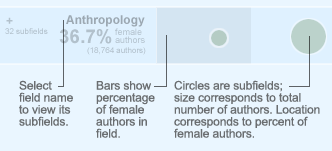
Female professors are increasingly active in academic research at American universities. In some disciplines, women are approaching parity with male counterparts, but in many others a gender gap remains.

gender-key

A new article in the Chronicle of Higher Education reports on the Eigenfactor Project’s analysis of the gender of academic authors, breaking down the percentages of male and female authors in a number of different fields and subfields. The data set used is constructed from JSTOR article database and organized by fields and chronological period.

The discipline that had the highest number of female authors in the period from 1991 to 2010 was Education, with women representing 46.6% of authors. The field of History had 30.8% female authors during the same period.

Women and gender scholars should examine these findings to assess the current state of the gender gap in the academic sphere.


Posted in Academic Publishing, Careers in History, Historiography and Social Theory, Human Rights, Humanities Education, Women and Gender History | Leave a comment

History of Violence Postdoctoral Fellowship

The Center for the History of Violence at the University of Newcastle in Australia is offering a postdoctoral fellowship in the History of Violence.

bostonmassacre

For a description of the position and application procedures see the posting on H-Net.


Posted in Grants and Fellowships, History of Violence, Religious Violence, War, Culture, and Society | Leave a comment

Women and War

Warfare is often assumed to be a purely masculine sphere of human activity. This gendered conception is a myth.

Women have historically been participants in diverse aspects of warfare: recruitment, training, mobilization, strategic formulation, military intelligence, war finance, logistical services, medical services, command, and even combat. Societies in every historical period have constructed different gender relations and gendered notions of warfare.

lynn-womenarmies

John A. Lynn’s Women, Armies, and Warfare in Early Modern Europe (Cambridge: Cambridge University Press, 2008) demonstrates that women played integral roles in the logistics and pillage economy of early modern armies. Lynn argues that women’s roles  were progressively limited by late seventeenth-century and eighteenth-century armies, but women still played various supporting roles for armies. The French Revolution and nationalism later created many more opportunities for women to participate directly in military organizations. As historian Lynn Hunt wrote in a blurb for Lynn’s book: “In an engaging work that combines military and social history, Lynn brings to life the indispensable role of women in early modern European armies and tracks down the reasons for a major shift in their place after 1650. We can never again imagine war as only men’s work.”

Individual women have at times cross-dressed to serve in armies, but groups of women have also acted openly as combatants in some armed forces. One of the most studied cases is the Israeli Defense Forces, where women have long served in combat roles.

During many civil wars, women have participated in combat roles not normally permitted in conventional inter-state wars. My own research shows that besieged women played an active role in siege combat defense: “‘Generous Amazons Came to the Breach’: Besieged Women in the French Wars of Religion,” Gender and History 16 (November 2004): 654-688. I am currently expanding this research into a book on gender and violence in the French Wars of Religion.

mackenzie-letwomenfight

Today, one of the most controversial issues relating to women and warfare is whether or not female soldiers should be permitted to serve in combat roles in national armies. A new article in Foreign Affairs argues that American female soldiers should be allowed to participate fully in combat operations. This article adds to a long-running debate in the United States, in both military and civilian spheres, about the place of women in the U.S. armed forces.

Posted in Civil Conflict, Current Research, Early Modern Europe, Early Modern World, European History, Gender and Warfare, History of Violence, Uncategorized, War, Culture, and Society, Warfare in the Early Modern World, Women and Gender History | Leave a comment

Interview with Hervé Drévillon

Historian Hervé Drévillon has launched a new Institut des Études sur la Guerre et la Paix (Institute for the Study of War and Peace) at Université de Paris I. Research centers and institutes at major universities are engines for original research and publication. This research institute, based in the Sorbonne building, includes an active graduate program with Master’s and Doctoral students.

drevillon-roisabsolus

Hervé Drévillon is the author of books on early modern European dueling, on Louis XIV’s army, on early modern France, and on the history of battle.

Histoire pour tous published an interview with Drévillon online.

I enjoyed presenting my book Warrior Pursuits: Noble Culture and Civil Conflict in Early Modern France (Baltimore, MD: Johns Hopkins University Press, 2010) at Drévillon’s seminar recently.  I was able to meet a number of graduate students who participate in the programs of the Institut des Études sur la Guerre et la Paix.

Historians of early modern war, culture, and society will be interested in Drévillon’s work and his new research institute.

Posted in Current Research, Early Modern Europe, Early Modern World, French History, History of Violence, Paris History, Strategy and International Politics, Uncategorized, War, Culture, and Society, Warfare in the Early Modern World | 1 Comment

Reenactment of Austerlitz

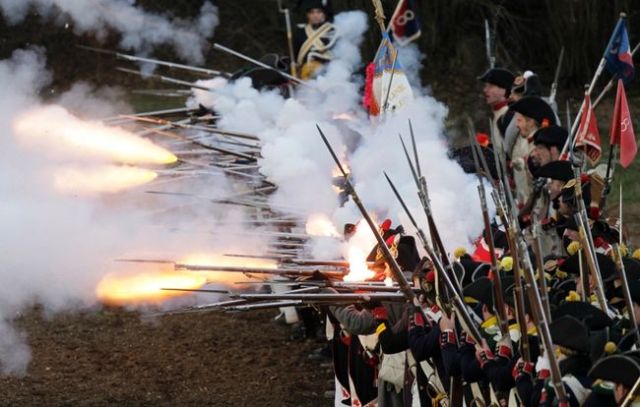
Austerlitz has been fought once again. The anniversary of the battle of Austerlitz was 2 December and historical reenactors once again took to the battlefield to commemorate one of the most celebrated victories of Napoleon.

austerlitz-reenactment

Emperor Napoleon’s Grand Armée fought an allied Austro-Russian army near the village of Austerlitz in Moravia (in the present-day Czech Republic) on 2 December 1805 during the War of the Third Coalition. French imperial forces had defeated an Austrian army at Ulm earlier in the year and then invaded Habsburg territories. But, the remaining Austrian forces fell back until they could link up with their Russian allies. With winter approaching, the Grand Armée was running out of time and supplies, but the Austro-Russian combined army continued to avoid battle.

On 1 December, Napoleon ordered his army to feign a retreat near Austerlitz in order to entice the Austro-Russians to advance.  This ruse worked, and the Austro-Russians attacked early on the morning of 2 December, hoping to surround the ostensibly retreating French army. Napoleon waited as most of the Austro-Russian army advanced in the fog toward the French right wing, then he launched a counter-attack up the Pratzen heights.  After intense fighting, the Grand Armée broke through the Russian Guard and routed the entire allied army.

Napoleon’s victory forced the Habsburgs to make peace and the Russians to retreat. Emperor Napoleon exploited his army’s victory through a massive propaganda campaign to solidify the support of his soldiers and the French public. The battle of Austerlitz and the campaign of 1805 showcased Napoleon’s military system at its most effective and has been studied by historians of war and society ever since.

For historical interpretations of Austerlitz and its significance, see the work of Gunther Rothenberg, Philip Dwyer, and Alan Forrest. For a purely narrative account of the battle, see David Chandler.

The Calgary Sun reports on the reenactment of the battle of Austerlitz. A website promotes the reenactment. Historical reenactments have become very popular activities for historical enthusiasts who like to dress in period clothing and simulate significant events and daily life.

Posted in Early Modern Europe, Empires and Imperialism, European History, French History, French Revolution and Napoleon, Uncategorized, War, Culture, and Society, Warfare in the Early Modern World | Leave a comment

NIU Huskies Heading to Orange Bowl

The Northern Illinois University Huskies football team has won the MAC conference championship and is heading to the Orange Bowl. This is the first time that a MAC conference member has been selected for a major post-season bowl game.

niu-football-orangebowl

The Chicago Tribune reports on the excitement of NIU students and alumni. NIU Today reports on the elated NIU fans on campus.

niu-orangebowlbound

The excitement about the MAC championship was tempered, however, by the news announced the following day that David Doeren, the winning head coach who led the Huskies to the MAC championship, is already leaving, having accepted a job at North Carolina State University. Doeren will not coach in the Orange Bowl game, but by Rod Carey, the offensive coordinator, now promoted to head coach. The NIU football team has suffered from the revolving door at the head coach position over the past decade. NIU Today reports on the coaching change.

I am missing the reactions of students on campus, since I am on research in France this semester.


Posted in Northern Illinois University, Uncategorized | Leave a comment

Napoleon’s Letter on Destroying the Kremlin in 1812

During Napoleon’s invasion of Russia in 1812, the French emperor came to the realization that he would have to abandon Moscow and order the retreat of his Grand Armée. In a coded letter to his foreign minister, he announced that he was planning to plant bombs in the Kremlin to destroy its fortifications before beginning the retreat.

napoleon-moscowletter

This letter was sold at auction this week and purchased by the Musée des Lettres et Manuscrits in Paris.

The BBC reports on the auction.

Posted in Archival Research, Early Modern Europe, Empires and Imperialism, European History, French History, French Revolution and Napoleon, Strategy and International Politics, War, Culture, and Society | Leave a comment

Piazza Fontana and Romanzo di una Strage

Major historical events often have to wait for years to receive serious treatment in historical film, especially in the case of controversial episodes that produce sharply opposing narratives of those events.

For the first time, the bombing in Piazza Fontana in 1969 is the subject of a major feature film, Romanzo di una Strage. A large bomb exploded in a bank in Piazza Fontana in Milano on 12 December 1969, killing 17 people and wounding 88. The bombing shocked Italians and produced outrage across the country, a crucial moment in the so-called strategia di tensione campaigns of right-wing and left-wing radicalism and violence in Italy in the late 1960s.

piazzafontana

Piazza Fontana launched a period of intensified political and social conflict, known as the Anni di Piombo (Years of Lead) throughout the 1970s.

Romanzo di una Strage (2012) is directed by Marco Tullio Giordana. The film focuses on the competing investigations, political murders, and cover-ups in the immediate aftermath of the Piazza Fontana bombing in 1969-1972. Giordana controversially places a sympathetic portrait of police commissioner Luigi Calabresi at the center of his political thriller. The Piazza Fontana case still remains unsolved today, despite several investigations, trials, and overturned convictions. The film posits its own theories on various threads of the complicated story, but hesitates to present its own definitive verdict on the case and the cover-up.

Marco Tullio Giordana explains his perspective in an interview published by Nouvel Observateur. Giordana actually witnessed the Piazza Fontana bombing from a passing tram and was interviewed by Luigi Calabresi as an eyewitness. It seems that Giordana’s personal experience strongly shaped the narrative structure and cinematography of the film.

The film’s interpretation of the Piazza Fontana bombing and its protagonists has provoked much interest and also sharp criticism. Republica TV published a video review of the film in Italian. Nouvel Observateur, Marianne, Libération, and Le Figaro provide reviews in French. For the reactions of Luigi Calabresi’s son, Mario, see a story in Corriere della Sera.

For context on the Piazza Fontana bombing and film representations of political violence in Italy during the Anni di Piombo, see: Alan O’Leary’s Tragedia all’italiana: Italian Cinema and Italian Terrorisms 1970-2010 (Oxford: Peter Lang, 2011), Alan O’Leary and Pierpaolo Antonello’s Imagining Terrorism: The Rhetoric and Representation of Political Violence in Italy, 1969-2006 (London: Legenda, 2009), and Paul Ginsborg’s A History of Contemporary Italy: Society and Politics, 1943-1988 (Palgrave Macmillan, 2003).

Romanzo di una Strage is released internationally as Piazza Fontana: The Italian Conspiracy.

Posted in Civil Conflict, European History, European Union, Historical Film, History of Violence, Italian History, Political Culture, Terrorism, Uncategorized, War, Culture, and Society | Leave a comment

Study Abroad in Southern France – Meeting at NIU

Study Abroad in Southern France in Summer 2013

Meeting on Monday, November 26 from 4-6 pm in Watson 110

Northern Illinois University is launching a Study Abroad Program in Southern France, based in Bordeaux, in Summer 2013. The program in History and Foreign Languages will be led by co-directors Brian Sandberg and Elizabeth Erbeznik.

Co-Director Elizabeth Erbeznik will be conducting an informational meeting about the program (where we will discuss such logistics as coursework, housing, excursions, and ball-park program costs) on Monday, November 26 from 4-6 pm in Watson 110. The meeting will not take the full 2 hours, but the two-hour come-and-go format should offer students a chance to get all the necessary information needed to start making arrangements and also to answer any questions.

If students cannot attend the meeting but are still interested in studying abroad in Bordeaux, please contact Elizabeth Erbeznik or Brian Sandberg (bsandberg@niu.edu) by email as soon as possible.

Posted in European History, French History, Graduate Work in History, Humanities Education, Northern Illinois University, Study Abroad, Undergraduate Work in History | Leave a comment

The Cultural History of Warfare

“The cultural history of war, then, is here to stay.”  So concluded Rob Citino in an impressive historiographical essay, which can be considered the first major article of military history to be published in a generation by the American Historical Review, the flagship academic journal in the historical discipline in the United States. [Robert M. Citino, “Military Histories Old and New: A Reintroduction,” American Historical Review 112 (October 2007): 1070-1090.]

Citino cites John A. Lynn’s Battle, Fred Anderson and Andrew Cayton’s The Dominion of War, and Isabel V. Hull’s Absolute Destruction as providing exemplary new histories of warfare utilizing cultural history approaches. [John A. Lynn, Battle: A History of Combat and Culture (Boulder, Colo., 2003); Fred Anderson and Andrew Cayton, The Dominion of War: Empire and Liberty in North America, 1500–2000 (New York, 2005); Isabel V. Hull, Absolute Destruction: Military Culture and the Practices of War in Imperial Germany (Ithaca, N.Y., 2005).]

The same year that Citino published his AHR article, Wayne E. Lee similarly underlined the importance of cultural approaches to warfare. Lee has gone on to publish two fascinating collective volumes on the cultural history of war. [Wayne E. Lee, “Mind and Matter—Cultural Analysis in American Military History: A Look at the State of the Field,” The Journal of American History 93 (2007): 1116-1142; Wayne E. Lee, ed., Warfare and Culture in World History (New York: NYU Press, 2011); Empires and Indigenes: Intercultural Alliance, Imperial Expansion, and Warfare in the Early Modern World (New York: NYU Press, 2011).]

As a practitioner of the cultural history of warfare, I am certainly glad to see the outpouring of cultural histories of warfare in various time periods and geographic regions. But, I also wonder why it has taken so long for historians of warfare to embrace cultural approaches to the study of war, an all too common human activity.

The New Cultural History is hardly new, after all. In the 1970s, as historians of warfare were grappling with how to use social methods to forge a History of War and Society, innovative anthropological and literary approaches were already challenging the then dominant Social History. Lynn Hunt’s highly successful edited volume The New Cultural History (Berkeley, CA: University of California Press, 1989) solidified a new label for the historical studies that were emerging from the Literary Turn in the 1980s.

Competing versions of cultural history drove new research on rituals, representations, images, imaginaries, political culture, gender, masculinities, emotions, memory, and other dimensions of culture throughout the 1990s and 2000s. The massive scholarship generated around these issues and debates allowed cultural history approaches to become well established in historical writing in the United States, Canada, Great Britain, and beyond. Arguably, the New Cultural History displaced Social History as the principal sub-field in the historical discipline, at least in the United States.

Even as the New Cultural History became dominant, many cultural historians were beginning to challenge its centrality to the discipline. Lynn Hunt, one of the key proponents and practitioners of cultural history, published another collective volume on Beyond the Cultural Turn: New Directions in the Study of Society and Culture (Berkeley, CA: University of California Press, 1999). So, even as historians of War and Society were becoming historians of War, Culture, and Society, cultural history was rapidly transforming. Since the dawn of the new millennium, many historians have been exploring ways of weaving cultural and social history together to study environmental history, religious history, history of science. Oh, and violence.

In case you haven’t noticed, violence studies are in. There has been a steady flood of publications on warfare and violence over the past decade. Major works on warfare such as Peter H. Wilson’s The Thirty Years’ War: Europe’s Tragedy, Drew Gilpin Faust’s This Republic of Suffering: Death and the American Civil War, Timothy Snyder’s Bloodlands: Europe Between Hitler and Stalin, have garnered attention from a wide audience of historians and general readers. Numerous new research centers on violence, peace, conflict resolution, civil conflict, and war studies have been launched at institutions such as Yale University, Arizona State University, University of Newcastle, and Université de Paris I. The shock of the September 2001 Attacks, the lengthy commitment of the Afghan War, and the polemics surrounding the Iraq War have all contributed to a massive growth in interest in the serious study of the history of violence and warfare. The University of Pennsylvania’s Penn Humanities Forum has announced Violence as its theme for its 2013-2014 fellowship competition, a sign of how seriously all historians and humanities scholars are taking violence these days.

I hope that historians of War, Culture, and Society are taking note and moving quickly to dialogue with their other historical colleagues. We have something important to say to a broader audience of humanities scholars, social scientists, policy makers, and the public.

This essay was cross-posted on the SMH Blog.


Posted in Early Modern Europe, Early Modern World, Historiography and Social Theory, History of Violence, War, Culture, and Society, Warfare in the Early Modern World | Leave a comment