Archivists, Historians, and the “Archival Divide”

Archivists and historians sometimes seem to be operating across an “archival divide”, with differing understandings of documentary collections and highly divergent agendas for those collections. Historians who have worked in archives in foreign nations will be acutely aware of the “culture shock” of working in archives with state officials, nationalist historiographies, and patrimonial agendas.  The presumed divisions between archivists and historians can seem all too real to history graduate students struggling with language and bureaucratic barriers while working in distant archival collections.

The American Historical Association (AHA) Annual Meeting in Chicago, which just concluded, included a session entitled Archivists, Historians, and the Future of
Authority in the Archives, that dealt precisely with the “archival divide” issue.  I was unfortunately unable to attend the panel due to my other commitments at the conference.

Luckily, Kate Theimer, one of the participants, posted her written comments on her Archives Next blog.

Archivists’ perspectives are important for graduate students to consider as they train to work in historical archives and as they consider avenues of professional development in the broader discipline of history. I would encourage my graduate students in History at Northern Illinois University to read some studies written by archivists in their own research subfields to gain an appreciation of archivists’ goals and approaches to documentary collections and archival studies.

Posted in Archival Research, Conferences, Graduate Work in History, Humanities Education | Leave a comment

New Directions in Graduate Teaching

One of the issues to emerge from the run-up to this year’s American Historical Association (AHA) Annual Meeting, which concluded last weekend in Chicago, is the need for reform in graduate training in history and the humanities.

Successive articles by outgoing AHA President Anthony Grafton and by AHA Executive Director Jim Grossman, including one co-written piece, have argued that historians need to prepare graduate students for public history and non-history jobs, in addition to research and teaching positions.  These calls for reform provoked quite a debate in the blogosphere before the AHA and several sessions at the conference deepened the discussion.

An article in Chronicle of Higher Education outlines the current state of the debate over new directions in graduate teaching in history.


Posted in Conferences, Graduate Work in History, Humanities Education | Leave a comment

Turning a Dissertation into a Book

American Historical Association (AHA) conferences usually include practical sessions on professional development issues, which are intended to assist graduate students and junior faculty members in becoming productive historians.  One of the most useful of these sessions is always the panel on turning a dissertation into a book.

This year’s AHA had a dissertation-to-book panel including: Aaron W. Marrs (Office of the Historian, U.S. Department of State), Timothy J. Gilfoyle (Loyola University Chicago) , Laurie Matheson (University of Illinois Press), Thomas J. Sugrue, (University of Pennsylvania), and D. Bradford Hunt (Roosevelt University).

I was unable to participate in this particular session, but it was clearly well attended.  For more information, see the AHA Today story on the panel.

Posted in Academic Publishing, Conferences, Graduate Work in History, Writing Methods | Leave a comment

Article Prize in European History

The Council for European Studies (CES) seeks nominations for its inaugural European Studies First Article Prize. The First Article Prize honors the writers of the best first articles on European studies published within a two-year period and will be awarded to two scholars, one working in the humanities and one in the social sciences.

A multi-disciplinary First Article Prize Committee appointed by the Council’s Executive Committee will choose the winner. Each prize winner will receive $500 and public recognition in Council publications and on our website.

Deadlines:
The submission period is open now and ends February 15, 2012. Nominees will be notified of the Committee’s decision no later than May 15, 2012.

Eligibility:
Each nominated article must meet the following criteria:
– Be the first article published by the nominee in the field of European Studies in a peer-reviewed journal;
– Be published between January 1, 2010 and December 31, 2011;
– Be the work of one author only or be an article on which the nominee is the first author;
– Be authored by a member of the Council for European Studies or a faculty/student of an institution that is a member.

Nominations may be submitted by the publisher, editor, author, or an admiring colleague, and must be accompanied by a nomination form and digital copy of the article. Paper submissions will not be accepted.

To nominate a title for the CES First Article Prize, complete the CES First Article Prize Nomination form here: http://www.councilforeuropeanstudies.org/grants-and-awards/first-article-prize/74

For more information about the prize and more details about the Committee’s definitions of “humanities” and “social sciences,” visit
http://www.councilforeuropeanstudies.org/grants-and-awards/first-article-prize.

If you have any questions about this prize or the Council, please contact ces@columbia.edu.

Corey Fabian Borenstein
Council for European Studies
Columbia University
420 West 118th Street, MC 3307
New York, NY 10027
Email: ces@columbia.edu

Visit the website at http://www.councilforeuropeanstudies.org/grants-and-awards/first-article-prize

Posted in Academic Publishing, European History, Graduate Work in History, Grants and Fellowships | Leave a comment

AHA 2012

The gargantuan American Historical Association (AHA) 2012 conference has now wrapped up, and numerous journalists and historians are providing assessments of the conference and the state of the discipline of history. An estimated 4,700 historians (including professors, instructors, public historians, and graduate students) attended the conference in Chicago last week.

The AHA Today website, History News Network, Chronicle of Higher Education, WGN, and Chicago Tribune all provide coverage of AHA 2012. An article in the New York Times reported on a session dealing with archives and government secrecy in the United States.

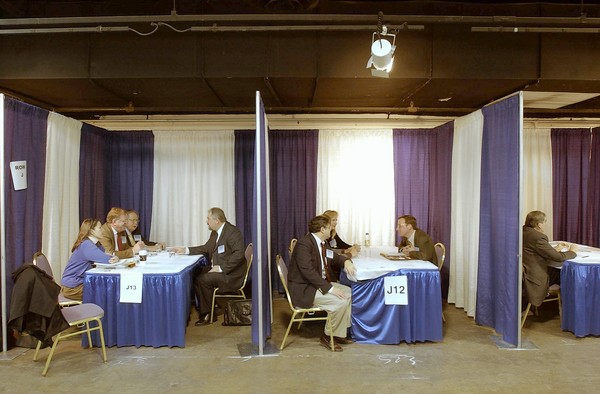
I would especially point to an article by Jennifer Howard in the Chronicle of Higher Education and an article by Ron Grossman in the Chicago Tribune, which also features a rare photo of ongoing interviews in the “job pit” at AHA:

Many universities and colleges hold their candidate interviews in hotel suites to avoid the cramped environment and general din of the “job pit”, but the suites are more expensive and some university administrators refuse to pay for better interviewing spaces. I was pleased that Northern Illinois University was able to conduct candidate interviews for all three of its searches in suites rather than in the “job pit”.

The AHA conference included numerous panels on new research, teaching techniques, digital humanities, and professional issues. I chaired a panel on “Creating Communities through Coercion in Seventeenth-Century France,” with presentations by Elizabeth Churchich, Jim Coons, and John McCormack. The session was well attended and the presentations provoked an excellent discussion with interventions by Orest Ranum, Jonathan Dewald, and others.  I was only able to make it to one other panel this year: “New Frontiers in the Environmental History of the Renaissance,” a fascinating session on environmental history in early modern Italy, Spain, and England.

The Book Exhibit is always a highlight of an AHA conference, allowing graduate students and professors to see the new books out in their research and teaching fields. Advanced dissertators and assistant professors often seek out editors from university presses at the Book Exhibit, hoping to attract interest in their book manuscripts. Instructors and professors browse the presses’ displays, considering books for adoption in their courses.

AHA is also somewhat of a class reunion for professors, who attend receptions hosted by specialized historical associations and universities.  I was able to attend the reception of the Society for Italian Historical Studies on Saturday evening to see some of my Italianist friends and colleagues from Firenze.  I also saw many of my peers from the graduate program of University of Illinois at Urbana-Champaign, where I did my doctoral work.

I was glad to see that a number of graduate students from Northern Illinois University were able to attend the AHA and get a glimpse into the inner workings of the historical profession.

Posted in Conferences, Graduate Work in History, History in the Media, Humanities Education, Renaissance Art and History | 1 Comment

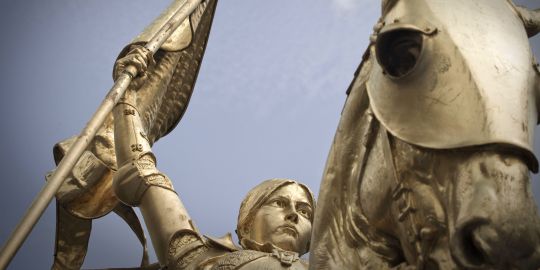
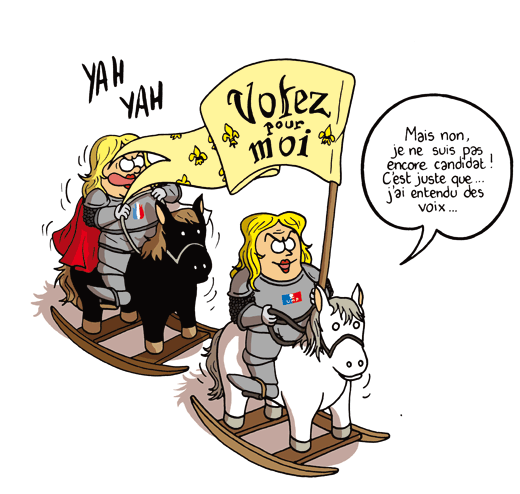
Contested Figure of Jeanne d’Arc

The image and historical legacy of Jeanne d’Arc (Joan of Arc) continues to be highly contested in France.  The 2012 Presidential Election in France is now fueling a new round of debates about the figure of Jeanne d’Arc and the place that the “maid of Orléans” should occupy in French history. Conservative Catholics and Front National politicians have long claimed Jeanne d’Arc as a devout and nationalist leader of France. Other social and political groups have also tried to claim to represent the legacy of Jeanne d’Arc.

Jeanne d’Arc provides an important model of gender and violence in French history. The religious dimensions of Jeanne d’Arc’s political agenda and military campaigns make her case significant for students of comparative religious violence and civil warfare.

Le Monde reports on current uses of the image of Jeanne d’Arc by French politicians, historians, and popular writers during the 2012 elections so far.  [Follow sidebar links for related articles on politicians’ use of Jeanne d’Arc.]

Posted in Civil Conflict, French History, Gender and Warfare, Political Culture, Religious Violence, Women and Gender History | Leave a comment

Creating Communities through Coercion

I will be chairing a session on “Creating Communities through Coercion in Seventeenth-Century France” at the American Historical Association (AHA) in Chicago in early January 2012.

AHA Session 183

Saturday, January 7, 2012: 2:30 PM-4:30 PM

Iowa Room (Chicago Marriott Downtown)

Chair: Brian W. Sandberg, Northern Illinois University

Topics:

“‘Let us melt into sadness’: Ordering France’s Emotions after the Assassination of Henry IV,” by John W. McCormack, University of Notre Dame

“Unwilling Allies: Forced Cooperation during the Princely Fronde, 1650–53,” by James Coons, University of Wisconsin-Madison

“Forcing French Catholicism: Noble Conversion and Reeducation after the Revocation of the Edict of Nantes,” by Elizabeth Churchich, Rutgers University-New Brunswick

The full session description is available in the AHA program online.

Posted in Conferences, Early Modern Europe, European Wars of Religion, French History, French Wars of Religion, Religious Violence, Warfare in the Early Modern World | 3 Comments

Jay M. Winter on “Filming War”

Historian Jay M. Winter has published an essay in Dædalus (Summer 2011) on “Filming War.” This article is part of a special issue of Dædalus devoted to “The Modern American Military,” including contributions by noted military historians Brian McAllister Linn, James J. Sheehan, Andrew J. Bacevich, and others.

Winter divides American filmmaking on war into three phases: to 1933, 1933-1970, and 1970 to the present. Winter’s essay is relatively brief, limiting the scope of his analysis. His main conclusion is that, at least by the 1970s, “the portrait of the soldier, and particularly the American soldier, came to be more important than the war in which he served.”

NIU students in HIST 390 History and Film: War in Film will be interested in this essay.

Posted in Historical Film, History of Violence, War in Film, War, Culture, and Society | Leave a comment

Fall of the Faculty

I am currently reading Benjamin Ginsberg’s The Fall of the Faculty: The Rise of the All-Administrative University and Why it Matters (Oxford: Oxford University Press, 2011).

Ginsberg, a professor of political science at Johns Hopkins University, provides a damning exposé of university administration in the United States, highlighting the dramatic growth of administrators and bureaucratic power in American universities over the past three decades. Ginsberg uses data on university administration, news stories about scandals involving administrators, and personal anecdotes from his own career to paint a disturbing portrait of presidents, “deanlets”, and other administrators. Professors will find many of Ginsberg’s observations about university administration all too familiar.

The book description is available at the Oxford University Press website.

The Wall Street Journal has published a book review of The Fall of the Faculty.  Inside Higher Ed interviews Ginsberg about the book on its website.

I am about halfway through the book now.  I will update this post with additional comments on the book once I am finished reading it.


Posted in Academic Freedom, Current Research, Humanities Education | Leave a comment

No al Razzismo!

Banners reading “No al Razzismo!” and “Il Razzismo Uccide!” have filled piazzas and adorned buildings in Firenze (Florence) following a shooting rampage by Gianluca Casseri on Tuesday. Casseri, a middle-aged Italian man who had ties to neo-fascist groups, killed two Senegalese men and wounded several others. Casseri attack seems to have had strong racist motivations, based on his connections with the neo-fascist organization, Casa Pound.

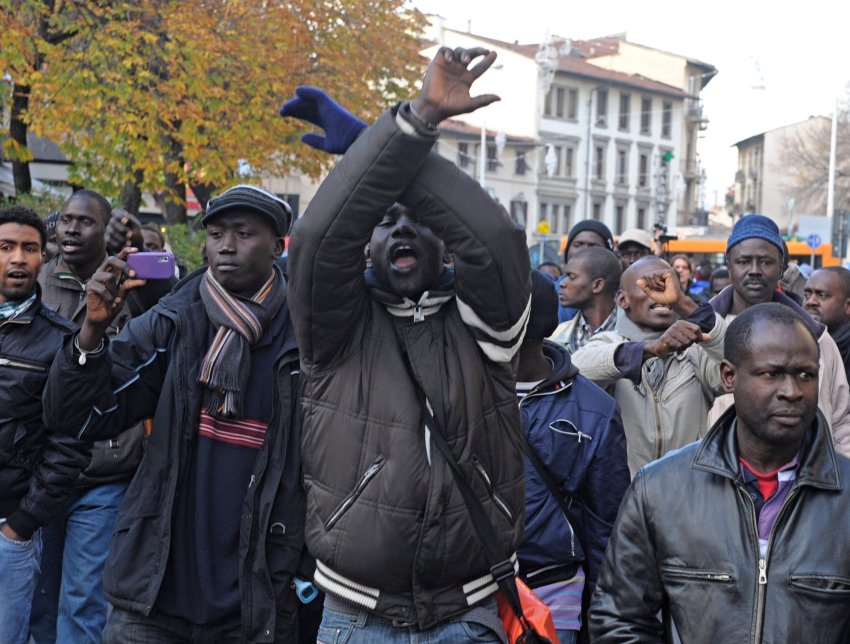
Members of the Senegalese community in Florence marched to protest the brutal killings and bring attention to the problem of racism in Italy.

Many other Florentines participated in memorials and protests in the wake of the shootings, declaring “No al Razzismo!”

La Repubblica reports on the Florentine response to the shootings and on a protest march in the nearby port of Livorno.  Der Spiegel reports on the problems of racism, extremism, and neo-fascist groups in Italy and Europe.

Posted in Arms Control, European Union, History of Violence, Italian History | Leave a comment