President Obama Marks End of Iraq War

President Obama marked the end of the Iraq War (2003-20011) with a speech at Fort Bragg today.

United States military forces are scheduled to depart from Iraq by the end of the month, but State Department officials, contractors, and security personnel will remain in the nation to support reconstruction and stability efforts.

Despite all the cheers for an end of the Iraq War, the political and security situation in Iraq remains unstable.

Historians of war and society are familiar with the difficulties of ending wars, especially ones involving serious civil conflict.  One good source for considering the problem of halting civil warfare is Roy Licklider, ed. Stopping the Killling: How Civil Wars End (New York: New York University Press, 1993).

Posted in Civil Conflict, History of Violence, War, Culture, and Society | Leave a comment

Accounts of Haditha Massacre Salvaged

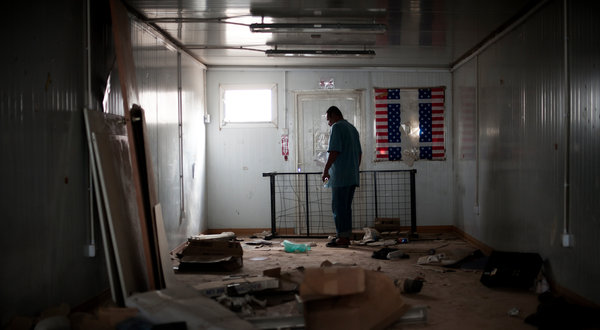
The New York Times is claiming that one of its reporters has salvaged classified documents that were part of an internal United States military investigation of the 2005 Haditha Massacre, one of the pivotal events of the Iraq War.

Photo source: New York Times.

If the New York Times claim is confirmed, it would suggest that U.S. military forces have engaged in a deliberate policy of destroying important legal and historical records.

Historians of warfare and society should be deeply concerned about the implications of this story. There seems to be a possibility that the U.S. military is destroying massive collections of documentary source material of vital importance for current and future historians of the Iraq War. U.S. military documents from the Iraq War should instead be destined for the National Archives of the United States.

The New York Times report is available at their website.

This is a breaking story, so I will provide more information once it becomes available.

Posted in Archival Research, Empires and Imperialism, History of Violence, War, Culture, and Society | Leave a comment

Children’s Reading and Political Culture

Julia Mickenberg (University of Texas at Austin) was interviewed recently on television about how children’s views are shaped by reading children’s books. Julia is the author of Learning from the Left: Children’s Literature, The Cold War, and Radical Politics in the United States (2006), and co-editor of Tales for Little Rebels: A Collection of Radical Children’s Literature (2008).

Children’s literature has been studied from a number of perspectives, but Julia’s research demonstrates the complex relationships between children’s books and political culture in the United States. Communism, Socialism, McCarthyism, and Conservatism all entered the pages of children’s books, sometimes overtly—but often subtly—shaping children’s attitudes.

Julia is a friend who was based at the Institute for Research in the Humanities in Madison with me in 2009-2010. Congrats to Julia on this fine television interview!

The interview is available on the website of Austin’s Fox affiliate, Fox 7.

Posted in Political Culture | Leave a comment

Grenade Attack in Liège and Shooting in Firenze

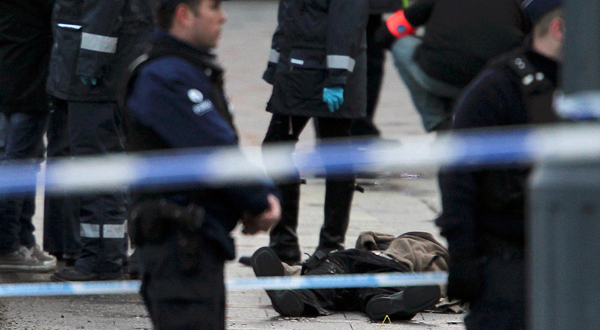
A young Belgian man attacked a crowd in the city of Liège today, firing shots and throwing multiple grenades at people in the central square in downtown Liège. Several people were killed and scores injured in this attack before the young man killed himself.

Details are just emerging on the attacker, who appears to have no ties to terrorist groups.  It appears that this attack was in retaliation for a judicial sentence, but investigations are ongoing.

Meanwhile, another attacker fired on African immigrants in Firenze (Florence), Italy, killing two Senegalese men.  The attacker, a middle-aged Italian man with known connections to racist groups, apparently committed suicide following the attacks.

France 24 News reports on the attacks in Liège, as does BBC and the New York Times.  La Repubblica reports on the attacks in Firenze.

Faculty and students at Northern Illinois University can sympathize with the victims in Belgium and Italy, and with all who have experienced similar acts of violence. An ex-student killed five students and wounded dozens in a shooting on NIU’s campus in 2008. Libération provides a map of the bloodiest rampages since 2001, but they have left out the NIU shooting in 2008 and other rampages:
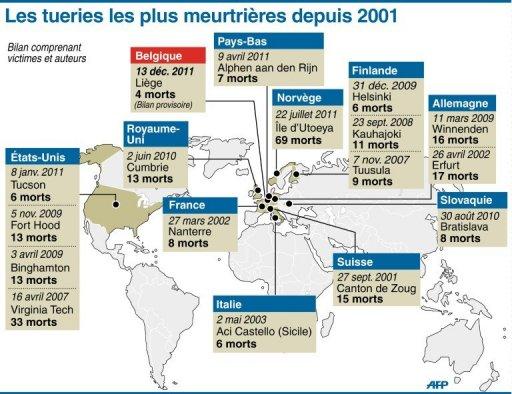
Gun violence and political extremism in the European Union are growing problems that need to be considered carefully by historians of violence. Europeans will doubtlessly wonder whether the attackers in both of these rampages had ties to extremist groups within Europe, since a number of acts of violence over the past several years were committed by European males who had connections with racist and/or militant groups.

France 24, Libération, and the BBC provide follow-up reports, indicating that 4 persons were killed and 125 wounded in the rampage in Liège. The attacker in Liège has been identified as Nordine Amrani, a Moroccan-Belgian man who had had been investigated for marijuana growing and arms possession. Amrani’s former lawyer has accused Belgian police of harassing his former client.  More information will follow as details emerge.

Posted in Arms Control, European Union, History of Violence, Italian History | Leave a comment

Commemorating the American Civil War in Illinois

The 150th anniversary of the American Civil War is being commemorated across the United States.

The Illinois Civil War Sesquicentennial Website has been created to provide information on events commemorating the American Civil War in Illinois, as well as resources on Illinois’s involvement in the American Civil War. The Abraham Lincoln Presidential Library and Museum, Chicago History Museum, Old State Capitol State Historic Site, and DuPage County Historical Museum will all be presenting exhibits.

NIU students interested in the American Civil War may find information on local and regional conferences and other events relating to the Civil War on the Sesquicentennial Website.


Posted in Civil Conflict, History in the Media, Northern Illinois University, War, Culture, and Society | Leave a comment

Postdoc in Religious Studies

CUNY Graduate Center has announced a Postdoctoral Fellowship in Religious Studies, with an interest in the history of religious violence.

According to the description: “The Graduate Center of the City University of New York, the Ph.D-granting institution of CUNY, announces a postdoctoral fellowship for the academic year 2012-2013 in the interdisciplinary Committee for the Study of Religion. The study of religion includes, but is not limited to, such areas of research as violence and sacred space, fundamentalism, popular religion, piety, and post-secularism.”

H-Net has the full announcement for this Postdoctoral Fellowship.


Posted in Graduate Work in History, Grants and Fellowships, Religious Violence | Leave a comment

A Growing Francophonie

Francophonie is apparently growing rapidly.

Demographic studies of French-speaking populations suggest that French language use is increasing worldwide.  Francophonie is normally defined as the group of nations that have adopted French as an official language—including France, Switzerland, Belgium, Canada, Haiti, Guadaloupe, Sénégal, Mali, Côte d’Ivoire, Madagascar, Viêt Nam, and other nations. Although the European French-speaking population is relatively stable, the Francophone population of many African, Asian, and Caribbean nations is growing rapidly.

Researchers at Université Laval in Canada project that the Francophone population will grow from an estimated 175 million French speakers worldwide in 2000 to 680 million French speakers by 2050.  See: Richard Marcoux et Mathieu Gagné, “La francophonie de demain : essai de mesure de la population appartenant à la francophonie d’ici 2050,” Cahiers québécois de démographie 32:2 (2003): 273-294.

French-language instruction programs in American and other Anglophone nations need to prepare students to interact with the growing Francophone population worldwide. French historians need to develop more courses dealing with French dimensions of globalization.  Too often, globalization is understood exclusively through Anglo-American or Chinese perspectives.

For more information on Francophonie, see the Organisation Internationale de la Francophonie (OIF).

Posted in Education Policy, French History, Globalization, Humanities Education | Leave a comment

Autolib’ in Paris

Autolib’ is arriving in Paris!

Following the success of the Vélib’ bicycle renting service, Paris is installing car rental stations across the city. Paris continues to reinvent itself and to redefine urban modernity. The Autolib’ system will use electric cars and is projected to significantly reduce the total number of cars in Paris.

French historians and graduate students doing research in Paris will be eager to use both the Vélib’ and Autolib’ systems, which allow new mobility for foreign scholars on long-term research stays in the city.

The BBC reports on Autolib’.

Posted in Environmental History, French History, Paris History | Leave a comment

Manuscript Studies and Multispectral Imaging

Manuscript studies are going hi-tech.

Historical researchers working on manuscripts from the ancient, medieval, and early modern periods can now utilize sophisticated imaging instruments to reveal traces of ink and other materials that have faded and are no longer legible.

Digital humanities projects involve much more than merely scanning and digitization projects.  Most humanities scholars are familiar with online digital humanities resources, which are certainly helpful in expanding accessibility to humanities documents.  Some humanities researchers are developing research techniques and tools that allow scholars to examine documents and collections in entirely new ways.

The Economist reports on the multispectral imaging instruments and techniques being used by a team of researchers at the University of Oxford.

It turns out that this is my 200th post in Historical Perspectives!  Thanks to everyone who has been reading my discussions of research, writing, teaching, and the historical discipline!

Posted in Archival Research, Digital Humanities, Early Modern Europe, Early Modern World, History of the Book | Leave a comment

Creating Communities through Coercion

I will be chairing a session on “Creating Communities through Coercion in Seventeenth-Century France” at the American Historical Association (AHA) in Chicago in early January 2012.

AHA Session 183

Saturday, January 7, 2012: 2:30 PM-4:30 PM

Iowa Room (Chicago Marriott Downtown)

Chair: Brian W. Sandberg, Northern Illinois University


Topics:

“‘Let us melt into sadness’: Ordering France’s Emotions after the Assassination of Henry IV,” by John W. McCormack, University of Notre Dame

“Unwilling Allies: Forced Cooperation during the Princely Fronde, 1650–53,” by James Coons, University of Wisconsin-Madison

“Forcing French Catholicism: Noble Conversion and Reeducation after the Revocation of the Edict of Nantes,” by Elizabeth Churchich, Rutgers University-New Brunswick

The full session description is available in the AHA program online.

Posted in Conferences, Early Modern Europe, European Wars of Religion, French History, French Wars of Religion, Religious Violence, Warfare in the Early Modern World | Leave a comment