Exeter College (Oxford) is offering a fellowship in early modern Spanish studies in honor of Sir John Elliott, renowned historian of early modern Spain and its empire.
Doctoral candidates and recent Ph.D.s working on early modern Spain and its empire may be interested in applying for this fellowship.
Here is the fellowship announcement from Exeter College:
Diego Velásquez, The Surrender of Breda, 1634-1635.
Exeter College (part of the University of Oxford) invites applications for the Sir John Elliott Fellowship in Early Modern Spanish Studies. This post is made possible through the generosity of Centro de Estudios Europa Hispánica (CEEH).
The Fellowship will be tenable for a period of 36 months from 1 September 2022, or as soon as possible thereafter.
The main duties of the post are to engage in advanced study and research in the area of Early Modern Spanish Studies – specifically, into some aspect of Spanish cultural expression between 1450 and 1700. Culture is understood as including literature, visual & performing arts, material culture and history of knowledge. The Fellow will build an international research profile through innovative original research, preparing work for publication (in monographs and/ or journals), and participating in international conferences. The postholder will also be a member of the Governing Body at Exeter College, with associated administrative and Trustee duties.
There will be no teaching obligation attached to the Fellowship, although the postholder will be welcome to do a limited amount of teaching within the collegiate University if they wish to do so, and especially where such teaching experience will enhance the career development of the postholder.
The successful candidate will:
Have a research record of international standing, appropriate to the stage of the candidate’s career, with evidence of, or evidence of potential for producing, research of international standing in Early Modern Spanish Studies;
Have the ability to undertake College administration and duties; and
Hold, or be close to completion of, a PhD, or equivalent, in a relevant field. They must also have submitted their doctoral thesis for examination between 1 June 2018 and 31 May 2022 (inclusive). As indicated in the Further Particulars, career breaks for family or health reasons, and pandemic-related disruption, will be taken into account.
The Fellow will be appointed on a salary of £33,309 per annum. In addition to salary, a range of other generous benefits are available, as set out in the Further Particulars.
The closing date for applications, and the last date for receipt of references direct from referees, is 12pm noon (GMT) on Monday 28 February 2022. It is the responsibility of each applicant to ensure that their application, and references, arrive before the deadline.
Exeter College is an equal opportunities employer and values diversity.
This year, French jurists and academics are remembering Jacques Cujas, an important humanist legal scholar who was born 500 years ago in 1522.
Jacques Cujas, Musée du Vieux Toulouse, Inv 22.5.1
Humanism is often understood primarily as a literary movement during the Renaissance, but humanists worked in diverse intellectual disciplines, including the fields of law.
Jacques Cujas’s legal writings became associated with a legal Renaissance in France during the sixteenth century. Cujas wrote during the upheavals of the French Wars of Religion (1559-1629).
France mémoire describes Jacques Cujas’s contribution to French legal humanism:
“Peu connu du grand public, Jacques Cujas devint, en participant à la Renaissance au renouvellement des méthodes employées dans l’enseignement du droit, une figure majeure de l’Université française. L’Empereur Justinien avait fait compiler, réviser, et amender au VIe siècle les règles du droit romain, et en avait réalisé la somme dans une série d’ouvrages appelée compilations justiniennes (Code, Digeste, Institutes, Novelles). Au cœur du Moyen Âge, ces textes réapparurent en Occident après cinq siècles d’un quasi-oubli. En rupture avec la scolatisque médiévale, l’humanisme renaissant chercha par une étude critique des textes à en rétablir le sens historique. Né il y a 500 ans, Jacques Cujas fut l’un des plus brillants représentants de cet « humanisme juridique » et exerça une influence durable dans le domaine du droit.”
This 500th anniversary may not be the biggest historical commemoration of the year, but students of early modern history, French history, Parisian history, and Renaissance studies will be curious to learn about Jacques Cujas.
Visitors to the Sorbonne in Paris may recognize the nearby rue Cujas, which commemorates the jurist’s historical contribution to French jurisprudence.
rue Cujas, 5th arrondissement, Paris.
France mémoire provides resources on Jacques Cujas and the French Renaissance in law.
Archaeologists made a curious find during recent excavations at St. Mary’s, a colonial settlement in Maryland.
One of the participants in a dig unearthed “a rare 370-year-old Spanish cross that had likely been made in the pilgrimage city of Caravaca, Spain, around 1650 and had made its way 4,000 miles to a meadow in southern Maryland.”
Image: The Washington Post.
The history of this particular cross is unknown, but it presumably belonged to one of the English Catholics who settled in early modern Maryland. The Washington Post explains that “Maryland’s original 150 colonists, including many English Catholics fleeing Protestant persecution, had arrived at St. Mary’s on two ships, the Ark and the Dove, in late March 1634.”
Religion and empire were closely intertwined in the early modern American colonies, and archaeological excavations continue to reveal new dimensions of religious practices and material culture from the early modern period.
The World History Association is developing a major curricular project on History for the 21st Century, aimed at improving History survey courses.
The WHA is currently hiring an Assistant Director for the History for the 21st Century Project.
The ad from the World History Association on H-Net reads:
Call for Applications: Assistant Director of History for the 21st Century
History for the 21st Century (“H/21”) is a collaborative, faculty-led initiative of the World History Association with a central mission of enabling college and university faculty to effectively introduce students to the historical thinking necessary for fostering an equitable and sustainable world. Most colleges and universities offer General Education history courses at the first-year level that aim to help students to understand their lives in historical perspective, to make mature decisions today, and to gain intellectual tools to build on that understanding throughout their lives. Recent years have seen changes in the focus and preparation of students, innovations in educational technology and pedagogies, new curricular requirements, and new ethical and ecological imperatives. The goal of History for the 21st Century is to support educators in adapting to this new environment through a faculty-led collaborative effort focusing centrally on General Education history courses. Our goal is to offer free, student-centered, inquiry-driven, and user-friendly materials for the General Education history classroom. These materials will enable students to see themselves (and their ancestors) within historical narratives that provide meaning for their present and for their future. For the first phase of this project, these materials will take the form of roughly 20 free, digitally available teaching units (called Modules Ready to Educate, or MREs) that help teach both historical skills and content.
Within this context, H/21 aims to focus on:
introductory college courses, since these are the highest impact courses and are often the only history course history (or, indeed, course in the humanities) that non-majors ever take.
both the world history and American history frameworks.
engaging students in active learning within large-class settings (H/21 is not focused on small seminars or cross-disciplinary ‘first-year experience’ programs).
producing materials including content, primary sources, activities, and assessment tools that faculty can adapt to the particular courses they offer.
engaging with the diverse range of human experiences, including going beyond standard historical narratives and centering peoples commonly de-centered in or absent from those narratives.
producing materials that are peer reviewed by content experts, vetted by experienced educators, and can be revised based on future evidence.
producing materials that are available to faculty and students at no charge.
Position Description
The Assistant Director of History for the 21st Century will support the Director in the production of the MREs. Their central responsibilities will include the design of digital MREs, the project’s website, and interactive portal(s) for faculty; liaising with authors (who will also be practicing historians) to ensure conformity of skills, language, and depth of content across the MREs; assisting to secure copyright permissions; and assisting to organize public events and training workshops. The Assistant Director should also be capable of producing MREs of their own based on best practices in history pedagogy and up-to-date scholarship in the discipline.
This two-year position will be the rough equivalent of a half-time job with compensation based on experience. There may be a possibility for extension after the first two years. The Assistant Director will report directly to the Director but will also attend and participate in Executive Council meetings. There is no fixed location for work.
Minimum Qualifications
Two years of experience teaching at the postsecondary level
A MA or PhD in History, with a demonstrated expertise in a coherently defined research project
Experience in digital humanities, including website construction and digital design
Experience with student-centered, inquiry-based, active learning
Preferred Qualifications
Experience producing independent syllabuses and lesson plans for large history courses at the postsecondary level
Experience in teaching introductory world history or General Education history courses at the postsecondary level
Ability to work positively, productively, and collegially with a diverse range of scholars
Experience with training educators
Experience with event organizing
Demonstrated ability to see complex projects (including research projects) to their completion
Application
To apply, submit a cover letter, CV, and sample syllabus by March 1st to info@history21.com. For questions, contact Jesse Spohnholz, Director, at spohnhoj@wsu.edu
I was excited to receive my copy of Die Kapitalisierung des Krieges: Kriegsunternehmer in Spätmittelalter und Früher Neuzeit yesterday in the campus mail at Northern Illinois University.
The book presents comparative studies of military entrepreneurship, war finance, military logistics, and early capitalism during the European Wars of Religion of the sixteenth and seventeenth centuries. A number of the essays in the volume focus on military entrepreneurs in the Thirty Years’ War (1618-1648). The volume should be useful for historians thinking about long wars and military contracting in modern and contemporary conflicts.
This newly published collective volume that grew out of a conference on Die Kapitalisierung des Krieges / The Capitalization of War, held at the Deutsches Historisches Museum in 2009.
I participated in the conference and presented a paper on military contractors in the French Wars of Religion, which I later developed into a chapter for the collective volume.
Brian Sandberg, “‘Avarice Never Made Him Unsheathe a Mercenary Sword’: Military Contractors in the French Wars of Religion, 1562–1629,” in Die Kapitalisierung des Krieges: Kriegsunternehmer in Spätmittelalter und Früher Neuzeit, ed. Matthias Meinhardt and Markus Meumann (Berlin: LIT Verlag, 2021), 85-104.
The publisher, LIT Verlag, provides a book description. Google Books offers a preview of the book.
The history of migration has become a major area of study in the Mediterranean World.
The recent patterns of migration by North Africans, Sub-Saharan Africans, and Syrians across the Mediterranean toward European nations has created a series of political crises in the European Union. Growing anti-immigrant sentiments and racial politics have greatly complicated efforts at alleviating the suffering of economic migrants and political refugees across the Mediterranean. Many migrants have lost their lives in shipwrecks and others have been detained in refugee camps.
Pre-modern historians have been working to set these current crises into a much longer history of migration that discusses expulsions, displacements, refugees, and exiles in complex ways. Mayte Green-Mercado’s work fits into this broader effort.
The Center for Renaissance Studies is hosting a Premodern Studies Seminar featuring Mayte Green-Mercado’s paper on “Mediterranean Displacements: Morisco Migrations in the Sixteenth Century.”
Graduate students interested in pre-modern History and Mediterranean studies will be interested in this seminar.
Here is the announcement from the Center for Renaissance Studies at the Newberry Library:
Mediterranean Displacements: Morisco Migrations in the Sixteenth Century
Mayte Green-Mercado, Rutgers University-Newark Friday, February 4, 2022 1-3 pm Central Time Zoom
This paper examines the phenomenon of migration and displacement of Moriscos—Iberian Muslims forcibly converted to Catholicism in the first two decades of the sixteenth century—before the expulsion of this community from the Iberian Peninsula in 1609. Taking a prosopographical and micro historical approach that focuses on the Izquierdos, a wealthy family of Morisco merchants who were at the center of a rebellion conspiracy in Valencia and Aragon in the 1570s and 1580s, the aim is to examine the experiences of displacement of Moriscos before the forced exiles. Some guiding questions that this paper will address are: to what degree did migrant and displaced Moriscos keep ties with their communities of origin? Did the mobility of Moriscos impact the lives of their coreligionists living in the Peninsula? This paper is part of a larger project that aims to consider the ways in which the fields of migration studies, diaspora studies, and critical refugee studies can contribute to our knowledge of Morisco history and identity.
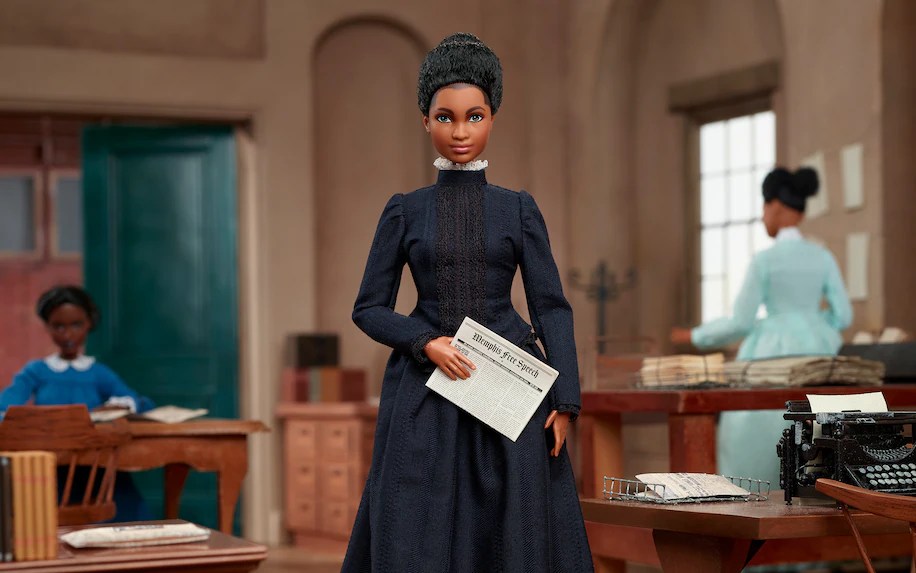
This Martin Luther King Day, a new historical action figure is being released. Mattel is launching a Barbie doll portraying Ida B. Wells.
The Washington Post reports that “Black American journalist, suffragist and anti-lynching crusader Ida B. Wells will have her likeness transformed into a Barbie doll to honor her historic achievements.
“Wells, who was born into slavery in Mississippi in 1862 during the Civil War, went on to break boundaries as a prominent suffragist fighting to expand the right to vote. Wells also won a posthumous Pulitzer Prize in 2020 for her ‘courageous reporting on the horrific and vicious violence against African Americans during the era of lynching’ and helped to found the National Association for the Advancement of Colored People (NAACP).”
Historical dolls and action figures have become quite popular among adult history fans, as well as children and teenagers.
Action figures depict major political and military leaders from many periods in world history: Ramses II, Alexander the Great, Genghis Khan, Pope Innocent III, George Washington, Wolfgang Amadeus Mozart, Napoléon Bonaparte, Karl Marx, Dwight Eisenhower, and The Beatles.
Historical action figures have been created for modern heroes of the Civil Rights movements, including Martin Luther King, Jr. Women’s Rights movements are celebrated with historical action figures of Susan B. Anthony and Ruth Bader Ginsburg, as well as images of powerful women like Rosie the Riveter and Wonder Woman.
Some historical action figures have been created for major historical commemorations. For example, Playmobil launched a Martin Luther action figure to coincide with the 500th anniversary of the Ninety-Five Theses in 2017.
Many graduate students and professors’ desks and bookshelves are now adorned with historical action figures.
The Washington Postarticle on the Ida B. Wells Barbie doll is available on its website.
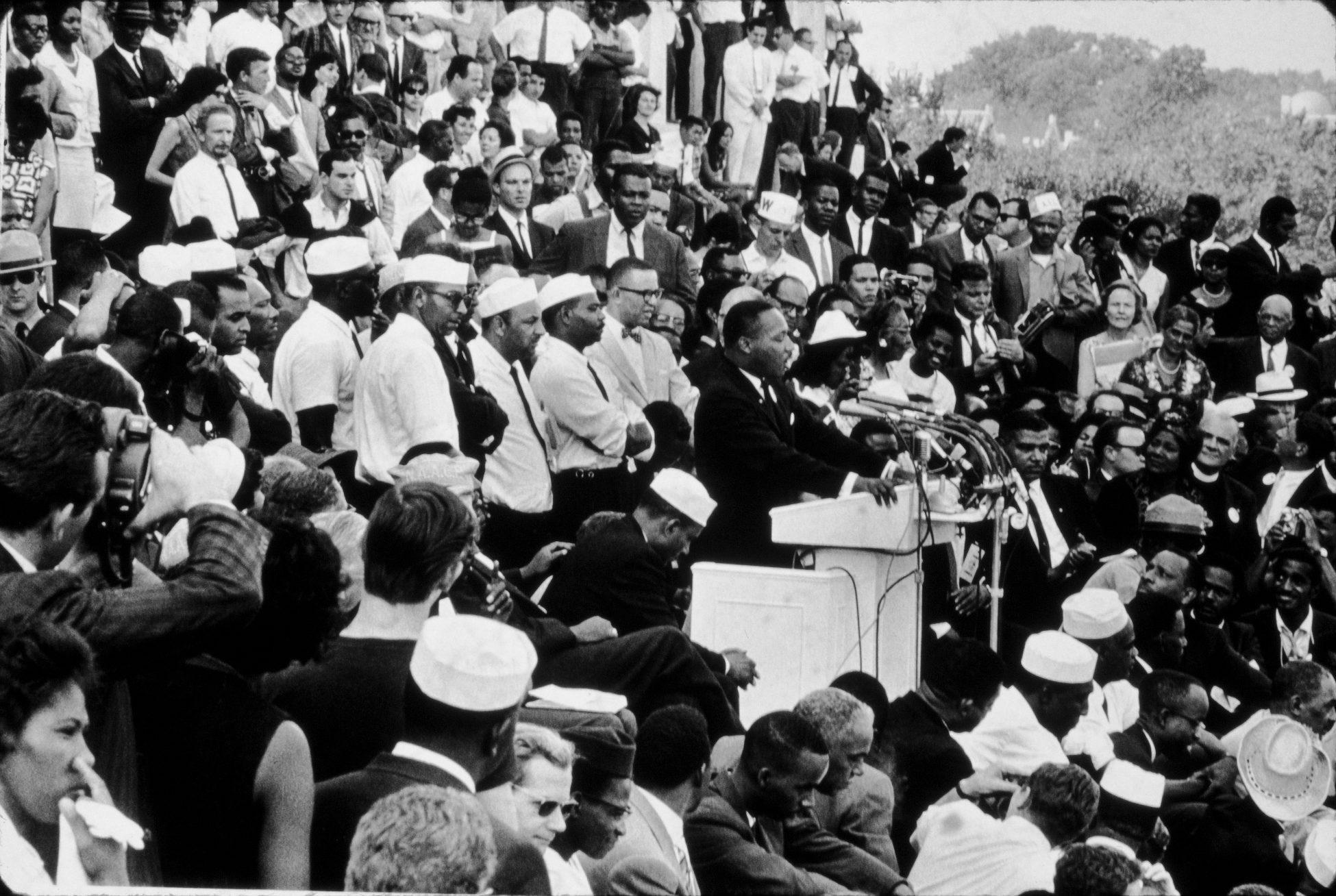
We are remembering Martin Luther King, Jr., and his powerful leadership of the Civil Rights Movement today on MLK Day 2022.
WBEZ in Chicago provides Studs Terkel’s famous recordings of the 1963 Train Ride to Washington, focusing on interviews with Chicagoans heading to Washington, D.C., to participate in the March on Washington. Many of those interviewees probably heard Martin Luther King, Jr., deliver his “I Have a Dream” speech.
Martin Luther King, Jr., commented in 1963 on the “minority of misguided senators” who would use the filibuster to block voting rights legislation.
The Washington Post recently reported on Dr. King’s comments on the filibuster and provided the video of those comments.
WBEZ provides Studs Terkel’s recordings on its website.
The Chicago History Museum offers a exhibition on Remembering Dr. King: 1929-1968, a virtual tour of Chicago sites associated with Martin Luther King, Jr.
Brown University’s Digital Publications Initiative is organizing an NEH Institute on Born-Digital Scholarly Publishing: Resources and Roadmaps in summer 2022.
Professors, post-doctoral researchers, and independent scholars working in Digital Humanities may be interested in this opportunity.
I have previously participated in NEH summer institutes and seminars for faculty and can recommend them highly.
Here is the announcement from Brown University’s Digital Publications Initiative, as posted on H-Net:
Brown University Library’s Digital Publications Initiative invites applications for participation in an NEH Institute on Advanced Topics in the Digital Humanities, Born-Digital Scholarly Publishing: Resources and Roadmaps. The three-week hybrid Institute will take place virtually July 11-24 and in person at Brown University July 25-29, 2022. Participant travel, lodging, and per diem expenses will be covered for the in-person component.*
Born-Digital Scholarly Publishing: Resources and Roadmaps supports scholars who wish to pursue interpretive projects that require digital expression and are intended for publication by a scholarly press, but who lack resources and capacity at their home institutions. Projects must be conceived of as born-digital, or digital-first. The Institute does not support digitization projects or the development of supplemental websites for print books, but rather publication projects anchored by an original, longform narrative. The Institute will train a cohort of 15 scholars – including unaffiliated scholars, adjunct professors, and part-time faculty from a range of disciplines, institution type, and geographical location – in best practices unique to the development of digital scholarly publications. The cohort will be supported by a faculty composed of authors of published or in-progress enhanced digital monographs and digital publishing experts from university presses and the Brown University Library.
The Institute has been organized as a hybrid, multi-phased training and mentoring program:
A two-week virtual course will introduce participants to resources, considerations, and strategies for digital publishing (July 11–22, 2022).
A one-week in-person workshop will yield individualized roadmaps for cohort projects (July 25–29, 2022).
Two two-day virtual check-ins will extend individualized project support (Oct. 2022 and Jan. 2023).
Eligibility
The application is open to scholars of all ranks, including university faculty and adjuncts, postdoctoral researchers, and independent scholars. Applicants must have a Ph.D.
Brown University Library is a member of the HBCU Library Alliance. Based on this affiliation, some slots will be reserved for participants from member institutions.
Applicants based in any country are welcome, though the NEH Institutes for Advanced Topics in the Digital Humanities (IATDH) program focuses on scholars currently studying or employed at institutions in the U.S. Thus, U.S. citizens and/or U.S.-based scholars will be given priority. International applicants and/or persons without a current U.S. visa should note that, if selected and if an in-person meeting is possible, a visa cannot be guaranteed.
How to Apply
The following materials should be sent to Allison Levy, Digital Scholarship Editor, Brown University Library (digitalpublishing@brown.edu), no later than March 15, 2022:
A statement (maximum 3 pages) thatdirectly addresses the following questions:
Describe your digital monograph project. Why is the digital format necessary for advancing your argument? What is the current state of the project?
How would your project benefit from and contribute to a collaborative Institute experience?
How will your participation in the Institute contribute to expanding digital scholarship at your institution or in your field?
A current C.V.
Notification of Acceptance: April 15, 2022
*Depending on public health guidelines related to COVID-19, plans for in-person training are subject to change.
All news reports adopt positions that are essentially political in nature (whether consciously or unconsciously), by presenting social issues through their selection of interview subjects, quotes, framing, interpretation, and commentary. Political philosophies and positions (not necessarily aligned with political parties) inform journalists’ choices in composing their reports. In this sense, the field of Journalism (like the discipline of History) is fundamentally interpretive. No reporter or columnist can escape from the interpretive nature of their practice.
News media companies and organizations inherently adopt political tendencies, since the editors (and sometimes the owners and managers) shape the selection of newsworthy events and issues, the reporting assignments, the writing and copyediting processes, the word counts of individual articles, the approval processes, the placement of articles within the print and/or online publication, the promotion and distribution of reports, and follow-up possibilities.
Unfortunately, these political positions and tendencies are often discussed simply through the lens of “biases,” which is a rather reductive and misleading notion in discussing news media.
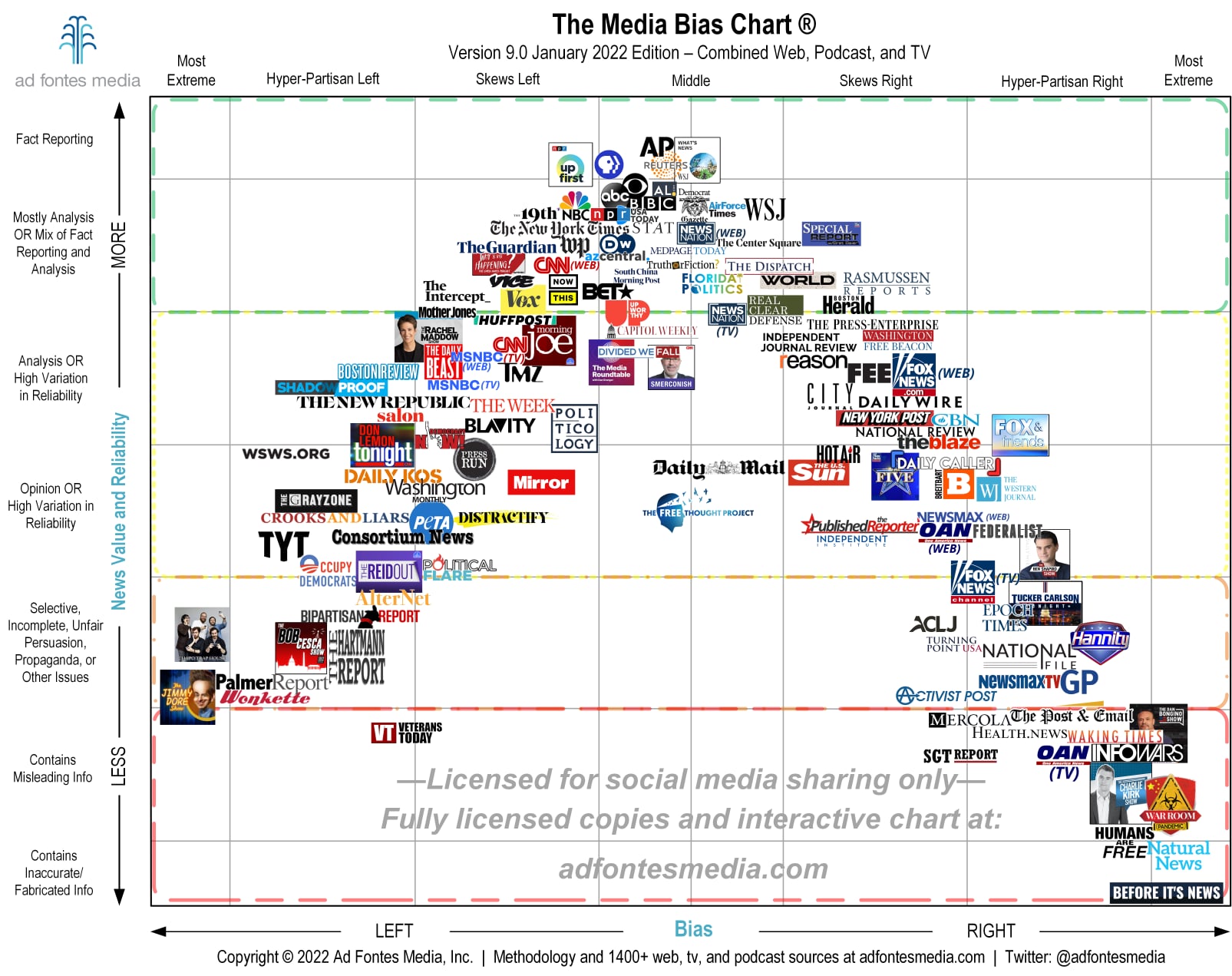
Many organizations seek to assess “media biases,” and Ad Fontes Media has just released its annual Media Bias Chart for 2022.
Media Bias Chart, 2022. Ad Fontes Media.
The Media Bias Chart provides an interesting visualization of the news media landscape in the United States, but its organization of media positions onto a Left – Middle – Right spectrum is highly problematic. This reifies an outdated model of politics which stems from the seating of deputies within the National Assembly during the French Revolution and their affiliations with Republican, Constitutional Monarchist, and Absolute Monarchist positions. However, these left, middle, and right distinctions broke down during the course of the French Revolution and Napoleonic Empire.
The Left, Middle, and Right spectrum was then used to describe classical political ideologies of nineteenth-century French and European political systems: Socialism, Liberalism, and Conservatism (with Communism eventually added). However, these ideological identifications with Left, Middle, and Right did not always work well to describe political identities or party affiliations. The distinctions were later modified to describe twentieth-century ideologies (Communism, Liberalism, and Fascism), Cold War ideologies, and the United States political system.
However, in the post-Cold War world, the continued use of Left, Middle, Right political labels has been completely disrupted by ethnic, racial, gender, environmental, and other political identities that simply cannot be grafted onto older political identification schemes. Political landscapes arguably need to be completely rethought.
Further the Media Bias Chart rates media organizations in terms of Skews (Left or Right) Hyper-Partisan (Left or Right), and Most Extreme (Left or Right), instead of actually identifying the positions and party affiliations or reporting. Further, the chart imagines a Middle as being unbiased, which reinforces an unattainable ideal news reporting as being “unbiased.”
Interestingly, there seems to be a sharp divergence between understandings of news media in the United States and Europe. Americans often complain of “biased” news reporting, but have no idea of political positions or affiliations of news organizations. Citizens of European nations are often much more aware of the political positions of the news media organizations that produce news reports. The public news media in many nations have channels designated for the majority party or coalition in the national parliament, as well as for the opposition party or coalition.
Since the late eighteenth century, newspapers, news radio channels, television news programs, and internet news companies have often had direct connections with organized political parties. Indeed, throughout modern history, many news media organizations have been official arms of political parties.
So, organizations like Ad Fontes Media might usefully alter their methodologies to investigate political positioning rather than “bias” in news media in the United States. Ad Fontes Media’s current Media Bias Chart uses a generic “left versus right” spectrum, rather than examining connections with particular political positions, parties, wings of parties, or organized political groups.
Ad Fontes Media’s mission statement reads: “Ad Fontes Media, Inc. is a company founded in 2018 by Vanessa Otero, creator of the Media Bias Chart®. The mission of Ad Fontes Media is ‘to make news consumers smarter and news media better.’ We rate the news for reliability and bias to help people navigate the news landscape. Ad Fontes is Latin for ‘to the source,’ because at the heart of what Ad Fontes Media does is look at the source—analyze the very content itself—to rate it. We have created a system of news content ratings that has beneficial applications for all stakeholders in a healthy news media landscape, including consumers, educators, publishers, researchers, advertisers, and social media platforms.”
At the same time, the Ad Fontes Media company is trying to sell memberships and products to individuals, media companies, and public school systems. So, readers may wonder about its political positions and educational agendas, too.
A deeper understanding of the history of news would arguably help students and citizens develop a better understanding of modern news media and a stronger analytical framework for reading news reports more critically.
For more information on the history of news media, see:
Peter Burke, A Social History of Knowledge, 2 vols. (Polity Press, 2000, 2012).
Peter Burke, What is the History of Knowledge (Polity Press, 2015).
Asa Briggs, Peter Burke, and Espen Ytreberg, Social History of the Media, 4th ed. (Polity Press, 2020). A book description is available at Polity Press.
Brendan Dooley, ed., The Politics of Information in Early Modern Europe (Routledge, 2001).
Brendan Dooley, ed., The Dissemination of News and the Emergence of Contemporaneity in Early Modern Europe (Ashgate, 2010).
Andrew Pettegree, The Invention of News (Yale, 2014).








 Brian Sandberg: Historical Perspectives