Sedition and Civil Conflict in the United States

Today, the FBI arrested a eleven members of the Oath Keepers, a far-right militia, over their involvement in the Storming of the United States Capitol on 6 January 2021. The U.S. Department of Justice is charging Stewart Rhodes, founder of the Oath Keepers, and his comrades with seditious conspiracy.

Stewart Rhodes, founder of the Oath Keepers. Image: The New York Times

Historians, political scientists, and scholars working on far-right political groups and militia organizations have been tracking the growing racial violence and civil conflict in the United States over the past decade. The Storming of the U.S. Capitol clearly brought heightened public awareness of these trends, even if some politicians have sought to downplay the threat of extremist violence and domestic terrorism.

Analysts have been debating the level of civil unrest and the forms and dynamics of violence. Much of the news media discussion of these issues has focused on whether or not there is a threat of a “civil war” in the United States, often referencing the American Civil War (1861-1865) as a model for understanding civil warfare. Yet, there are other ways of envisioning the potential for civil conflict in contemporary American society, which is deeply divided by partisan politics, culture wars, religious animosities, and racial tensions. After all, the United States has experienced many periods of serious civil conflict in its history that involved armed coercion, intimidation, political assassinations, bombings, raids, massacres, and guerrilla warfare.

Storming of the U.S. Capitol, 6 January 2021

Students who have taken my courses on Religious Violence in Comparative Perspective and on Religious Politics and Sectarian Violence over the past fifteen years have considered readings on far-right politics, militia movements, the Turner Diaries, Timothy McVeigh, and White Christian Nationalists in the context of terrorism and comparative religious violence. They have read works on comparative religious violence by Mark Juergensmeyer, Talal Asad, R. Scott Appleby, Stanley Tambiah, and other scholars to contextualize and understand this violence.

Last semester (Fall 2021), I taught a course on Communal Strife: Civil Wars in World History, in which students considered White Christian Nationalists and the Storming of the U.S. Capitol as a case of civil conflict. My students read analyses of the Storming of the Capitol by Kathleen Belew, Philip Gorski, Monica Duffy Toft, Stathis Kalyvas, and others. They also had the opportunity to compare the recent civil violence with other episodes of civil conflict from 1500 to the present.

The charging of the Oath Keepers with seditious conspiracy brings the potential for sedition and civil violence into sharper relief, as legal arguments will now be deployed on the issue.

The New York Times rightly indicates that “the arrest of Mr. Rhodes, 56, was a major development in the sprawling investigation of the Capitol attack. He and the other Oath Keepers are the first to be charged with sedition among the more than 700 people accused so far of taking part in the assault.”

According to The New York Times, “beginning only days after the 2020 election, Mr. Rhodes oversaw a seditious plot ‘to oppose the lawful transfer of presidential power by force,’ prosecutors said. Some members of the Oath Keepers under his command broke into the Capitol in a military-style formation on Jan. 6 and went in search of Speaker Nancy Pelosi, the indictment said. Others, it said, were stationed in a hotel in Alexandria, Va., as an armed ‘quick reaction force,’ ready to rush into Washington if needed.”

The active prosecution of the Oath Keepers for sedition should bring an awareness of the reality of civil conflict in United States society and the serious potential for further violence.

The New York Times reports on the arrest of the Oath Keepers and the charges of seditious conspiracy.

Posted in Civil Conflict, Comparative Revolutions, History in the Media, History of Race and Racism, History of Violence, Political Activism and Protest Culture, Political Culture, Religious Politics, Religious Violence, Revolts and Revolutions, Terrorism, United States History and Society, War, Culture, and Society | Leave a comment

The Newberry Library is Reopening

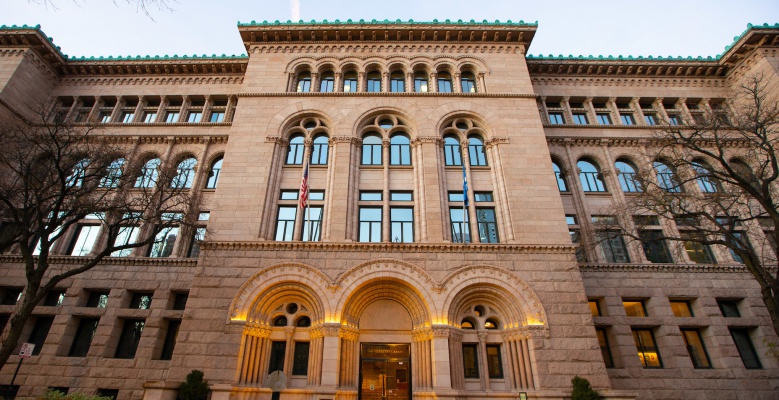
The Newberry Library in Chicago has announced that it will reopen on 18 January, following a temporary closure due to the Omicron wave of Covid.

The Newberry Library states: “We look forward to welcoming you back to the Newberry starting Tuesday, January 18. We’ve updated our COVID-19 visitor policy, following new guidance from public health officials.”

Many undergraduate and graduate students in History, English, and other Humanities disciplines use Newberry collections in their research projects on a wide variety of subjects. The Newberry houses impressive collections of manuscripts, printed pamphlets, and rare books that support original research in history, literary studies, cartography, history of the book, history of science, history of medicine, and interdisciplinary Renaissance studies.

A number of doctoral candidates in History have pursued manuscript and rare books research in Renaissance studies and early modern history at the Newberry on topics such as armed clergy during the French Wars of Religion and information management in Louis XIV’s France. Other NIU students have used Newberry resources in their teaching and Digital Humanities projects on Illinois History, United States History, European History, and World History.

Faculty members and graduate students in History at NIU have actively participated actively in the seminars, conferences, and other programs of the Newberry Library’s research centers:

Center for Renaissance Studies

D’Arcy McNickle Center for American Indian and Indigenous Studies

Hermon Dunlap Smith Center for the History of Cartography

Chicago Studies Program

The Newberry Library also supports teacher training and high school teaching of history and the humanities in the Chicago area.

It is certainly welcome news that the Newberry Library will be reopening just in time for the beginning of the Spring 2022 semester.

The Newberry Library has posted its updated visitor guidelines on its website.

Posted in Archival Research, Current Research, Digital Humanities, Early Modern Europe, Early Modern France, Early Modern World, European History, French Empire, French History, French Wars of Religion, Graduate Work in History, History of Science, History of the Book, Illinois History and Society, Manuscript Studies, Reformation History, Renaissance Art and History, Undergraduate Work in History, United States History and Society, World History | Leave a comment

Gruyère: The Latest Round in the Food Culture Wars

Food is Culture! This proclamation is a both a popular idea and a serious anthropological approach to food, cuisine, and agricultural production. Food historians take the cultural dimensions of food production and consumption seriously as revealing important social dynamics. Food is Culture has also become a slogan and is even being used as the title of a project by the Slow Food organization.

If food is culture, it is also a key battleground in the Culture Wars. Local and regional food producers have long attempted to distinguish their food products and market them on broader markets. These food producers often seek to establish rules on production to uphold standards and protect their techniques.

Many European food producers have been engaging in such trade regulation for centuries, although their “traditions” have often changed over time more than modern food producers would like to admit. The makers of Parmgiano Regiano, Roquefort, Camembert, and other cheeses have long tried to protect their products through regulations designating their specific geographic regions as the areas or approved production (essentially, making their products’ names into trademarks). Producers of Prosciutto di Parma, Speck Alto Adige, and Jamón Iberico have used similar geographic regulations on production. Lardo di Colonnata famously had to fight for European Union approval of its method of curing lard in marble tubs in order to maintain its status.

Yet, many of these products relying on geographic regions of production are protected by national or European Union regulations, not by international law, leading to food producers outside of Europe using their names on their products. The globalization of food cultures and tastes has made the protection of food production ever more complicated. The marketing of “European” food products made in Wisconsin, Maine, or California has fueled international competition and Food Culture Wars. European wine producers have also attempted to control the name of regional wines—such as Champagne, Chardonnay, Pinot Noir, and Bordeaux—with varying success.

The latest round in the Food Culture Wars is being fought in courts in the United States over Gruyère cheese, one of the most famous varieties of cheese in the world.

Swiss regulations insist that Gruyère cheese “must be made in the region around Gruyères, Switzerland, which has produced the cheese since the 12th century,” according to The New York Times.

“In the United States, however, gruyère can be made anywhere, according to a federal court ruling that was made public last week. It was the latest development in a long-running legal tangle between American cheese producers and producers in Switzerland and France over what makes gruyère gruyère.”

The New York Times reports on a court case in the United States concerning the use of the term “gruyère” by cheese producers in the U.S. “In the ruling last month in U.S. District Court for the Eastern District of Virginia, Judge T.S. Ellis III wrote, ‘Although the term gruyère may once have been understood to indicate an area of cheese production, the factual record makes it abundantly clear that the term gruyère has now, over time, become generic to cheese purchasers in the United States.’ Under U.S. law, trademarks cannot be given to generic terms.”

This decision clearly undermines the manufacture and sale of authentic cheeses from Gruyères, but also threatens local and regional food production in other areas of Europe and the world. Many local food products in Europe developed their specific identities in the early modern period (1500-1800), but often without clear legal designations or protections for their “traditional” methods of food production. Artisanal production and guild regulations provided certain types of control, but these were often only local in nature and later supplanted by municipal regulations and national laws. There is a long and complex history of regulations on food production, trade, and consumption.

Which local aspects of food production (water, soil, ingredients, implements, and techniques) can be legally protected? How can “traditional” food production be defined? These are highly contested issues and they are increasingly being fought out in courts of law in different nations.

As The New York Times points out, “in Europe, countries are staunchly protective over their culinary heritage. The European Union says it aims to protect the names of specific products to promote the unique characteristics that are linked to their geographical origin.”

The Culture Wars will undoubtedly continue and food is increasingly central to battles over who controls the production and consumption of food as culture.

The New York Times reports on “Is Gruyère Still Gruyère if It Doesn’t Come From Gruyères?”

Slow Food has a website for its project on Food is Culture.

Allen J. Grieco is one of the leading scholars of food history in Renaissance Italy and the early modern world. Grieco’s website lists numerous publications on Renaissance food history.

Author’s disclosure: I admit to having a strong bias on this issue, since Gruyère is definitely one of my favorite cheeses.

Posted in Cultural History, Culture, Early Modern Europe, Early Modern World, Environmental History, European Studies, European Union, Food and Cuisine History, Francophonie, French History, Globalization, History in the Media, Italian History, Material Culture, Renaissance Art and History, United States History and Society, World History | Leave a comment

Summer Seminar in Military History

The National World War II Museum and the Society for Military History are co-organizing a Summer Seminar in Military History in Summer 2022.

This is a seminar for graduate students, post-doctoral researchers, and professors working on the history of war, culture, and society.

Here is the announcement from the Society for Military History:

The National World War II Museum and The Society for Military History invite applications to participate in “The Summer Seminar in Military History” from 12 June – 2 July 2022. This three-week, in-residence experience at the National World War II Museum in New Orleans is primarily intended for faculty and advanced graduate students who wish to enhance their ability to study and to teach both US and global military history. The program consists of a series of content and pedagogical seminars led by expert faculty and guest lecturers, as well as museum tours and battlefield staff rides. Lodging, meals, and a stipend are provided.

Applicants will be selected based upon their potential contributions to the field of military history and upon the contribution the program can make to their future teaching and research. Recent PhDs, advanced graduate students who have completed all requirements for their doctorate other than submission of the dissertation (ABD), and senior faculty members interested in working in military history but without a strong background in the field are eligible to apply. A selection committee will consider each applicant’s packet on its own merits.

Interested candidates should submit:

  1. A completed application form
  2. Curriculum vitae
  3. One letter of recommendation that addresses both teaching and research abilities
  4. A short writing sample

Additional program, eligibility, and application information, to include application forms, can be found at https://www.nationalww2museum.org/war/institute-study-war-and-democracy/summer-seminar-military-history

Inquiries may be directed to the program executive director, Professor Gregory A. Daddis, San Diego State University.

Applications will be reviewed beginning 15 March 2022 with selections announced no later than 15 April 2022.

Posted in Graduate Work in History, History of Violence, Lectures and Seminars, Maritime History, Strategy and International Politics, United States History and Society, War, Culture, and Society, World History | Leave a comment

RSA Digital Days of Learning

The Renaissance Society of America is once again organizing its Digital Days of Learning workshops. These workshops offer introductions to Digital Humanities tools and techniques for students and scholars working in the field of Renaissance Studies.

I have participated in some of the previous Digital Days of Learning workshops dealing with paleography tools and digital mapping techniques. The workshops are normally very practical, providing hands-on experiences and guidance from trained users.

I would like to encourage graduate students in History at Northern Illinois University to participate in one of these Digital Days of Learning.

The announcement from the Renaissance Society of America is here below:

Registration is now open for our Day(s) of Digital Learning. The workshops will be held on several days throughout the two-week period spanning February 21–March 4, 2022.


The Day(s) of Digital Learning will feature a varied menu of sessions involving hands-on, participatory work with digital tools and resources. The events will be open to all RSA members without charge.
More information can be found on the topics, schedule, and registration for the Day(s) of Digital Learning, by clicking here. Please email the RSA with questions.


Sincerely,

The RSA

Posted in Careers in History, Digital Humanities, Early Modern Europe, Early Modern World, European History, Graduate Work in History, Humanities Education, Information Management, Lectures and Seminars, Manuscript Studies, Paleography, Reformation History, Renaissance Art and History | Leave a comment

Graduate Student Conference in Renaissance Studies

The Center for Renaissance Studies at the Newberry Library will be hosting its annual Multidisciplinary Graduate Student Conference on 27-29 January 2022. The conference is normally held in person, but will be held online viz Zoom due to the current wave of Covid.

Graduate students in History, Art History, English, World Languages and Cultures, Music History, Religious Studies, and other disciplines who are interested in Renaissance Studies are invited to participate.

This conference has a great track record at providing opportunities for graduate students to present their research in Renaissance Studies and also learn about professional development issues in the field. The conference also allows graduate students from diverse humanities disciplines at different universities to share ideas and experiences.

I strongly encourage graduate students in History at Northern Illinois University to participate in this excellent conference. NIU is a member of the Center for Renaissance Studies Consortium.

Here is the announcement from the Center for Renaissance Studies:

2022 Multidisciplinary Graduate Student Conference
#NLGrad2022
January 27-29, 2022
Online via Zoom

CRS encourages all who are able to attend the all-virtual 2022 Multidisciplinary Graduate Student Conference.

This annual graduate student conference, organized and run by advanced doctoral students, has become a premier opportunity for emerging scholars to present papers, participate in discussions, and develop collaborations across all fields of medieval, Renaissance, and early modern studies. Participants from a wide variety of disciplines find a supportive and collegial forum for their work, meet future colleagues from other institutions and disciplines, and become familiar with the Newberry and its resources. Conference programming will include professionalization sessions and rare book presentations in addition to the workshops and conference panels.

Although the 2022 conference program had been scheduled to include both virtual and in-person sessions, the recent surge in Covid-19 cases has prompted us to shift all programming to a virtual format.

The 2022 Multidisciplinary Graduate Student Conference is free and open to the public. Registration is not required, and sessions will be accessible using the Zoom links in the posted schedule. Sessions without links included will be limited to conference participants only.

For more information about the conference, including a complete schedule with Zoom links, please visit the conference calendar page here: https://www.newberry.org/01172022-2022-multidisciplinary-graduate-student-conference-nlgrad22 

Posted in Conferences, Cultural History, Early Modern Europe, Early Modern World, European History, European Studies, Graduate Work in History, History of the Book, History of the Western World, Humanities Education, Reformation History, Renaissance Art and History | Leave a comment

Military Contractors in the French Wars of Religion

I am happy to report that my latest publication on military contractors in the French Wars of Religion is finally in print. This is a chapter in a collective volume on Die Kapitalisierung des Krieges / The Capitalization of War.

Here is the full citation:

Brian Sandberg, “‘Avarice Never Made Him Unsheathe a Mercenary Sword’: Military Contractors in the French Wars of Religion, 1562–1629,” in Die Kapitalisierung des Krieges: Kriegsunternehmer in Spätmittelalter und Früher Neuzeit, ed. Matthias Meinhardt and Markus Meumann (Berlin: LIT Verlag, 2021), 85-104. 

This chapter is published in a collective volume that grew out of a conference on Die Kapitalisierung des Krieges / The Capitalization of War, held at the Deutsches Historisches Museum in Berlin in 2009.

The collective volume includes works on warfare, war finance, and political economy in the early modern period. The essays are written in English and German languages and cover a range of topics on war, culture, and society in the sixteenth and seventeenth centuries. The citation for the collective volume is:

Matthias Meinhardt and Markus Meumann, eds., Die Kapitalisierung des Krieges: Kriegsunternehmer in Spätmittelalter und Früher Neuzeit, (Berlin: LIT Verlag, 2021).

A preview of the book is now available on Google Books.

Posted in Current Research, Early Modern Europe, Early Modern World, Empires and Imperialism, European History, European Studies, European Wars of Religion, French Wars of Religion, History of Violence, Mercenaries, Museums and Historical Memory, Reformation History, Religious Violence, Renaissance Art and History, Strategy and International Politics, War, Culture, and Society, Warfare in the Early Modern World | Leave a comment

History of Sleep in Medieval and Early Modern Europe

Nothing could seem more “natural” than our rhythms of sleep, yet there is a history of sleep. Historians have recognized various changes in sleeping patterns in the modern industrialized and post-industrial world, which have also been studied by scientists.

Over the past several decades historians are discovering and documenting earlier patterns of sleep in the medieval and early modern periods.

Late medieval sleeping arrangements depicted in an illuminated manuscript. Image: BBC/Getty.

Historian Roger Ekirch (Virginia Tech University) has studied pre-industrial sleep patterns and has made some interesting discoveries. According to the BBC, “Ekirch had been researching a book about the history of night-time, and at the time he had been looking through records that spanned the era between the early Middle Ages and the Industrial Revolution. He was dreading writing the chapter on sleep, thinking that it was not only a universal necessity – but a biological constant. He was sceptical that he’d find anything new.”

Ekirch began to discover curious references to sleep in court records, literary sources, and other period documents. Many medieval and early modern people slept in two different blocs of sleep nightly, referred to in English as “first sleep” and “second sleep.” Ekirch has designated these patterns as segmented sleep patterns (or biphasic sleep).

The BBC explains that “Biphasic sleep was not unique to England, either – it was widely practised throughout the preindustrial world. In France, the initial sleep was the ‘premier somme‘; in Italy, it was ‘primo sonno‘. In fact, Eckirch found evidence of the habit in locations as distant as Africa, South and Southeast Asia, Australia, South America and the Middle East.”

Historian Craig Koslofsky (University of Illinois at Urbana-Champaign) has examined the history of the night in early modern Europe, focusing on the use of stage lighting and street lights to illuminate darkness in early modern cities. His study also explores distinctions between urban and rural experiences of lightness and darkness, which may help explain divergences in urban and rural sleep patterns even before the Industrial Revolution.

Sleep scientists have been conducting sleep experiments for decades, examining how clocks, electric lighting, and industrial work routines have significantly altered sleep patterns. Some of their recent findings suggest that segmented sleep patterns still exist in some areas of the world and that they can be encouraged by certain environmental factors.

The history of sleep in the medieval and early modern periods is informing the ways in which sleep scientists research sleep patterns today.

A. Roger Ekirch, The Great Sleep Transformation: How the Industrial Revolution Changed Our Nights (Amsterdam, 2021).

A. Roger Ekirch, “The Modernization of Western Sleep: Or, Does Insomnia Have a History?,” Past & Present 226 (February 2015): 149-192.

Craig Koslofsky, Evening’s Empire: A History of the Night in Early Modern Europe (Cambridge: Cambridge University Press, 2011).

A. Roger Ekirch, At Day’s Close: Night in Times Past (W.W. Norton, 2005).

The BBC reports on the history of segmented sleep patterns.

Posted in Archival Research, Cultural History, Early Modern Europe, Early Modern France, Early Modern World, Environmental History, European History, Globalization, History in the Media, History of Medicine, History of Science, History of the Western World, Italian History, Medieval History, Reformation History, Renaissance Art and History, Social History, World History | Leave a comment

Digital Humanities and Renaissance Letter-Writing

Renaissance letter-writing is being re-examined using Digital Humanities tools to explore letterlocking techniques of securing correspondence.

The New York Times explains: “To safeguard the most important royal correspondence against snoops and spies in the 16th century, writers employed a complicated means of security. They’d fold the letter, then cut a dangling strip, using that as an improvised thread to sew stitches that locked the letter and turned the flat writing paper into its own envelope. To get inside, a spy would have to snip the lock open, an act impossible to go undetected.”

Historians who study the Renaissance using manuscript correspondence will certainly recognize the signs of letterlocking in archival collections. Letters that were received and opened during the sixteenth century have the pierced holes and sometimes fragments of the strips of paper that formed the spiral locks.

Letterlocking provided a certain level of security for correspondence, allowing recipients to recognize that the letter had not been opened in transit. Other security techniques utilized in Renaissance correspondence included encryption, secret ink, and oral transmission by couriers. Historians, archivists, and librarians have been studying all of these techniques and broader the material culture of letter-writing for some time.

A research team at M.I.T. has been digitally modeling letterlocking techniques and analyzing letters written by Queen Elizabeth I of England, Mary Queen of Scots, and Queen Catherine de’ Medici of France. What is new here is the use of Digital Humanities tools in conjunction with the material culture methodologies. The M.I.T. team’s major new approach is to scan unopened letters and digitally “unfold” them.

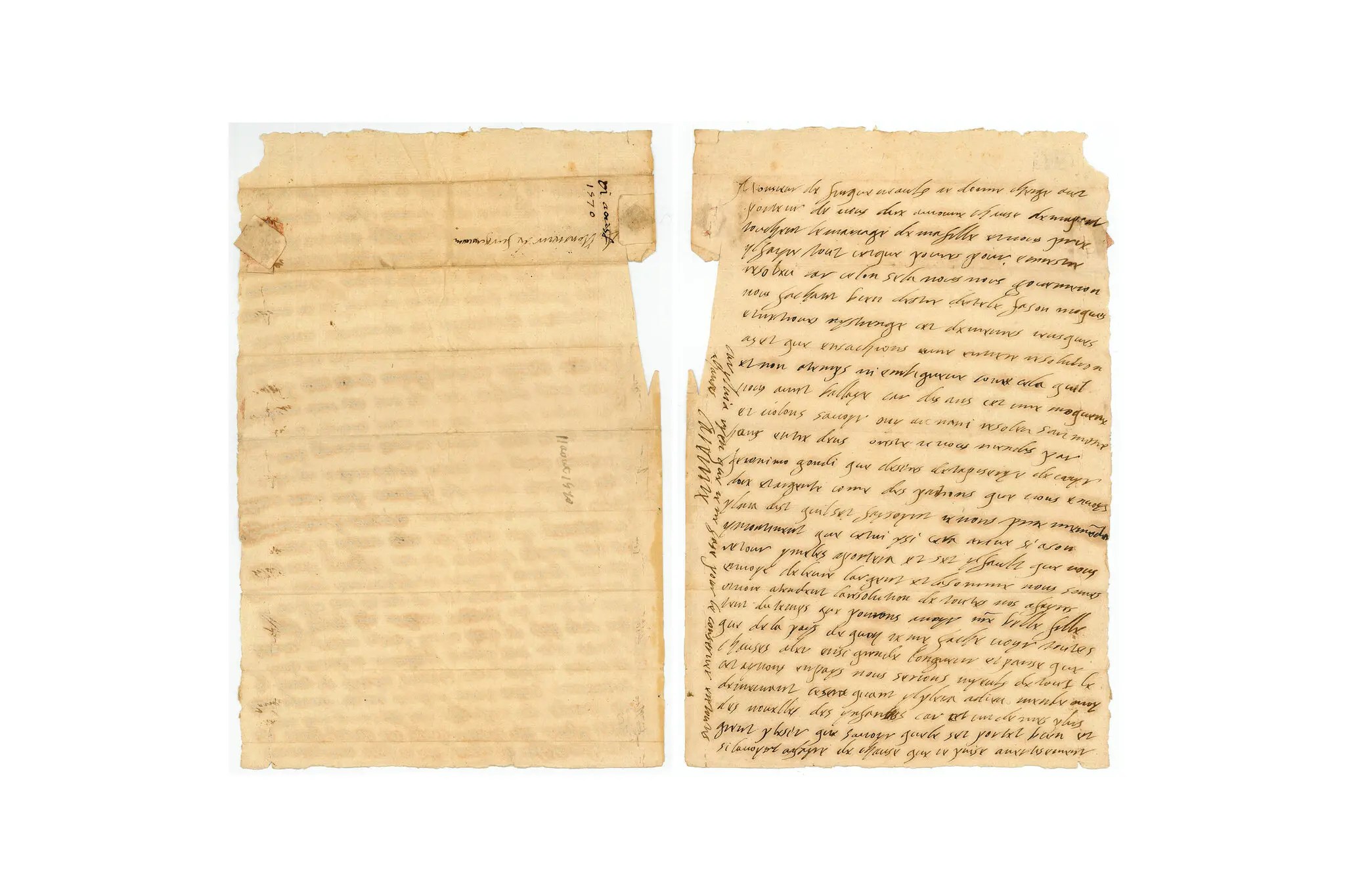
One of the letters analyzed by the M.I.T. team is a letter by Queen Mother Catherine de’ Medici written in 1570.

Catherine de’ Medici to Raimond de Beccarie, sieur de Fourquevaux, 1570.

The M.I.T. team has published their findings in several articles and has created a video (available on YouToube) to demonstrate letterlocking techniques:

The New York Times reports on the M.I.T. reseach project on letterlocking.

Previous reports by The New York Times, NPR, and the BBC have discussed the M.I.T. project and Mary Queen of Scots’ use of letterlocking.

The M.I.T. team has published their findings in several articles, including:

Dambrogio, J., Ghassaei, A., Smith, D.S. et al. “Unlocking history through automated virtual unfolding of sealed documents imaged by X-ray microtomography.” Nature Communications 12, 1184 (2021).

DOI https://doi.org/10.1038/s41467-021-21326-w

Posted in Archival Research, Court Studies, Cultural History, Digital Humanities, Early Modern Europe, Early Modern France, Early Modern World, European History, European Wars of Religion, French History, French Wars of Religion, Information Management, Manuscript Studies, Material Culture, Noble Culture and History of Elites, Political Culture, Reformation History, Renaissance Art and History, Strategy and International Politics, Women and Gender History | Leave a comment

Mapping the Early Modern World

The Newberry Library will be hosting a National Endowment for the Humanities Summer Institute on Mapping the Early Modern World in Summer 2022.

This NEH Summer Institute is being co-organized by the Hermon Dunlap Smith Center for the History of Cartography and the Center for Renaissance Studies of the Newberry Library.

The NEH Summer Institutes provide university and college faculty opportunities to engage in specialized education and research on particular themes during a concentrated period during the summer break. Each year, summer institutes are offered on different themes and issues in the humanities.

I participated in one of the previous NEH Summer Institutes in early modern studies and highly recommend the institutes for other faculty members.

Here is the announcement from the Newberry Library:

The Newberry Library is pleased to announce Mapping the Early Modern World, a four-week summer institute for higher education faculty from July 18 through August 12, 2022. The institute will be held on site at the library, situated on the near north side of Chicago. The interdisciplinary institute will be co-organized by the Newberry’s Hermon Dunlap Smith Center for the History of Cartography and its Center for Renaissance Studies. Dr. James Akerman (Director of the Smith Center) and Dr. Lia Markey (Director of the Center for Renaissance Studies) will co-direct the institute. The institute’s 25 participants will pursue a program of seminars, workshops, discussion, and research exploring interdisciplinary approaches to the study of maps in connection with the global intellectual, cultural, and geographical transformations of the world between 1400 and 1700. The course of reading and discussion will consider five major “theaters” in which the production and use of maps operated: the world, the city, the land, the sea, and the skies. The co-directors have invited eight accomplished guest faculty from a broad range of humanities fields to lead seminar sessions and research workshops. In addition to these sessions, each participant will pursue a research project utilizing the Newberry’s renowned collections of early modern maps and other humanities resources.

For more information and to apply, see: https://mappingearlymodernworld22.wordpress.com/

Posted in Archival Research, Careers in History, Cartographic History, Cultural History, Early Modern Europe, Early Modern World, European History, Humanities Education, Lectures and Seminars, Reformation History, Renaissance Art and History, World History | Leave a comment