Florence is almost always associated with the Renaissance, but until relatively recently the focus of Florentine history was on the quattrocento (1400s) and Republican Florence.
Eric Cochrane’s groundbreaking work, Florence in the Forgotten Centuries: A History of Florence and the Florentines in the Age of the Grand Dukes (1973), charted a new course toward studying the history of the princely state of Florence and Tuscany and its Medici rulers.
Eric Cochrane was a professor of History at the University of Chicago and shaped a generation of graduate students and scholars in Renaissance studies there. Cochrane’s book helped to question definitions of the Renaissance and inspired a new wave of interdisciplinary Renaissance studies in the 1990s and beyond.
The Center for Renaissance Studies at the Newberry Library is organizing a roundtable discussion of Eric Cochrane’s landmark study.
The roundtable will be held online via Zoom on Friday 25 February 2022 at 12 noon (Central Time).
Here is the announcement from the Center for Renaissance Studies:
It has been nearly 50 years since Professor Eric Cochrane of the University of Chicago published Florence in the Forgotten Centuries, 1527-1800: A History of Florence and the Florentines in the Age of the Grand Dukes (1973), a book that has inspired generations of scholars. This interdisciplinary roundtable in Professor Cochrane’s honor examines the state of research on the Medici Grand Duchy today, considering in particular how the lenses of gender, globalization, and race have revitalized the scholarship on Florence in the late Renaissance.
Co-organized by Friends of the Medici Archive Project. The Center for Renaissance Studies is grateful to an anonymous donor for inspiring this event.
As Black History Month is celebrated in the United States, it seems like a good time to revisit its history.
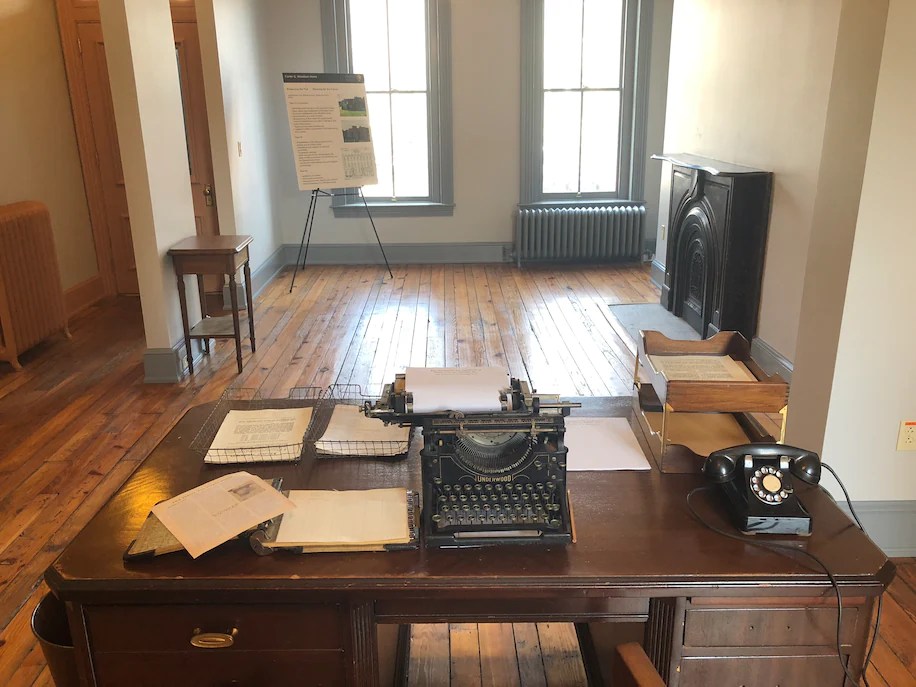
“In his red-brick rowhouse in the heart of D.C., the man who would become known as the ‘father of Black history’ wrote furiously. From a second-floor ‘home office’ at 1538 Ninth Street NW, Carter G. Woodson led and orchestrated a movement to document Black history, dictating dozens of books, letters, speeches, articles and essays promoting Black people and their place in American history.”
Carter G. Woodson was a groundbreaking African-American historian who helped to establish African-American history as a major field of historical study.
Carter G. Woodson’s office. Photo: The Washington Post
The Washington Post reports that “At 12:15 p.m. on most days, Woodson, who would launch what became Black History Month, met with his staff in the kitchen of the house. He’d give orders and strategize. There was little time to waste. He saw his mission — to correct how White people wrote about Black people, and to place Black Americans at the front and center of American history — as critical. ‘If a race has no history,’ Woodson wrote, ‘it has no worthwhile tradition, it becomes a negligible factor in the thought of the world, and it stands in danger of being exterminated.'”
Woodson launched “Negro History Week” in 1926 to focus on African-Americans’ experiences in the United States and their roles in American history. Albert Broussard (Professor of Afro-American history at Texas A&M University) emphasizes that “Woodson’s goal from the very beginning was to make the celebration of Black history in the field of history a ‘serious area of study,'”
According to WBEZ, “The idea eventually grew in acceptance, and by the late 1960s, Negro History Week had evolved into what is now known as Black History Month. Protests around racial injustice, inequality and anti-imperialism that were occurring in many parts of the U.S. were pivotal to the change.” Many colleges and universities began to celebrate Black History Month with seminars, workshops, lectures, and other events each February. The annual celebrations were transformed into a nationally recognized Black History Month in 1976.
The history of race and racism has expanded enormously since Woodson created “Negro History Week” started, but African-American historians continue to shape the histories of the United States, Africa, and the Atlantic World, transforming historical methods and all of World History in the process.
The Washington Post reports on Carter G. Woodson and the history of Black History Month.
WBEZ broadcast a story about African-American Chicagoans’ role in the origins of Black History Month.
The California Rare Book School is organizing a course on History of the Renaissance Book, which will be held at UCLA on 15-19 August 2022.
Students viewing rare books. Photo: California Rare Book School
The course description states: “This course will serve as a comprehensive introduction to the history of the book in early modern Europe, from the beginning of the fifteenth century to the middle of the seventeenth. Our goal will be to use the holdings of the UCLA Research Library, with a focus on its Aldine collection, the Getty Research Institute Research Library, and the Huntington Library to learn to ‘read’ a Renaissance book, both as a physical object and as a carrier of cultural values. We will examine in turn how these books were produced, how they were distributed, and how they were used by those who bought and read them.”
The Folger Shakespeare Library will be offering a research methods seminar in early modern studies in May 2022 for graduate students pursuing Renaissance and early modern studies.
Graduate students who are considering applying for this research methods seminar are invited to tune into an online discussion of research methods and an orientation to the seminar. This will be held on Thursday 10 February 10 2022 at 3:30 pm.
I would like to encourage graduate students in History and English at Northern Illinois University who are working in early modern studies to participate in this online discussion.
The Folger Shakespeare Library has stellar collections in Renaissance studies, Reformation studies, English history and literature, history of the book, literary history, and early modern European and world history. The Library also provides important training and support in paleography, research methods, and digital humanities.
Former President Trump has now explicitly stated that he aimed on overturning the 2020 election. Trump delivered a speech at a rally in Conroe, Texas, on Saturday, 29 January 2022. “Mike Pence did have the right to change the outcome, and they now want to take that right away,” Mr. Trump said. “Unfortunately, he didn’t exercise that power, he could have overturned the election!”
The New York Times reports: “The statement was the first time Mr. Trump described his goal as overturning an election. But Mr. Trump’s statement also included his usual false assertions about election fraud, suggesting he does not believe the election was legitimate.”
Former President Trump speaking on 29 January 2022. Photo: New York Times.
The former President’s statement indicates clearly his own intent to overturn the 2020 election, effectively overthrowing the entire electoral system and subverting the Constitution of the United States.
This revelation comes as prosecutions of militia group members move forward on charges of seditious conspiracy related to the Storming of the U.S. Capitol on 6 January 2021.
Political analysts, journalists, and pundits continue to debate whether or not the United States is heading toward civil war. The increasing cases of civil violence are undeniable, and this debate is largely shaped by misperceptions of the nature of civil conflict. Many observers in the United States continue to define all civil conflict through comparisons with the American Civil War—a sectional conflict involving a separatist movement built around a regional wing of a political party in order to defend a slave regime built on an institutionalized legal system and economy.
There are, of course, many other forms of civil conflict.
Indeed, the United States has experienced waves of civil violence in diverse forms throughout its history: colonial war, massacres, ethnic conflict, revolutionary war, guerilla warfare, rebellion, sedition, racial terrorism, lynchings, race riots, strikes, union busting campaigns, political assassinations, ideological conflict, religious conflict, church bombings, and more.
It is time to take the reality of civil violence seriously and consider the potential for further civil conflict.
As trials of sedition unfold, Trump’s own words already show that the path of responsibility leads ultimately to the Oval Office. Former President Trump and members of his administration clearly had the intent of overturning an election and remaining in power. Their impunity would be the worst possible result for the nation’s political system.
My undergraduate students at Northern Illinois University have been studying the history of civil conflict comparatively in my course Communal Strife: Civil Wars in World History. I hope that they are continuing to utilize the different interpretations of civil conflict that we studied in considering civil violence in the United States.
The Arizona Center for Medieval and Renaissance Studies is hiring two Postdoctoral Research Scholars in RaceB4Race Studies.
These postdoctoral fellowship positions will provide great opportunities for recent Ph.D.s in History and the humanities who work on premodern race studies.
Here is the announcement from the Arizona Center for Medieval and Renaissance Studies:
The Arizona Center for Medieval and Renaissance Studies (ACMRS) is looking for two outstanding and motivated Postdoctoral Research Scholars with PhDs in literature, history, religion, philosophy, comparative literature, classics, or related humanistic fields to join our ongoing Andrew W. Mellon Foundation-funded RaceB4Race initiative for a two-year appointment starting Fall 2022 at a stipend salary of $75,000/fiscal year. This is a full-time, benefits eligible, fiscal-year (July 1- June 30) appointment.
The desirable applicant will have expertise in premodern critical race studies and conduct their own individual research in their area of study. We are defining premodern as including classical, medieval, and early modern scholarship in any humanistic field. We also seek to recruit postdoctoral scholars who have the potential to assume a tenure-track faculty position and who would benefit from a mentored professional development opportunity.
Postdoctoral Research Scholars are expected to pursue an active research agenda. In lieu of teaching, scholars will be expected to collaborate closely with undergraduates, graduates, and faculty affiliated with RaceB4Race to create innovative premodern critical race studies curricula, including peer-to-peer social media content. Postdoctoral Research Scholars will also participate in professional advancement and mentoring programs.
For more information, see the full ACMRS announcement.
CRS encourages all who are able to attend the all-virtual 2022 Multidisciplinary Graduate Student Conference.
The 2022 Multidisciplinary Graduate Student Conference is free and open to the public. Registration is not required, and sessions will be accessible using the Zoom links in the posted schedule. Sessions without links included will be limited to conference participants only.
French literary scholars are commemorating the 450th anniversary of the beginning of the writing of Montaigne’s Essais.
Michel de Montaigne began writing his innovative essays in southwestern France in 1572, the year of the Saint Bartholomew’s Day Massacre.
France Mémoire indicates that “En 1572, Michel de Montaigne entreprend la rédaction des Essais dans le château périgourdin qu’il vient d’hériter de son père, et invente un nouveau genre littéraire. Écrits sur plusieurs années dans un contexte de grands désordres civils, rédigés dans un français en pleine évolution, les Essais de Montaigne rendent compte d’une pensée mouvante, parfois contradictoire, sur toutes sortes de sujets, sur la vie et sur la mort. 450 ans plus tard, en vertu de l’antique et universel précepte du « Connais-toi toi-même », cette œuvre pensée comme une œuvre éphémère, ancrée dans l’ici et le maintenant, n’a pas cessé d’être pour ses lecteurs un espace ouvert à explorer entre soi et le monde.”
Anonymous, Michel de Montaigne. Photo: Wikimedia Commons.
Montaigne was directly involved in the French Wars of Religion (1559-1629), serving as Mayor of Bordeaux and acting as a political negotiator in various contexts. He was able to observe the religious conflicts that raged between Catholics and Huguenots (French Calvinists) in southwestern France for decades. These experiences clearly shaped his commentaries on politics, culture, and society in the Essais.
Montaigne would continue to write and revise his essays for the rest of his life. The first edition of his Essais appeared in 1580, but he published revised and expanded versions of the Essais in 1582 and 1588. A posthumus edition was published in 1595.
France Mémoire celebrates Montaigne’s Essais on its website and provides an article by Alain Legros.
Philippe Desan, Montaigne, une biographie politique (Paris: Odile Jacob, 2014).
An English translations of Philippe Desan’s biography is available: Philippe Desan, Montaigne: A Life, translated by Steven Rendall and Lisa Neal (Princeton, N.J.: Princeton University Press, 2017).
The Triangle Institute for Security Studies (TISS) is organizing its annual New Faces conference, an academic conference that focuses on early career scholars in security studies.
The TISS website indicates that “The Triangle Institute for Security Studies (TISS) is a consortium of Duke University, North Carolina Central University, North Carolina State University, and the University of North Carolina–Chapel Hill, dedicated to the study of national and international security. TISS is one of the nation’s oldest academic centers committed to advancing scholarship and education on security studies, broadly conceived. Since its founding in 1958, TISS has promoted interdisciplinary study and collaboration between scholars, students, and practitioners across North Carolina’s Triangle region.”
Doctoral candidates and recent Ph.D.s in History, Political Science, Sociology, and related disciplines may be interested in participating in this conference.
Northern Illinois University students who are enrolled in my HIST 384 History of War since 1500 course this semester, or who took my HIST 399 Communal Strife: Civil Wars in Comparative Perspective course last semester, may be interested in learning more about career paths in policy analysis and security studies.
The current Ukraine-Russia crisis certainly highlights the need for more historians to become involved in security studies and policy formulation.
Russian tanks conducting military exercises in southern Russia, near the Ukrainian border in January 2022. Photo: AP.
Here is the conference announcement from the Triangle Institute for Security Studies:
New Faces is an annual conference, geared toward the professional development and networking of early career scholars in security studies. Started in 2000, New Faces is one of TISS’ signature programs with a vast network of former participants.
New Faces is designed to offer advanced PhD candidates and newly-minted PhDs a chance to present their research and receive feedback in a format akin to an academic job talk.
Our goal is to create and strengthen ties among scholars working on national and international security questions, crossing disciplinary boundaries. Participants in New Faces approach the study of security from a number of disciplinary backgrounds, including political science, history, public policy, and beyond.
TISS will cover all travel and accommodation costs for selected participants. Priority will be given to applications without a tenure-track position.
The 2022 conference will be October 6-8, 2022, with the primary workshop being held on Friday, October 7, 2022 at the Rizzo Center in Chapel Hill, North Carolina. to apply
Those interested in being considered for this year’s New Faces should complete an online application form and submit a cover letter, project abstract, CV, and letter of recommendation by email to susan.colbourn@duke.edu.
Novelist Ana Iris Simón has created a political debate over Spanish identity with her recent novel, Feria, which is set in Campo de Criptana in rural La Mancha.
The New York Times reports that the novel is “based on her childhood in the arid heartland of Spain, with parents who were postal workers and grandparents who were farmers on one side, traveling fairground workers on the other. Little happens, but that is intentional — she wants readers to appreciate her rural upbringing in Castilla-La Mancha, the region made famous by the Cervantes classic, Don Quixote.”
The small town of Campo de Criptana is situated in the heart of La Mancha, which is known for its historic windmills, many of them dating from the sixteenth century.
Campo de Criptana. Photo: The New York Times
Some far-right Spanish politicians have seized on the novel’s nostalgia portrayal of rural life, even if Ana Iris Simón has a record of supporting socialist causes and protesting against economic inequality. The novelist is currently working as a journalist with El País, a major Spanish news organization.
“The book has struck a chord with readers, but it has also become a lightning rod in Spain’s emotional political debate, fueled by party fragmentation and polarization. Ms. Simón said her book had been interpreted as ‘a questioning of the dogmas of liberalism,’ to an extent that she had not anticipated.”
Pablo Simón, a professor of Political Science at the Universidad Carlos III in Madrid comments that Feria has has created controversy because “even if it is a novel and not a political treaty, the book ascertains that the current generation is worse off than the previous ones, which is a claim that is easy for politicians to use, even if it is not necessarily based on facts,” according to The New York Times. Note that the political scientist was presumably referring to a political treatise, not a “political treaty.”
I have not had a chance to read the novel, and will likely wait until an English translation is published, since my Spanish is rusty. However, I am interested to see how Spanish identity politics develops in response to the book.
As an early modern historian, I am particularly curious how the “traditional” idea of Spanishness and the imagery of Don Quixote are being deployed in this debate. The historic windmills of La Mancha seem likely to continue to figure in debates over Spanish identity.
Miguel de Cervantes immortalized the windmills of La Mancha in his novel, Don Quixote (1605): “Just then, they discovered thirty or forty windmills in that plain. And as soon as don Quixote saw them, he said to his squire: “Fortune is guiding our affairs better than we could have ever hoped. Look over there, Sancho Panza, my friend, where there are thirty or more monstrous giants with whom I plan to do battle and take all their lives, and with their spoils we’ll start to get rich. This is righteous warfare, and it’s a great service to God to rid the earth of such a wicked seed.” [Proyecto Cervantes]
Cervantes’s novel was written during the European Wars of Religion and raises many interesting questions about identity, politics, religion, violence, noble culture, and society in early modern Spain and its empire. The book has been celebrated as one of the first novels, arguably influencing the form of the modern novel. So, perhaps it not surprising to find Don Quixote at the center of debates about Spanish identity once again.
Ana Iris Simón, Feria (Círculo de Tiza, 2020).
The publisher, Círculo de Tiza, provides a book description on its webpage.
For an online edition of Miguel de Cervantes, Don Quixote, in English translation, see the Proyecto Cervantes at Texas A&M University. The first edition, Miguel de Cervantes, El Ingenioso hidalgo Don Quixote de la Mancha, compuesto por Miguel de Cervántes Saavedra… (1605), may be downloaded from Gallica at the Bibliothèque nationale de France.







 Brian Sandberg: Historical Perspectives