Irish in Illinois

I would like to celebrate the publication of The Irish in Illinois a new book by my friends and colleagues, Sean Farrell and Mathieu W. Billings.

Sean Farrell works on sectarian violence in Irish history and teaches with me as a Professor of History at Northern Illinois University. Mat Billings earned a Ph.D. in History at Northern Illinois and now teaches at the University of Indianapolis. Their newly released co-authored book examines the history of Irish Americans in Illinois.
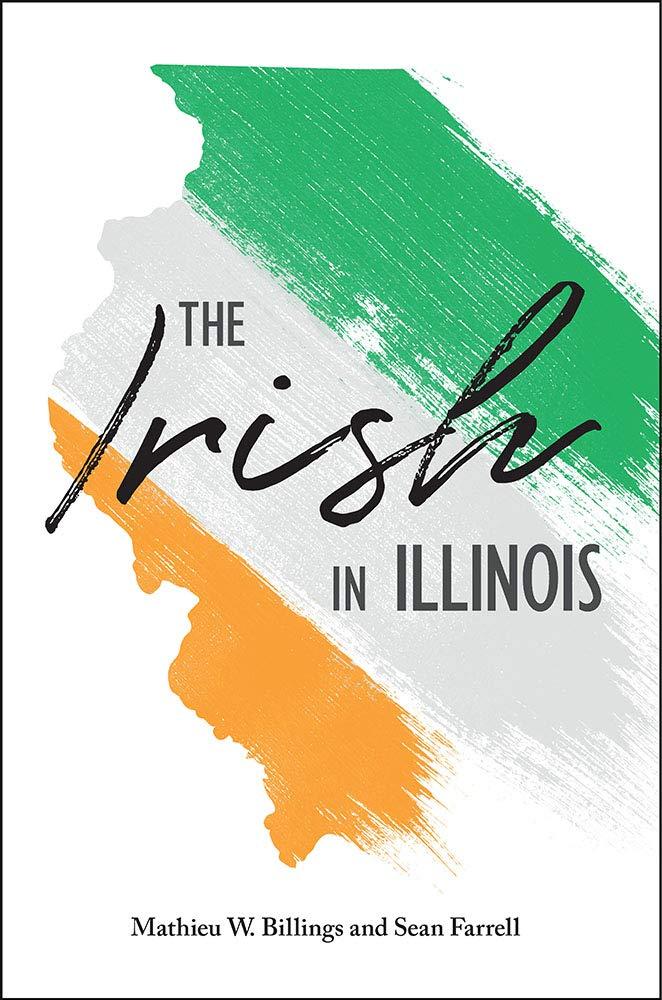
Here is a short description of the book:

Today over a million people in Illinois claim Irish ancestry and celebrate their love for Ireland. In this concise narrative history, authors Mathieu W. Billings and Sean Farrell bring together both familiar and unheralded stories of the Irish in Illinois, highlighting the critical roles these immigrants and their descendants played in the settlement and the making of the Prairie State. Short biographies and twenty-eight photographs vividly illustrate the significance and diversity of Irish contributions to Illinois.

Billings and Farrell remind us of the countless ways Irish men and women have shaped the history and culture of the state. They fought in the French and Indian War, the American Revolution, the Civil War, and two world wars; built the state’s infrastructure and worked in its factories; taught Illinois children and served the poor. Irish political leaders helped to draw up the state’s first constitution, served in city, county, and state offices, and created a machine that dominated twentieth-century politics in Chicago and the state.

This lively history adds to our understanding of the history of the Irish in the state over the past two hundred fifty years. Illinoisans and Midwesterners celebrating their connections to Ireland will treasure this rich and important account of the state’s history.

The full book description is available on the Southern Illinois University Press website.

Congratulations to Sean and Mat on the new publication!

Posted in Cultural History, European History, Illinois History and Society, Northern Illinois University, Social History, United States History and Society | Leave a comment

Depicting an Early Modern Emperor

Early modern empires continue to have echoes in the contemporary world. A recent New York Times online feature focuses on Shah Jahan, a seventeenth-century Mughal Emperor who is known today for commissioning the Taj Mahal.

The interactive webpage examines a miniature portrait of Shah Jahan, offering an analysis of its complex composition and multicultural visual references. The feature utilizes Digital Humanities and art history techniques—zooming in and out of the miniature portrait to show its details and many external references

Chitarman, Miniature portrait of Shah Jahan (c. 1627), Metropolitan Museum of Art, New York City (The New York Times).

Researchers and students of the the Mughal Empire, Indian history, Renaissance studies, art history, early modern empires, court studies, Islamic history, and premodern World history may be interested in this web feature.

The New York Times published this interactive feature on its website.

Posted in Art History, Court Studies, Cultural History, Early Modern Europe, Early Modern World, Empires and Imperialism, History in the Media, Manuscript Studies, Museums and Historical Memory, Noble Culture and History of Elites, Renaissance Art and History, Warfare in the Early Modern World, World History | Leave a comment

Renaissance Teaching Award for High School Teachers

The Renaissance Society of America is offering a new award for innovative teaching of Renaissance studies during the Covid-19 pandemic. The award aims to recognize high school teachers and educators who teach Renaissance studies to high school students.

History teachers who are doing graduate work at Northern Illinois University are encouraged to apply. Please feel free to contact me to discuss your ideas for a pedagogical project to submit.

Here is call for applications from the Renaissance Society of America:

In the wake of the COVID pandemic, high school teachers around the globe have been searching for and creating new ways to immerse their students in the experience of Renaissance culture. In an effort to recognize and share these innovative teaching methods, the RSA is delighted to announce a new competition for the best online teaching projects in secondary education.


The three winners of this competition will each receive an award of $1,000 and will present their projects at a Zoom conference that we plan to make available to a wide range of secondary school teachers, not only current members of the RSA but those who want to learn more about Renaissance studies. The conference will be held on Wednesday, June 30, 2021.


The competition is open to scholars actively engaged in teaching high school students: for instance, museum docents, library curators, and directors of education at theatre companies as well as high school teachers. Proposals from such fields as art history, drama, history, literature, languages, and music are all welcome. The project could include virtual tours of museums, architectural sites, or rare book libraries, or online performances of drama and music. The deadline for proposals is Monday, May 17, 2021. Please email us at rsa@rsa.org with any questions.

Posted in Art History, Cultural History, Early Modern Europe, Early Modern World, European History, Graduate Work in History, Humanities Education, Museums and Historical Memory, Northern Illinois University, Reformation History, Renaissance Art and History, The Past Alive: Teaching History | Leave a comment

2021: The Year of Napoleon

This year is being billed as the “Year of Napoleon” by the French government and the Réunion des Musées Nationaux. Major museum exhibitions and commemorations are planned across France.

Professor Marlene L. Daut (University of Virginia) writes: “After a year in which statues of enslavers and colonizers were toppled, defaced or taken down across Europe and the United States, France has decided to move in the opposite direction. The year 2021 is being hailed by many museums and institutions in the country as the “Year of Napoleon” to commemorate France’s biggest tyrant, an icon of white supremacy, Napoleon Bonaparte, who died 200 years ago on the island of Saint-Helena on May 5, 1821.”

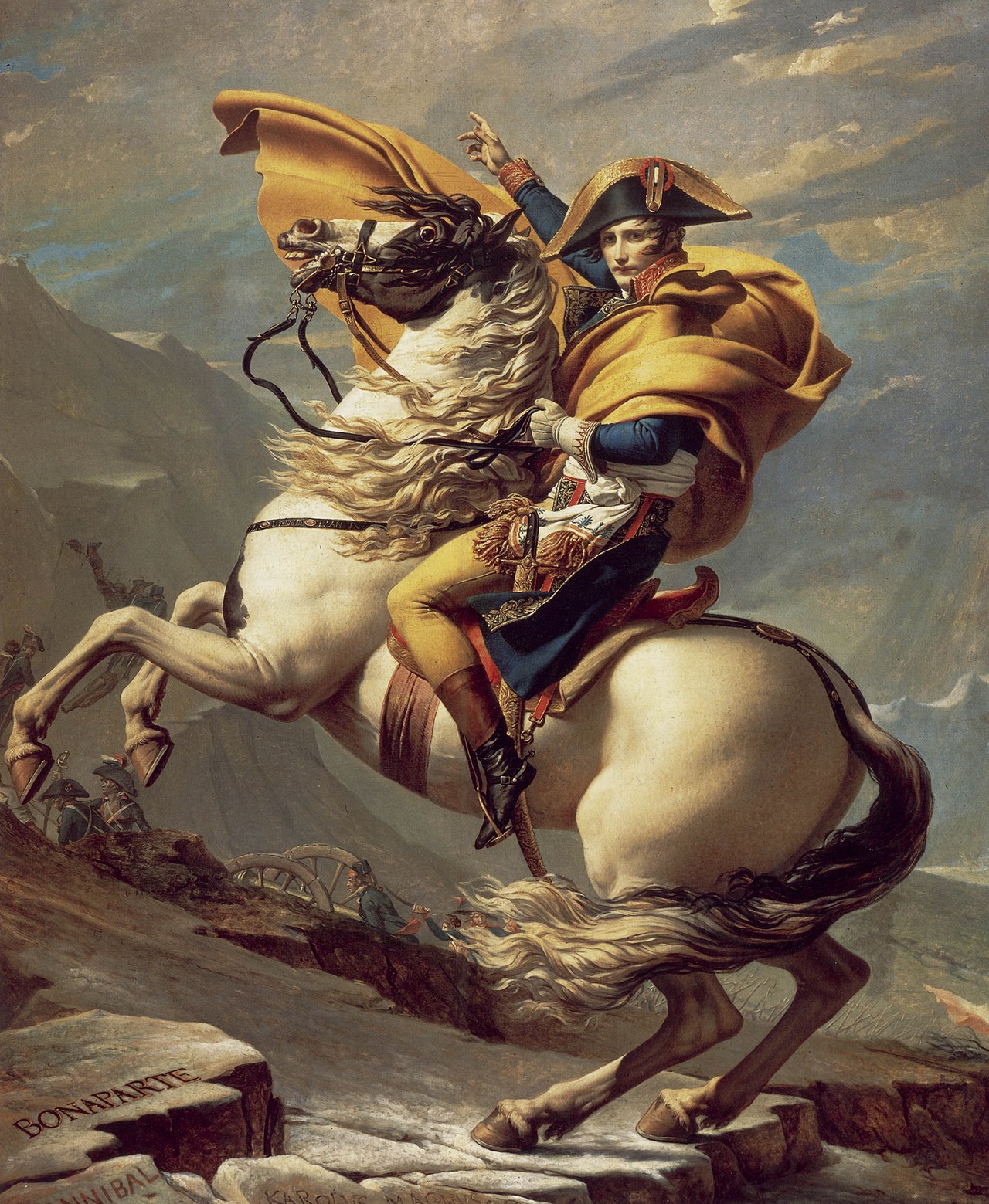
Jacques-Louis David, Napoleon Crossing the Alps (1801)

Professor Daut is right to criticize Napoleon Bonaparte’s record on slavery and human rights issues related to his restoration of slavery in Saint-Domingue. Other historians have condemned Napoleon’s anti-republican politics, authoritarian state-building, imperial propaganda, censorship policies, international law abuses, militarism, and war crimes.

Napoleon’s legacy is complex, but his image has been increasingly appropriated by far-right and nationalist politicians in France in recent decades. Marine Le Pen and other leaders of the Rassemblement National (RN), a far-right nationalist party formerly known as the Front National (FN), have associated themselves with Napoleon’s charismatic nationalist politics and militarism.

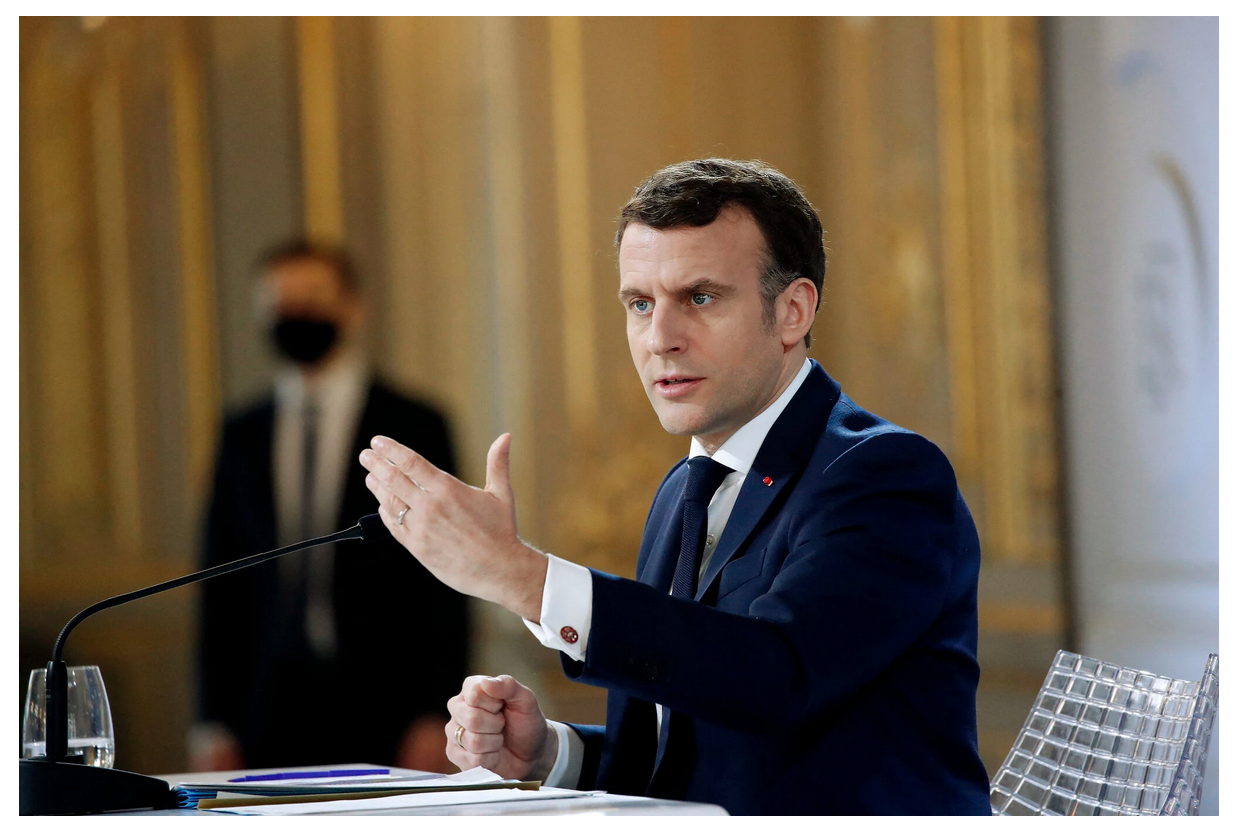
Daut emphasizes that “the ‘Year of Napoleon’ has arrived during a dangerous time. French academics who study race, gender, ethnicity and class are under attack. President Emmanuel Macron has derided the field of post-colonial studies by suggesting that it ‘has encouraged the ethnicization of the social question’ to the point that the Republic is in danger of ‘splitting’ apart. The minister of higher education, research and innovation outright called for an investigation, ‘so we can distinguish proper academic research from activism and opinion,’ and said that scholars studying critical race theory and decolonization, along with sexual identity and social class, were promoting ‘Islamo-leftist‘ ideology.”

The fate of the “Year of Napoleon” is certainly not assured in a politically divided France that faces a third wave of coronavirus infections. The ongoing Covid-19 pandemic and repeated lockdowns in France may disrupt many of the planned exhibitions and events.

The New York Times published an op-ed by Marlene L. Daut on “Napoleon Isn’t a Hero to Celebrate.”

For further context, see the report in Marianne on French President Emmanuel Macron’s plans for commemorations of Napoleon in 2021. RTL reports on the political controversies surrounding commemorations of Napoleon this year. Le Monde reports on the politicization of historical memory in France relating to multiple significant historical anniversaries in 2021.

Posted in Atlantic World, Civil Conflict, Comparative Revolutions, Cultural History, Early Modern Europe, Early Modern World, Empires and Imperialism, European History, French History, French Revolution and Napoleon, Globalization, History of Race and Racism, History of Violence, Museums and Historical Memory, Political Culture, Revolts and Revolutions, War, Culture, and Society, Warfare in the Early Modern World | 1 Comment

A New World Map Innovates

A new world map may transform the way we look at the earth. This map is a two-dimensional double-sided disk centered on the earth’s poles.

Major innovations in the history of cartography are difficult to achieve, despite new digital tools such as Geographic Information System (GIS) mapping. The New York Times reports that “Most of the world maps you’ve seen in your life are past their prime. The Mercator was devised by a Flemish cartographer in 1569. The Winkel Tripel, the map style favored by National Geographic, dates to 1921. And the Dymaxion map, hyped by the architect Buckminster Fuller, debuted in a 1943 issue of Life.”

“Enter a brash new world map vying for global domination. Like sports, the mapmaking game can sometimes grow stale when top competitors are stuck on the same old strategy, said J. Richard Gott, an astrophysicist at Princeton who had previously mapped the entire universe. But then along comes an innovator,” according to The New York Times.

J. Richard Gott, Robert Vanderbei and David Goldberg, Double-sided disk world map, New York Times.

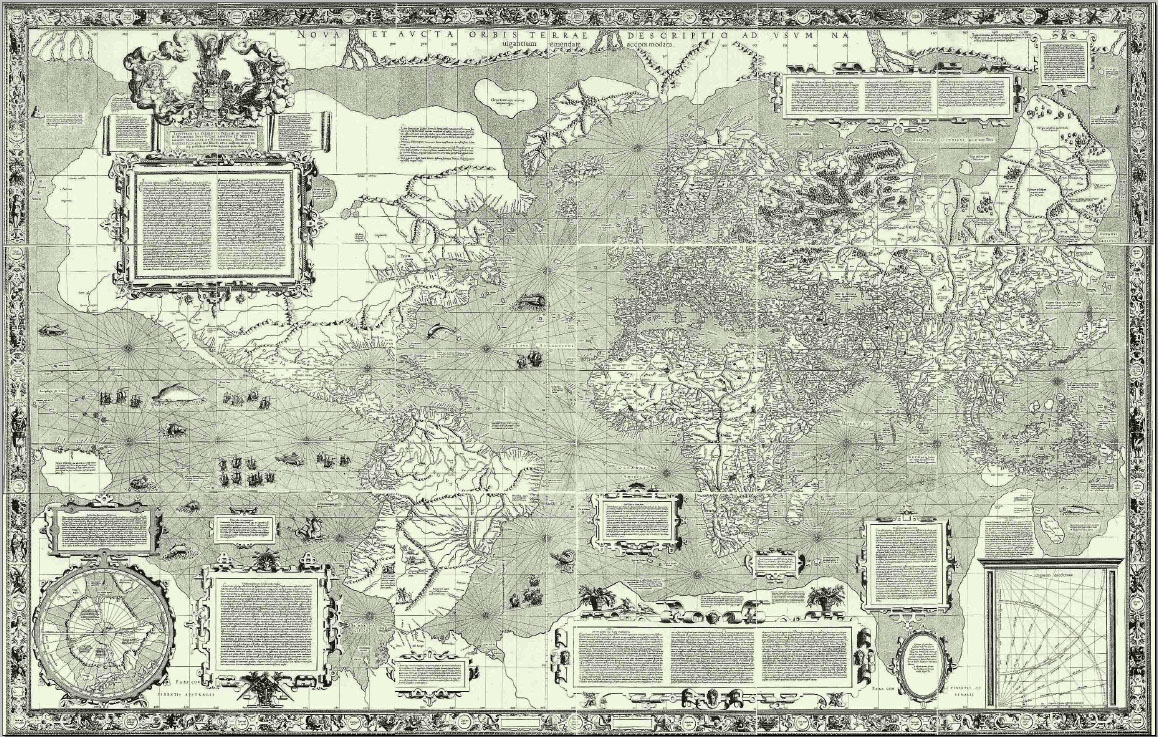
This world map presents a perspective of the globe that is radically different from the classic Mercator projection, which was developed by geographer and cartographer Gerardus Mercator in 1569. Mercator’s projection relies on straight rhumb lines and perpendicular intersections of parallels and meridians, making it practical for maritime navigation.

Gerardus Mercator, Nova et Aucta Orbis Terrae Descriptio ad Usum Navigantium Emendate Accommodata (1569). Wikipedia.

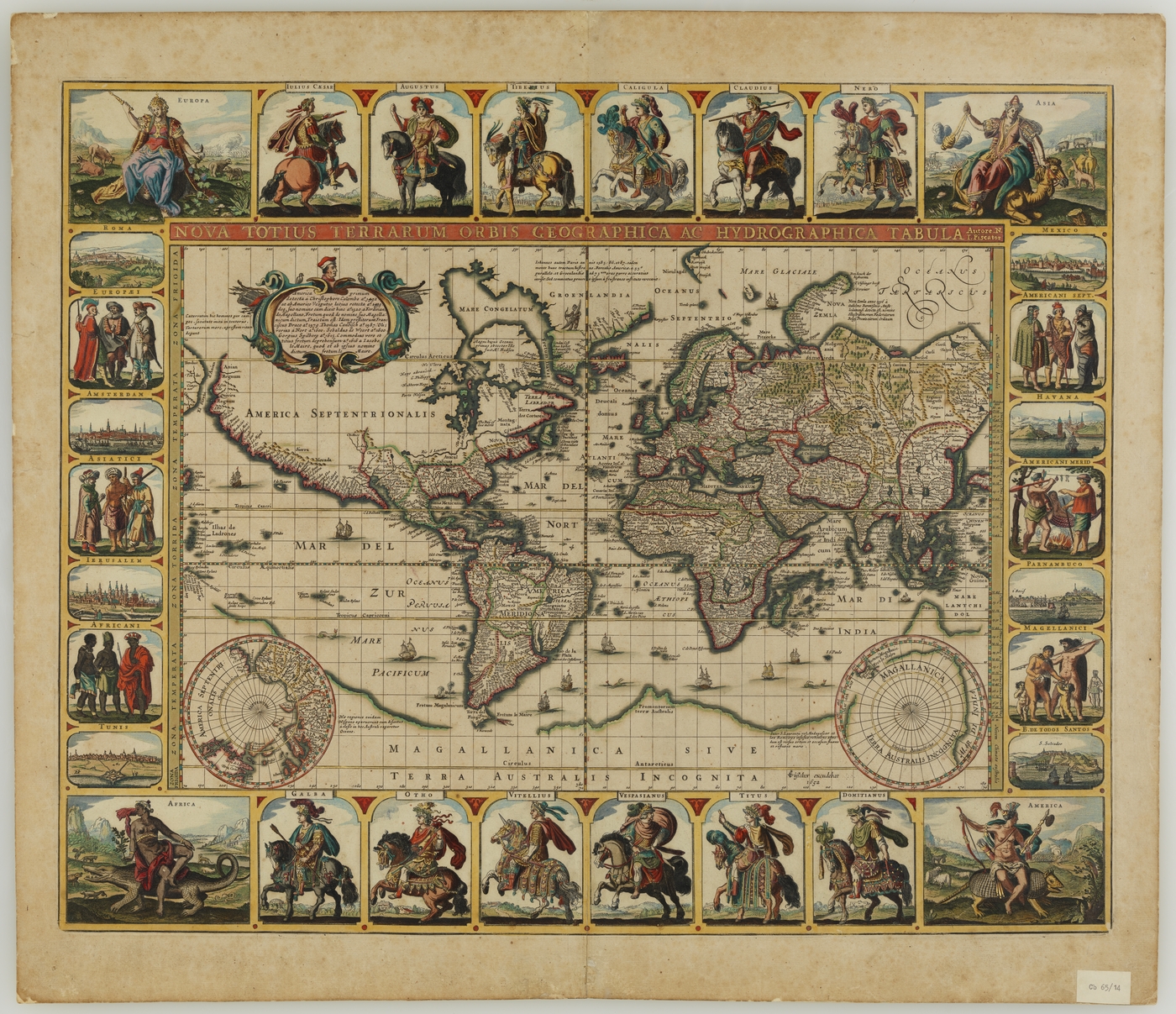
The Mercator projection also became very popular for prestige world maps that showcased empires, kingdoms, and cultures around the world. This map by Claes Jansz Visscher shows how elaborate such prestige world maps became by the mid-seventeenth century.

Claes Jansz Visscher, Nova totius terrarum orbis geographica ac hydrographica tabula (Amsterdam, 1652).
New South Wales State Library

Although competing cartographic solutions to mapping the world have challenged the prominence of Mercator’s world map, his projection is still used in many academic works and news publications today. So, the new double-sided disk map is a welcome development in the history of cartography.

The New York Times reports on the new double-sided disk map.

Posted in Atlantic World, Cartographic History, Digital Humanities, Early Modern World, History in the Media, History of the Western World, Maritime History, Museums and Historical Memory, Renaissance Art and History, World History | Leave a comment

NIU Undergraduate Researcher Publishes Research

I want to highlight the accomplishments of one of our undergraduate students in the Department of History at Northern Illinois University, whose research experiences reminded me of my own experiences conducting research as an undergraduate History Major at the University of Texas at Austin and as a graduate student at the University of Illinois at Urbana-Champaign.

NIU Newsroom recently published a nice feature on Jeremy Knoll, one of our undergraduate students in the Department of History.

Jeremy Knoll is a History and Economics double major and an Honors student who did a mentored research project with me on prisoners of war in the American Civil War his freshman year as a Research Rookie.

Jeremy then took my course, HIST 384 The History of War since 1500, which involves intense reading and writing on war and society in the early modern and modern world. The course considers wars and armed conflicts from the Renaissance to today comparatively.

He has gone on to write a paper on Civil War monuments constructed in the state of Illinois from 1865 to 1929, under the direction of Professor Aaron Fogleman. A revised version of this paper will soon be published as an article in the Journal of the Illinois State Historical Society, the leading academic journal of Illinois history. The article contributes new perspectives on the historical memory of the American Civil War and the monument building in the United States.

It is incredibly rare for an undergraduate student to publish their research in an academic journal. So, I am very proud of Jeremy!

The article on Jeremy Knoll’s research is available on NIU Newsroom. I will update this piece when Jeremy’s article is published in the Journal of the Illinois State Historical Society.

The Research Rookie program at Northern Illinois University provides exciting opportunities for undergraduate researchers to engaged in directed research with faculty mentors. The Department of History at NIU regularly works with Research Rookie students to develop their research projects on themes in United States, European, Latin American, African, Asian, and World History.

Posted in Academic Publishing, Civil Conflict, Cultural History, History in the Media, History of Violence, Illinois History and Society, Material Culture, Museums and Historical Memory, Northern Illinois University, Undergraduate Work in History, United States History and Society, War and Society, War, Culture, and Society | Leave a comment

Italian Renaissance Armor Restored to the Louvre

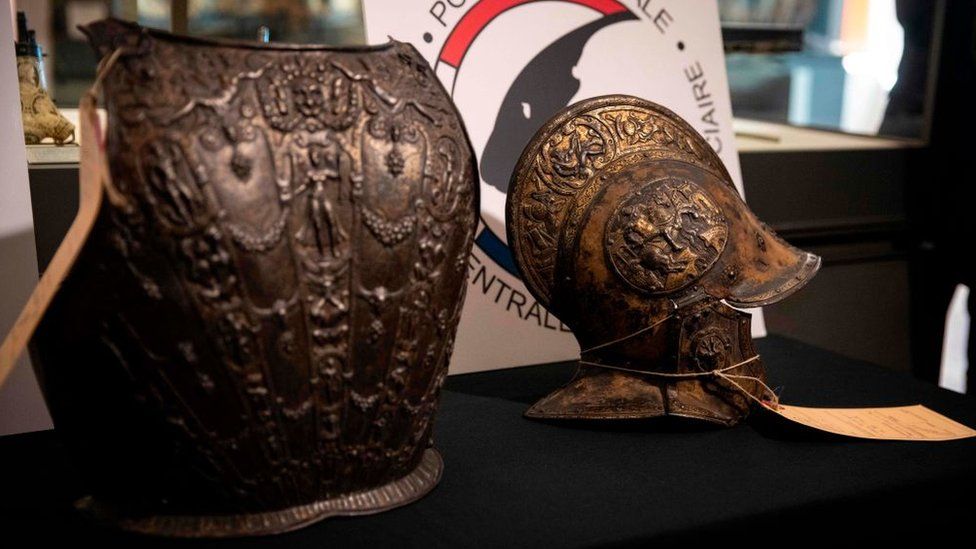
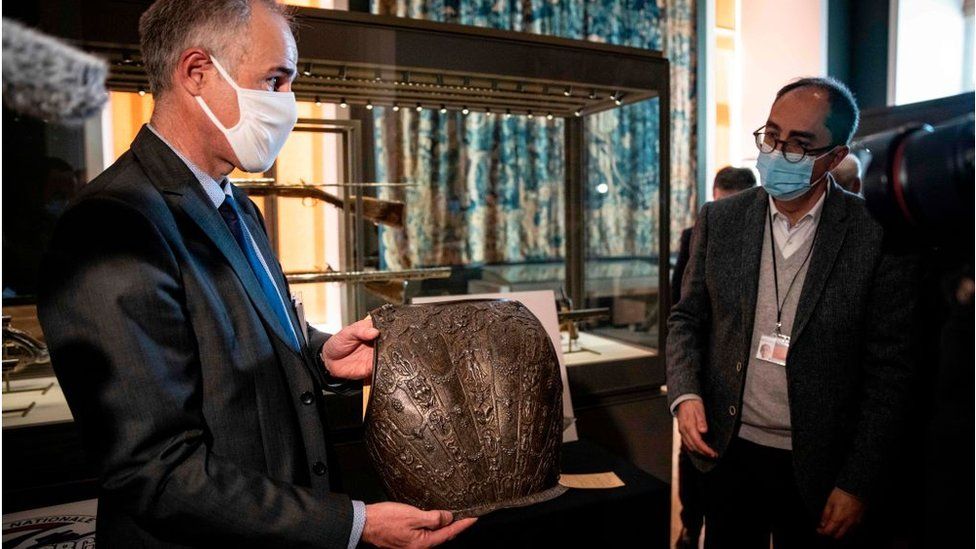
Two magnificent pieces of Italian Renaissance armor have been restored to the Musée du Louvre in Paris, after being recovered by French police.

The prestige armor had originally been donated to the Museée du Louvre by the Rothschild family in 1922. The armor was stolen from the Louvre in May 1983 and presumably sold to a private collector. A military antiques expert who was advising a family in Bordeaux on their collection became suspicious about the armor’s origins and informed the police.

Italian Renaissance armor restored to the Musée du Louvre. Photo: Getty Images

The ornate suit of armor, including an elaborately decorated Burgundian helmet and backplate, was crafted in sixteenth-century Milan—one of the most important centers for the production of luxury arms and armor in early modern Europe. The suit of armor was not stolen in its entirety, so the breastplate and helmet will now be reunited with the suit’s other components at the Louvre. News reports have not yet indicated the make of the armor, but it looks similar to the prestige armor crafted by the Negroli family for use in tournaments and civic entries by royal and noble elites throughout Europe.

Philippe Malgouyres, conservateur en chef du Patrimoine in the Objets d’art department at the Musée du Louvre commented: “I was certain we would see them reappear one day because they are such singular objects. But I could never have imagined that it would work out so well – that they would be in France and still together,” according to The Guardian.

Italian Renaissance breastplate displayed at the Musée du Louvre. Photo: Getty Images

For more information on arms and armor in the collections of the Musée du Louvre, see: Philippe Malgouyres, Armes européennes : histoire d’une collection au Musée du Louvre (Paris: Musée du Louvre, 2014). Malgouyres recently gave an online lecture at the Louvre in 2020.

BBC News, The Guardian, and The New York Times report on the return of the armor to the Musée du Louvre. LCI provides a video report in French.

Posted in Art History, Court Studies, Cultural History, Early Modern Europe, Early Modern World, European History, European Wars of Religion, French History, French Wars of Religion, History in the Media, History of Violence, Material Culture, Museums and Historical Memory, Noble Culture and History of Elites, Paris History, Reformation History, Renaissance Art and History, War, Culture, and Society, Warfare in the Early Modern World | Leave a comment

New Digital Humanities Techniques Open Locked Letters

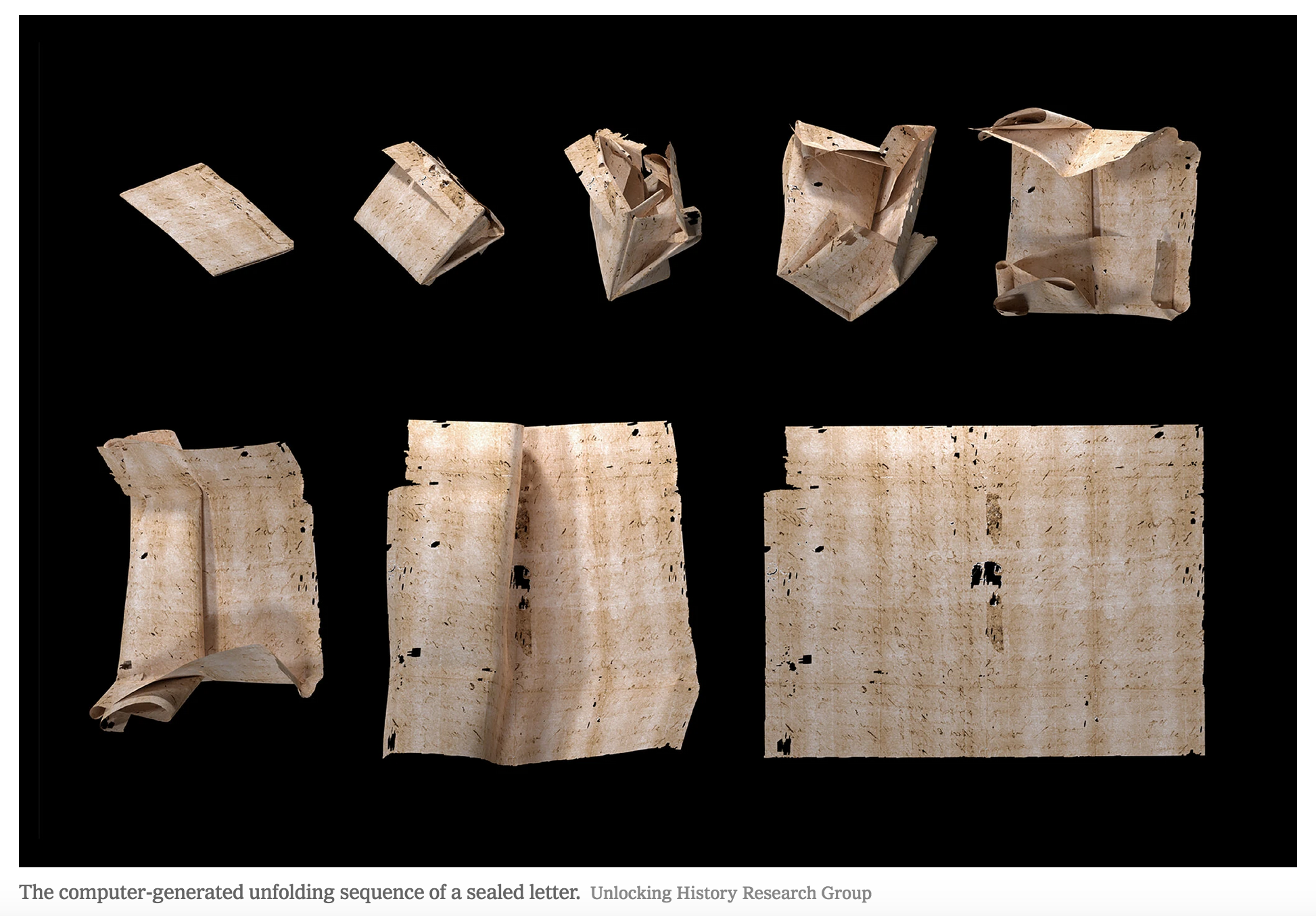
Early modern writers sometimes employed letterlocking in order to close letters securely using complex practices of folding, cutting, inserting tabs, and sewing.

The New York Times reports: “In an era before sealed envelopes, this technique, now called letterlocking, was as important for deterring snoops as encryption is to your email inbox today. Although this art form faded in the 1830s with the advent of mass-produced envelopes, it has recently attracted renewed attention from scholars. But they have faced a problem: How do you look at the contents of such locked letters without permanently damaging priceless bits of history?”

New Digital Humanities techniques are now allowing researchers to access locked letters without disturbing the complex folding systems.

“On Tuesday, a team of 11 scientists and scholars at the Massachusetts Institute of Technology and other institutions disclosed their development of a virtual-reality technique that lets them perform this delicate task without tearing up the contents of historical archives,” according to The New York Times. The MIT team is particularly focused on the Brienne Collection of locked letters, conserved in The Hague (Netherlands).

There are a number of Digital Humanities research groups active in Renaissance studies and early modern history at this point, building diverse research tools. I can especially recommend the 1641 Depositions project, based at Trinity University Dublin (Ireland) and the Medici Archive Project‘s MIA database, based in Florence (Italy).

The New York Times reports on the Brienne Collection Digital Humanities project. The MIT team has published an article about their research in Nature Communications.

Posted in Archival Research, Cultural History, Digital Humanities, Early Modern Europe, Early Modern World, European History, History in the Media, Information Management, Manuscript Studies, Material Culture, Museums and Historical Memory, Political Culture | Leave a comment

Franco-American Culture Wars

American multiculturalism and intellectual influences are increasingly threatening French identity, according to French President Macron and his ministers.

The New York Times reports on the developing Franco-American Culture Wars: “Stepping up its attacks on social science theories that it says threaten France, the French government announced this week that it would launch an investigation into academic research that it says feeds ‘Islamo-leftist’ tendencies that ‘corrupt society.’ News of the investigation immediately caused a fierce backlash among university presidents and scholars, deepening fears of a crackdown on academic freedom — especially on studies of race, gender, post-colonial studies and other fields that the French government says have been imported from American universities and contribute to undermining French society.”

Questions of race and laïcité (secularism) seem to be at the heart of the French political debate over American intellectual influences and French identity.

French concepts of religious toleration and laïcité developed during the French Wars of Religion (1559-1629), when Huguenots and Catholics engaged in confessional struggles over French religious identity. Laïcité then took on new dimensions during the French Revolution and Napoleonic Empire (1789-1815), when a dechrstianization movement challenged the Catholic Church and then a Concordat with the Pope re-established Catholicism. Subsequent revolutions and social movements during the nineteenth century added new layers of complexity. The concept of laïcité has been enshrined in French law since 1905, guaranteeing an ostensibly neutral nation-state.

The notions of religious toleration and laïcité have remained problematic within French political culture, however, and have re-emerged as touchstones of controversy in recent years. Veiling controversies, racial tensions in the banlieues, terrorist attacks, a #MeToo reckoning, Gillets Jaunes protests, and Black Lives Matter protests have all contributed to tensions in French political culture.

Now, academic research has emerged as a new conflict zone in the “culture wars” in contemporary France. “Frédérique Vidal, the minister of higher education, said in Parliament on Tuesday [16 February] that the state-run National Center for Scientific Research would oversee an investigation into the ‘totality of research underway in our country,’ singling out post-colonialism,” The New York Times indicates.

In response, the French Conférence des Présidents des Universités condemned Vidal’s remarks and rejected the claims of the Macron government outright. Vidal’s proposed investigation has been crticized as a political witch-hunt directed primarily against researchers in the social sciences and humanities. The noted economist Thomas Piketty, sociologist Dominique Méda, and over 600 other French professors and researchers have called for Frédérique Vidal to resign over his investigation of so-called islamo-gauchisme.

The New York Times reports on the controversy in an article entitled, “Heating Up Culture Wars, France to Scour Universities for Ideas That ‘Corrupt Society.'” Le Monde reports on the calls for Frédérique Vidal to resign.

Posted in Academic Freedom, Cultural History, European History, European Union, French History, French Revolution and Napoleon, French Wars of Religion, History of Race and Racism, Human Rights, Political Culture, Women and Gender History | 1 Comment

The World in the Book: 1300-1800

The Center for Renaissance Studies at the Newberry Library is offering an undergraduate seminar on The World in the Book: 1300-1800 in Fall 2021.

Northern Illinois University undergraduate students interested in medieval, renaissance, and early modern studies are encouraged to apply to take this seminar. Northern Illinois University is a Center for Renaissance Studies consortium member, giving its students and faculty access to Newberry Library seminars, workshops, and conferences.

Here is the seminar call for applications from the Center for Renaissance Studies:

The World in the Book: 1300-1800

CRS Undergraduate Seminar
Fall 2021
Online via Zoom

CRS is thrilled to announce that applications are now being accepted for its first-ever undergraduate seminar, which will take place virtually in Fall 2021.

Hosted by the Newberry Library’s Center for Renaissance Studies (CRS), this 10-week, three credit hour course will use the multidisciplinary field of book history to explore how medieval and early modern people used different media—theological texts, maps, travel narratives, reference works, literature, and more—to make sense of a changing world. Through lectures, discussions, and interactive workshops with faculty from CRS consortium institutions, participants will learn how book history can illuminate the ways in which premodern people used religion, science, art, and technology to grapple with new economic, intellectual, and cultural challenges in a rapidly-expanding global community. In so doing, students will develop a framework for using the past to help illuminate and guide their own contemporary experience.

This seminar is free and open for undergraduate students in any field of medieval or early modern studies, but space is limited. Priority will be given to undergraduates from CRS consortium institutions. Accepted students must make arrangements with their home institutions to receive credit for the course. Please direct any questions to renaissance@newberry.org.

For more information about the course, including guest speakers and a link to apply, please visit the course website here: https://www.newberry.org/09282021-world-book-1300-1800

Posted in Cultural History, Early Modern Europe, Early Modern World, European History, History of the Book, History of the Western World, Information Management, Lectures and Seminars, Reformation History, Renaissance Art and History, Undergraduate Work in History, World History | Leave a comment