Giovanni Contarini’s Account of the Lepanto Campaign

I am happy to report that my book review of Kiril Petkov’s translation of Giovanni Pietro Contarini’s account of the Lepanto campaign has been published by the Mediterranean Seminar Review.

Contarini, Giovanni Pietro. From Cyprus to Lepanto. Trans. Kiril Petkov. New York, NY: Italica Press, 2019. ISBN-13:978-1599103815. Xxvi+162pp. 3 b/w images. $35.00 (Hardcover); $17.00 (Paperback); $9.99 (Kindle). 

As I explain in my book review, “The armadas of the Holy League and the Ottoman Empire fought an epic battle in the Gulf of Lepanto on 7 October 1571, involving over 450 warships with at least 150,000 crew members— representing one of the largest naval battles in world history. This dramatic naval engagement during the Ottoman-Venetian War of 1570-1573 is often interpreted as an important Christian victory that slowed the expansion of the Ottoman Empire in the Mediterranean.”

My review focuses on the significance of Contarini’s accont: “This book provides an English translation of the first edition of Giovanni Pietro Contarini’s History of the Events, Which Occurred from the Beginning of the War Brought against the Venetians by Selim the Ottoman, to the Day of the Great and Victorious Battle against the Turks, which was written in Italian and published in Venice in 1572. Contarini dedicated his work to Giovanni Grimani (1506-1593), Patriarch of Aquileia, and provides a Venetian perspective on the Ottoman- Venetian War and the Lepanto campaign. The book was widely disseminated and seems to have been very successful, since it was reprinted twice and then translated into Latin and German. Petkov explores the hybrid nature of the text, which borrows from other contemporary accounts of the sieges of Nicosia and Famagusta and the battle of Lepanto (xviii-xix). Petkov refers to Contarini’s History of the Events as “a ‘chronohistory,’ a carefully compiled factual narrative governed by a distinct philosophical agenda” (xxi). …”

My book review can be downloaded as a .pdf file from the Mediterranean Seminar Review website.

Posted in Early Modern Europe, Early Modern World, Empires and Imperialism, European History, History of the Western World, History of Violence, Italian History, Maritime History, Mediterranean World, Religious Violence, Renaissance Art and History, War, Culture, and Society, Warfare in the Early Modern World | Leave a comment

Nazi Roundups of Dutch Jews in Amsterdam

A new historical exhibition on “The raids of February 22 and 23, 1941” investigates the fates of Dutch Jews who were rounded up by Nazi forces during the German occupation of the Netherlands during the Second World War.

The exhibition focuses particularly on the Dutch Jews who were victims of one of the first Nazi roundups of Jews in the Netherlands on 22-23 February 1941.

Photo: NIOD / Jon van der Maas Collection

The New York Times provides background on the roundups: “In February 1941, nine months after the German Reich invaded and occupied the Netherlands, the first pogroms began on Dutch soil. Local Nazi party members posted bills in shop and cafe windows that read ‘Jews Not Wanted.’ Then they trolled the Jewish Quarter, breaking windows and shouting jeers. Young Jewish men and boys prepared to protect their neighborhood. When Dutch Nazis returned a few days later, the Jews fought back. Street fights went on for days resulting in many casualties, including the death of one Dutch Nazi, Hendrik Koot. In retaliation, the Green Police — German Nazi officers in long green coats and high boots — randomly grabbed about 400 Jewish men off the streets during a two-day sweep, ultimately forcing them into trucks and driving off into the night.”

The exhibition examines the fates of each of the 400 Dutch Jews who were abducted, providing new insights on the early phases of the Holocaust.

Dutch historian Wally de Lang conducted extensive historical research on the Nazi roundups and organized the exhibition in conjunction with the Amsterdam City Archives.

The exhibition is being held at the Amsterdam City Archives. An accompanying book and website provide global access to the historical research.

The New York Times reports on the exhibition.

Posted in Archival Research, Atrocities, Civilians and Refugees in War, Digital Humanities, European History, European Studies, History of Violence, Manuscript Studies, Museums and Historical Memory, War, Culture, and Society | Leave a comment

French Politics and the Memory of the Algerian War

The historical memory of the Algerian War (1954-1962) looms large in French politics.

Commemorations this weekend of the 60th anniversary of the end of the Algerian War and the establishment of Algerian independence in 1962 come in the midst of intense campaigning for the French Presidential Election.

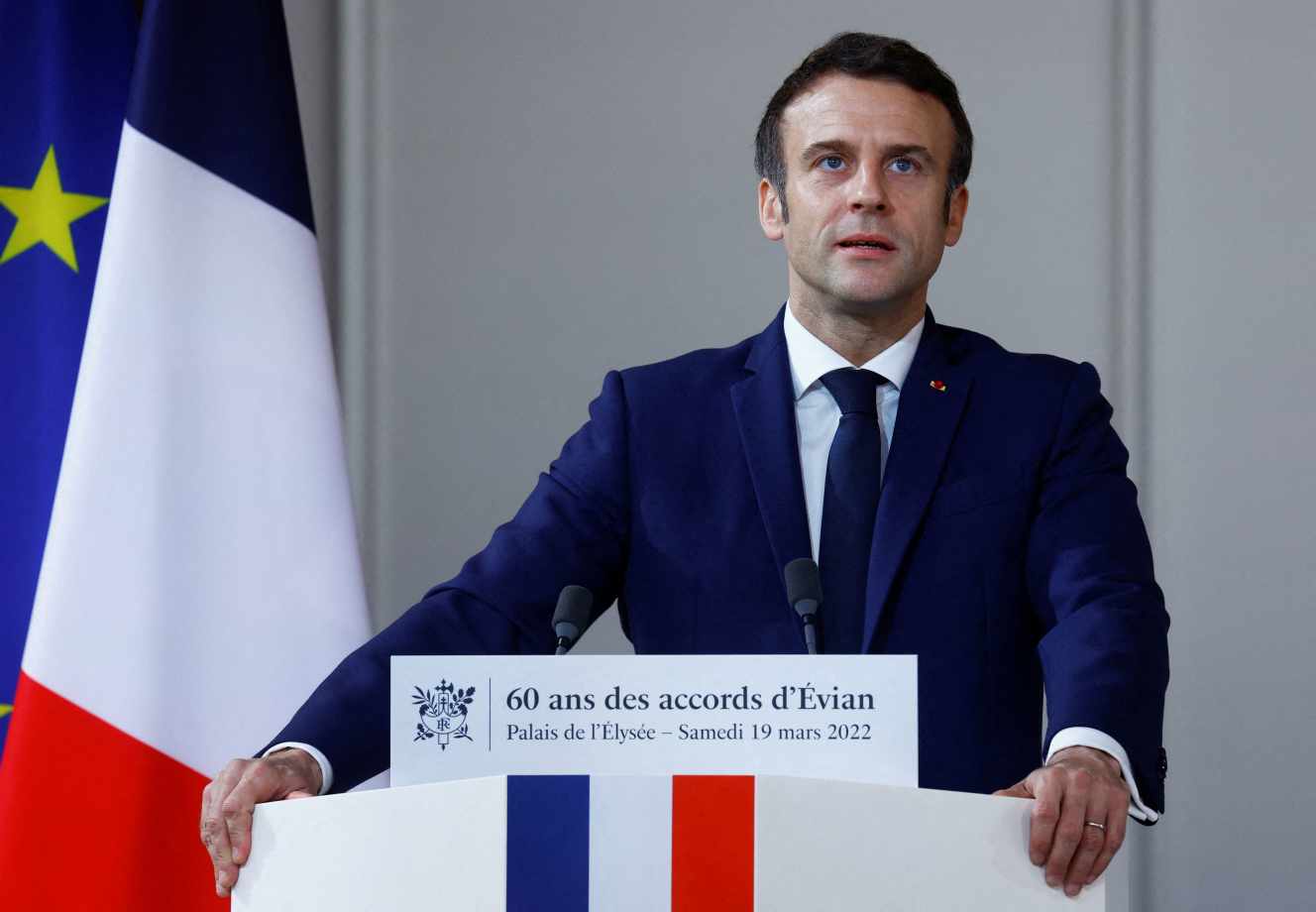
The New York Times reports that “While President Emmanuel Macron of France has tried over the past year to address the painful memories of his country’s colonial history in Algeria, the long shadows of that past — provoked by such messages — have increasingly pervaded the campaigns of right-wing candidates in next month’s presidential elections.”

President Emmanuel Macron 19 March 2022. Photo: GONZALO FUENTES / POOL / AFP.

Far-right candidates Éric Zemmour and Marine Le Pen have both denounced Macron’s efforts, employing racist language against Algerian and other North African immigrants.

Historians such as Benjamin Stora and Sylvie Thénault, who have studied the Algerian War closely, have weighed in on the commemorations of Algerian Independence and historical memories of Algerian War in the current French Presidential Election. Historian Malika Rahal conducted an in-depth interview with Le Monde on the legacies of the Algerian War.

Protest in Algiers, August 1962. Photo by Fernand PARIZOT / AFP.

Le Monde provides a series of reports on the 60th anniversary of the Évian Accords (1962) that ended the Algerian War.

The New York Times offers an analysis in English of the commemorations of the end of the Algerian War and Algerian Independence.

Posted in Civil Conflict, Empires and Imperialism, European History, European Studies, French Empire, French History, History of Violence, Museums and Historical Memory, Strategy and International Politics, War, Culture, and Society | Leave a comment

French Presidential Elections 2022

The Russian invasion of Ukraine has already had an enormous impact on European politics and society. Poland and other Eastern European nations are rightly nervous and have bolstered their defenses, supported by NATO. Germany has radically increased its defense spending and has begun providing direct military support to Ukraine. The entire European Union is grappling with massive shifts in military spending and security policies.

The Ukraine War has also significantly affected the current French Presidential Elections, as French presidential candidates prepare for the first round elections on 10 April 2022. The top two candidates from the first round election will then advance to a second round runoff, which will be held on 24 April 2022.

Last night, the French television channel TF1 held a live televised forum on La France Face à la Guerre, which offered French citizens a series of fast-paced interviews with the eight leading presidential candidates from across the political spectrum.

The program was essentially a pseudo-debate focused on the Ukraine War, immigration issues, economic and social policies, and retirement reforms.

A recording of the TF1 program La France Face à la Guerre is available online.

Meanwhile, professors and researchers of French History, French Studies, and Political Scientists are closely following the ongoing French Presidential campaign.

At Northern Illinois University, Professor Emma Kuby and I both conduct research on French History and incorporate contemporary French culture into our teaching of HIST 311 Early Modern France, HIST 312 Modern France, HIST 339 French Overseas Empire, HIST 423 French Revolution and Napoleon, and other courses.

For more information on French History and the Undergraduate and Graduate Programs in History at Northern Illinois University, see the NIU Catalog and the NIU Department of History website.

Research centers and institutes at other universities are organizing discussions and programs on the French Presidential Elections. The Modern French History Seminar at the Institute of Historical Research (IHR), based at the University of London, will be hosting a roundtable on the French Presidential Elections.

Here is the announcement from the IHR’s Modern French History Seminar:

IHR Modern French History seminar will gather on Zoom on  Monday 21 March, 17:30 (London time) for a roundtable on the French Presidential Elections.

We will be delighted to welcome:

Helen Drake (Loughborough), Marc Lazar (Sciences Po), Rainbow Murray (QMUL), William Rispin (independent researcher), and Andrew Smith (Chichester). Julian Jackson will chair the session.

Please register via the IHR website to join us for the live discussion. You will receive the zoom codes in your registration confirmation email. 

More information is available at the Institute of Historical Research website.

Posted in European History, European Studies, European Union, French History, Political Culture, Political Theory, Security Studies, Strategy and International Politics, War and Society, War, Culture, and Society | Leave a comment

Fighting around Kharkiv

The Russian invasion of Ukraine has proceeded at a relatively slow pace, as Russian troops face stiff resistance in suburban and urban areas, especially in the outskirts of Kharkiv, the second largest city in Ukraine.

Historians of siege warfare recognize the developing patterns of encirclement and blockade, coupled with heavy aerial and artillery bombardments. Russians forces seem to be intensifying their efforts to take Kharkiv and they may be preparing to launch a major assault and engage in close urban combat. The Russian 1st Tank Army has not yet encircled Kharkiv, but is engaging Ukrainian forces on a broad front stretching for many miles north and east of the city.

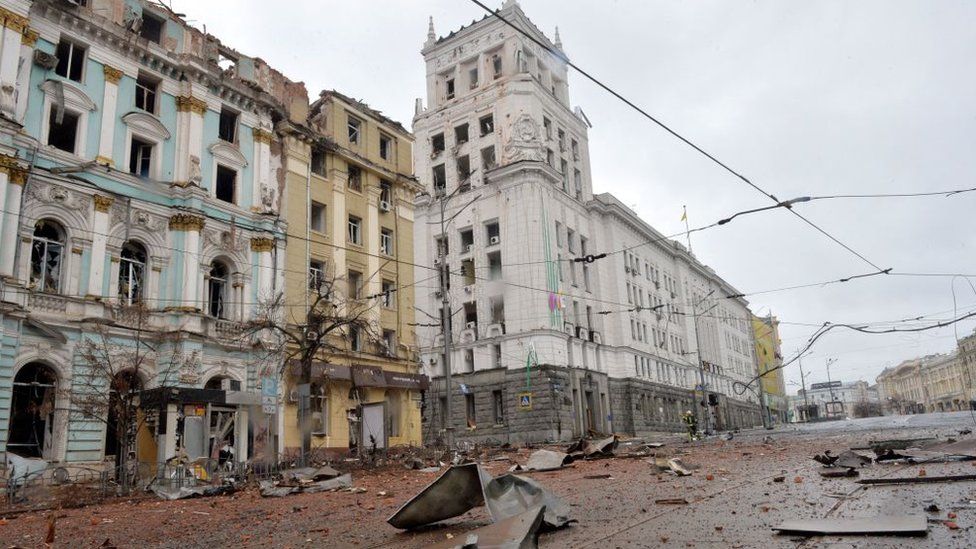
Buildings damaged by Russian shelling in Kharkiv, Ukraine. Photo: Getty/BBC

Although siege warfare is often dismissed as “positional warfare,” sieges are often very dynamic, involving complex maneuvers, concentrated firepower, and massive logistical efforts. The seemingly slow pace of sieges can be misleading, since multidimensional siege operations often evolve much more rapidly than observers realize. Siege warfare can involve many different dimensions: blockade, encirclement, starvation tactics, entrenchment, approach, bombardment, mining, sniper harassment, infiltration, sortie, psychological warfare, and direct assault. The methods of siege warfare can be employed in varying degrees and do not always follow a script, making them unpredictable.

The Russian operations around Kharkiv are incredibly complicated and difficult to discern, despite satellite imagery and reports from the ground. The Institute for the Study of War (ISW) has been reporting on the fighting around Izyum, southeast of Kharkiv. The ISW’s analyses have raised the possibility that Russian forces may be seeking to blockade Kharkiv and bypass it, rather than preparing to assault the city.

BBC correspondent Quentin Sommerville recently ventured beyond the front lines to report on the fighting in Kharkiv. Sommerville and his cameraman, Darren Conway, filed a haunting video report on the BBC website.

For analyses of the developing military operations in Ukraine, see the Institute for the Study of War website.

On siege warfare, see Anke Fischer-Kattner and Jamel Ostwald, eds., The World of the Siege: Representations of Early Modern Positional Warfare, (Leiden: Brill, 2019). doi: https://doi.org/10.1163/9789004395695

Posted in Civil Conflict, Civilians and Refugees in War, European History, European Studies, History of Violence, Security Studies, Siege Warfare, Strategy and International Politics, Urban History, War, Culture, and Society | Leave a comment

Understanding the Ukraine War

Many historians are closely observing the Ukraine War and commenting on different historical dynamics and patterns that are potentially shaping the conflict.

At my university, Northern Illinois University, the College of Liberal Arts and Sciences is currently organizing a Teach-In on the Ukraine War, including two members of the Department of History. Universities around the world are organizing similar roundtable discussions to serve their student audiences and local communities.

Ukrainian refugee, Irpin, Ukraine. Photo: Reuters

Historians are also active in writing about the Ukraine War, based on their research specializations in Ukrainian History, Russian History, Eastern European History, Military History, International History, Violence Studies, War Studies, Strategic Studies, Refugee Studies, and related fields.

Mark Fitzpatrick, Professor of International History at Flinders University (Australia), has written an article for The Conversation on historical responses to the Ukraine War.

Mary Elisa Sarotte, Professor of Historical Studies at Johns Hopkins University and a specialist on Cold War History, wrote an opinion piece for The New York Times, arguing that the current situation represents the onset of a new Cold War.

Lev Golinkin, a Ukrainian memoir writer, suggests in an opinion piece for The New York Times that Russian forces aim to erase Ukrainian history in the current war.

Historian Miles Pattenden, Senior Research Fellow at Australian Catholic University, argues in the Sydney Morning Herald that a relative lack of knowledge of European history has produced misunderstandings of the historical contexts for the Ukraine crisis and has also contributed to strategic miscalculations leading to the Ukraine War.

Several historians have weighed in on the possible ways that the Ukraine War may eventually be resolved in an article for the Boston Globe.

The New York Times and The Guardian have both published reading lists of historical works on Ukrainian History, Russian History, and conflict in Ukraine.

#Ukraine #UkraineWar #RussianInvasion #History #Historians #WarNews

Posted in Atrocities, Civil Conflict, Civilians and Refugees in War, European History, European Studies, European Union, History of Violence, Human Rights, Security Studies, Strategy and International Politics, War, Culture, and Society | Leave a comment

Seeing Race Before Race Fellowship: Reminder

I am re-posting this fellowship announcement, since the deadline (8 March 2022) for applications is fast approaching.

Premodern critical race studies is a rapidly expanding field within premodern studies. Many historians of the Medieval and Early Modern World are investigating the histories and languages of race and racism in premodern contexts.

The Center for Renaissance Studies is currently hiring a Postdoctoral Fellow in conjunction with its Seeing Race Before Race project.

Recent Ph.D.s in premodern History and related fields may be interested in applying for this postdoctoral fellowship.

Here is the announcement from the Center for Renaissance Studies at the Newberry Library:

The Newberry Center for Renaissance Studies seeks an early career scholar in Premodern Critical Race Studies to serve as a Public Humanities Postdoctoral Fellow for one year (with the possibility of renewal for a second year pending grant funding) to support Seeing Race Before Race, a multi-year project including an exhibition, public and scholarly programming, a publication, and digital initiatives. The Fellow will begin in Fall 2022, one year before the exhibition launches in Fall 2023.

The Public Humanities Fellow will be responsible for ensuring that all exhibition assets align with prevailing methods of premodern critical race studies. This position will assist in creating and editing exhibition texts; acting as the internal and external communications lead for the project; managing exhibition programming work; developing digital resources; and liaising with departments across the Newberry. The Fellow will report to the Director of the Center for Renaissance Studies.

This position requires a PhD in a humanities field related to medieval, early modern, colonial, Atlantic World, or Indigenous studies from 1100-1800, with expertise in critical race studies preferred. Preference may be given to candidates whose scholarly work or career has been focused on public history, museums, libraries, and archives.

Please email your cover letter, resume, and contact information for three references to Human Resources at jobs@newberry.org. In the email’s subject, please note the position you are applying to. Please combine all requested documents into a single PDF document and submit as an email attachment. For more information, please visit the Newberry’s Employment page here: https://www.newberry.org/employment

Applications will be reviewed beginning March 8, 2022, on a rolling basis, and the review will continue until the position is filled.

Please direct all questions about the position to renaissance@newberry.org

Posted in Cultural History, Digital Humanities, Early Modern Europe, Early Modern World, European History, Grants and Fellowships, History of Race and Racism, History of Violence, World History | Leave a comment

Russian Offensives in Ukraine

Ten days into the Ukraine War, we can begin to assess the Russian offensives in Ukraine on multiple fronts.

Separate Russian offensives are threatening to encircle the major cities of Kyiv and Kharkiv in northern Ukraine, while the Russian forces from Crimea advance in southern Ukraine, and fighting continues in eastern Ukraine. Russian forces have employed airstrikes, missile strikes, and bombardments of strategic sites, government facilities, and urban centers throughout Ukraine.

Countless news reports and social media posts offer real time perspectives on the fighting, but there have also been many documented cases of fake news and false claims. In addition, government agencies and militaries have differing interests that affect war news and information. So, we have to be very careful in assessing news of the ongoing military campaigns.

Assessing military units’ movements and combat is extraordinarily difficult, despite satellite photography and social media video posts. The Institute for the Study of War continues to provide some of the best daily assessments of the military operations. Their maps of military operations are being used by most major news media organizations, a sign of their influence on war reports and strategic analyses. Maps, daily analyses of military operations, and strategic assessments are available at the Institute for the Study of War.

Historians and political scientists are playing a role in deciphering the strategic situation. Here is one example of a Foreign Policy interview with Alexander Motyl, Professor of Political Science at Rutgers University-Newark:

What Putin’s Past Says About Ukraine’s Future A historian speaks on how the Russian president’s history helps explain his current mindset. Mary Yang Foreign Policy

Many news organizations have published opinion pieces and analyses that offer predictions on the course of the war and potential outcomes. This approach is related to military and diplomatic organizations’ practices of “war gaming” scenarios to train for future conflicts. Here is a BBC report on five potential scenarios for the outcome of the Ukraine War:

Ukraine: How might the war end? Five scenarios What are some of the possible scenarios that politicians and military planners are examining? BBC News

Posted in Empires and Imperialism, European History, European Studies, European Union, Security Studies, Strategy and International Politics, War, Culture, and Society | Leave a comment

RSA High School Teaching Grants

The Renaissance Society of America (RSA) is once again offering teaching grants for high school teachers who teach online lessons or units on Renaissance studies.

The RSA is currently inviting high school teachers to submit proposals for their Grants in Support of Innovative Teaching of Renaissance Studies to High School Students.

The RSA’s announcement reads:

In the wake of the COVID pandemic, high school teachers around the globe have been searching for and creating new ways to immerse their students in the experience of Renaissance culture. To recognize and share these innovative teaching methods, the RSA is delighted to announce our second annual competition for the best online teaching projects in secondary education.

The winners of this competition will each receive an award of $1,000 and will present their projects at a Zoom conference that we plan to make available to a wide range of secondary school teachers, not only current members of the RSA but those who want to learn more about Renaissance studies. The conference will be held on Wednesday, June 29, 2022.

The competition is open to scholars actively engaged in teaching high school students: for instance, museum docents, library curators, and directors of education at theatre companies as well as high school teachers. Proposals from such fields as art history, drama, history, literature, languages, and music are all welcome. The project could include virtual tours of museums, architectural sites, or rare book libraries, or online performances of drama and music. The deadline for proposals is Monday, May 9, 2022. Please email us at rsa@rsa.org with any questions.

Sincerely,

The RSA Committee for Grants in Support of Innovative Teaching of Renaissance Studies to High School Students

Previous Winners include:

Tim Overkempe, “Living Pasts: Bringing History Alive through Locals and by Digital Means”

Emma Whipday, “Stay at Home Shakespeare”

Santiago Muñoz-Abeláez, “Paisajes coloniales: redibujando los territorios andinos en el siglo XVII [Colonial Landscapes: Redrawing Andean Territories in the 17th Century]”

Jorge Torres, “Nahua Music at the Time of the Conquest”

Thomas Hendrickson, “Unedited Neo-Latin Manuscripts in the High School Classroom”

Elisa Frei, “On the Edition of Renaissance Manuscripts”

Johnny L. Bertolio, “Le vie dorate: Un’altra letteratura italiana: da San Francesco a Igiaba Scego [The Golden Paths: Another Diverse Italian Literature from Saint Francis to Igiaba Scego]”

Anne Blaney, “Fun with Words” (Exploring the Folger Shakespeare API)

Posted in Art History, Cultural History, Digital Humanities, Early Modern Europe, Early Modern World, European History, Grants and Fellowships, Humanities Education, Mediterranean World, Reformation History, Renaissance Art and History, The Past Alive: Teaching History | Leave a comment

Ukraine War

My students in HIST 384 History of War since 1500 at Northern Illinois University are following the developments in the Ukraine War, which relates directly to the themes we are studying this semester.

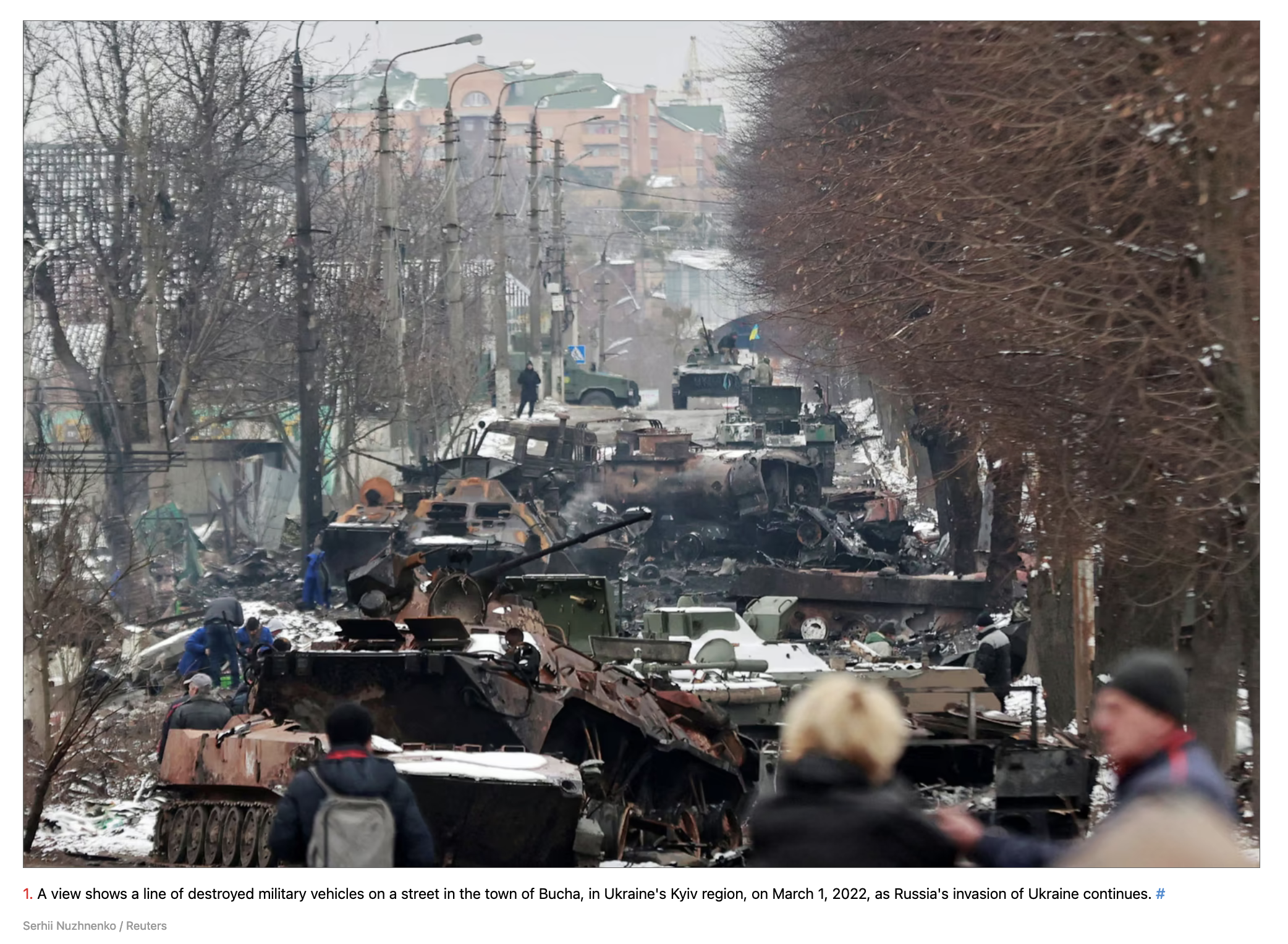
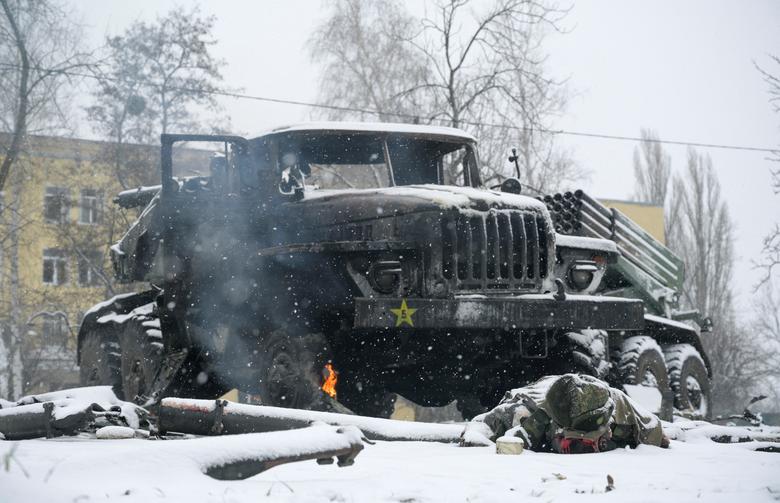
Russian rocket launcher destroyed in fighting around Kharkiv, Ukraine. Photo: Reuters

I have opened an optional Discussion Forum this week for NIU students who would like to discuss the Ukraine War and consider the comparative history of war.

My personal website and blog already includes links for websites analyzing the Russian invasion of Ukraine. One of the websites that I highlight is the Institute for the Study of War (ISW), a think tank specializing in the comparative study of war.

The ISW’s maps and analyses of the Ukraine crisis and Russian invasion are being used by many major news media. Here is ISW’s latest update on the Ukraine War:

https://www.understandingwar.org/backgrounder/ukraine-conflict-update-10

I will be posting additional information on my personal website soon.

My students will definitely be discussing the Ukraine War in HIST 384 History of War since 1500 throughout the rest of the semester and during the last week on current conflicts and the future of war.

A Russian military build-up on Ukraine’s borders created the Ukraine Crisis (November 2021 – February 2022), but this crisis grew out of political tensions and unresolved strategic concerns involving Russia and Ukraine stemming from the end of the Cold War and the breakup of the Soviet Union.

We can discuss many political, military, strategic, economic, and historical factors that have contributed to the current conflict.

The Maidan Revolution in Kyiv in February 2014 ousted a Russian-backed government in Ukraine, provoking a Russian annexation of Crimea and support for Russian separatists in eastern Ukraine (Donetsk People’s Republic and Luhansk People’s Republic). Since 2014, Ukrainian military forces and Russian separatists have repeatedly clashed, and pro-Ukraine and pro-Russia militia groups have fought a low-intensity conflict in eastern Ukraine. We might consider whether state or non-state armed actors have been more important in the civil conflict in Ukraine from 2014 to 2022 (prior to the Russian invasion of last week)?

For an overview of Ukrainian and Russian history, see NPR’s report:

https://www.npr.org/2022/02/12/1080205477/history-ukraine-russia

United States military intelligence issued a series of warnings of a possible Russian invasion of Ukraine. The Institute for the Study of War, a major think tank specializing in war studies issued its own warning of a probable Russian invasion on 18 February:

“Russia may launch an attack on Ukraine on Saturday, February 19, 2022. The attack would likely begin with an air and missile campaign targeting much of Ukraine to decapitate the government and degrade the Ukrainian military as well as the ability of Ukrainian citizens to prepare to resist a subsequent Russian invasion. US and allied governments have been warning of such an attack for some days, pointing to the size of the Russian forces concentrated on Ukraine’s borders. …”

Russia launched a major invasion of Ukraine a few days later, on 24 February 2022.

We can discuss why some nation-states, military organizations, and political groups downplayed the threat of a Russian invasion prior to the outbreak of war?

Posted in Arms Control, Civil Conflict, Civilians and Refugees in War, Comparative Revolutions, European History, European Studies, European Union, Revolts and Revolutions, Security Studies, Strategy and International Politics, War, Culture, and Society | 4 Comments