Historians are collaborating with scientists in new ways these days, especially in the growing field of environmental history. Scholars are making new and fascinating discoveries about the long history of human transformations of environments.
Historians of the Columbian Exchange, beginning with groundbreaking environmental historian Alfred Crosby, have argued that the environmental changes wrought by trans-oceanic and global exchanges from c. 1500 to today have been monumental. Some scholars use the term “anthropocene” to describe a new era in earth’s history based on human’s ability to transform global environmental systems and affect climate change.
Geckos offer a nice example of how environmental history and science can provide new perspectives on humans’ roles in reshaping the natural environment.
African house gecko (Hemidactylus mabouia)
TheNew York Times reports: “Little and brown, the African house gecko is now widespread in the Western Hemisphere. But the gecko originated in southeastern Africa, from Zimbabwe, Mozambique and nearby areas. So how did it cross an ocean and come here?”
A new study of various lineages of the African house gecko, Hemidactylus mabouia, provides evidence on the spread of this species of gecko in the Americas. Ishan Agarwal, et al, recently published their findings in an article entitled, “How the African house gecko (Hemidactylus mabouia) conquered the world,” in The Royal Society.
According to The New York Times, “the paper also offers a new way to test an old hypothesis — that African house geckos stowed away on vessels involved with the trans-Atlantic slave trade. The slave trade is also thought to have transported the Aedes aegypti mosquito and several earthworm species to the Americas from the African continent, and the new research further reveals its ecological effects in addition to its human toll.”
Ishan Agarwal, et al, “How the African house gecko (Hemidactylus mabouia) conquered the world,” is published by The Royal Society.
Alfred W. Crosby’s study of the Columbian Exchange was originally published in 1972. A new edition was released in 2003: Alfred W. Crosby, Jr. The Columbian Exchange: Biological and Cultural Consequences of 1492, 30th Anniversary Edition (Praeger, 2003).
I recently gave an interview on the history of the Medici family for an episode of the Ithaca Bound podcast, hosted by Andrew Schiestel.
I spent three years working as a post-doctoral fellow with the Medici Archive Project, a major Digital Humanities project based in Florence, Italy. So, it is always fun to discuss the Medici family and their fascinating history.
The episode, entitled “The Medici Family during the Italian Renaissance” is available streaming online at the Ithaca Bound website.
Ithaca Bound website on PodBean
I want to thank Andre Schiestel for inviting me to join him in discussing the history of the Medici family for the podcast.
Ithaca Bound is a podcast specializing in Mediterranean history and culture. The Ithaca Bound website indicates that “The Ithaca Bound podcast is a daily podcast that explores history and mythology in the Mediterranean Basin. It’s hosted by Andrew Schiestel.”
For more information on the history of the Medici family, see the Medici Archive Project website.
Historians and educators across the United States are responding to the current political attacks on Critical Race Theory and politicians’ attempts to dictate the ways in which professional historians teach about race and racism in American history.
Many historians and journalists have rightly pointed out that the entire controversy over Critical Race Theory has been manufactured by Christopher Rufo, a far-right political activist, and his allies based on serious and deliberate misunderstandings of the history of race and racism in the American colonies, and later in the United States. The opponents of Critical Race Theory simply ignore the well-documented history of race and racism in North America and they deny outright the existence of systematic institutional racism in the United States.
Far-right media organizations and extremist groups have amplified this “controversy” into a cause célèbre, prompting conservative politicians at the local, state, and national level to introduce new legislative measures to try to control the teaching of United States history. Their aim is to threaten the professional history and social studies teachers who educate middle school and high school students on the complexities of American history and society. Far-right group also seek to attack academic historians who conduct research on race and racism by challenging Critical Race Theory.
The American Historical Association, the flagship scholarly association of academic and professional historians in the United States, has joined with other academic organizations to respond directly to this manufactured political controversy by issuing a Joint Statement on Legislative Efforts to Restrict Education about Racism and American History.
The American Historical Association has announced that: “The American Association of University Professors, the American Historical Association, the Association of American Colleges & Universities, and PEN America have authored a joint statement stating their ‘firm opposition’ to legislation, introduced in at least 20 states, that would restrict the discussion of ‘divisive concepts’ in public education institutions. It is not possible to address divisions that exist, however, without an honest reckoning with their histories. ‘The clear goal of these efforts is to suppress teaching and learning about the role of racism in the history of the United States,’ the letter explains. Education proceeds from exploration, facts, and civil debate. ‘These legislative efforts,’ on the other hand, ‘seek to substitute political mandates for the considered judgment of professional educators, hindering students’ ability to learn and engage in critical thinking across differences and disagreements. . . . Americans of all ages deserve nothing less than a free and open exchange about history and the forces that shape our world today.'”
While the focus of this statement is on the teaching of United States History, we need to recognize the broader implications of this political controversy for teaching of World History and other history and social studies courses.
The history of race and racism is much longer and broader than many people have realized. Historians around the world are currently delving into evidence of longue durée patterns of racial categorization and racism. I have conducted research and published on the connections between race, violence, and imperialism in the early modern Mediterranean and Atlantic World. I recently participated in a conference on Centring Race in History: Antiquity to the Present, which showcased new findings in the growing field of research on the history race and racism in the premodern world.
I am a member of the American Historical Association and am active in the Society for French Historical Studies, Western Society for French History, World History Association, and other academic organizations that are signatories of the joint statement. I endorse the Joint Statement on Legislative Efforts to Restrict Education about Racism and American History.
Undergraduate students in Northern Illinois University’s History and Social Science Secondary Educator Licensure Programs will be especially interested in reading the AHA’s joint statement. NIU’s Department of History trains many students who go to become middle school and high school teachers of History and Social Sciences in Illinois. Professional educators will surely continue to grapple with the “History Wars” and the broader “Culture Wars” long after the current controversy over Critical Race Theory subsides.
The entire joint statement is available as a .pdf document on the American Historical Association’s website.
The Atlantic has published an article tracing the development of the political controversy about Critical Race Theory.
Michelle Goldberg describes Christopher Rufo as “a clever propagandist who has done more than anyone else to whip up the national uproar over critical race theory.” Her opinion column is available at The New York Times.
Eugene Robinson’s commentary on the Critical Race Theory controversy is available at The Washington Post.
Historian Tim Snyder, a specialist on the history of totalitarianism, has published an essay on the latest episodes in the culture wars, “The War on History is a War on Democracy,” in The New York Times.
Maritime historians have recognized that premodern ships represented diverse onboard communities, composed of multicultural—and often multiracial—crews. The social spaces of ships brought together officers, navigators, sailors, soldiers, artisans, and slaves recruited or coerced from very different population groups.
But, the written evidence of crew members’ social origins is often very sparse, since permanent navies did not develop until the seventeenth century and premodern records rarely focused on detailing the background of sailors and other crew. Some exceptional archival documents have offered glimpses of the diversity of ships’ crews and historians have been exploiting such records to analyze maritime shipboard communities. For example, Sara Caputo (Magdalene College, University of Cambridge) has discovered evidence of the British Navy’s transnational recruitment of sailors during the eighteenth century. See: Sara Caputo, “Towards a Transnational History of the Eighteenth-Century British Navy / Vers une histoire transnationale de la marine britannique au XVIIIème siècle,” Annales Historiques de la Révolution Française 397 – Perspectives Transnationales, 1780s-1820 (2019): 13-32.
Now, new archaeological and DNA evidence offers additional information on the crew of a famous premodern ship, the Mary Rose, one of the principal warships in the fleet of King Henry VIII of England during the Franco-English wars of the first half of the sixteenth century.
Mary Rose, depicted on the Anthony Roll, 1546. Image: Pepys Library, Magdelene College, Cambridge.
BBC News reports that “archaeologists have been revealing the ethnic diversity of the crew on the Mary Rose using remains from the warship. The ship sank in 1545, but the wreck, 19,000 artefacts and the remains of 179 crew members were recovered in 1982.”
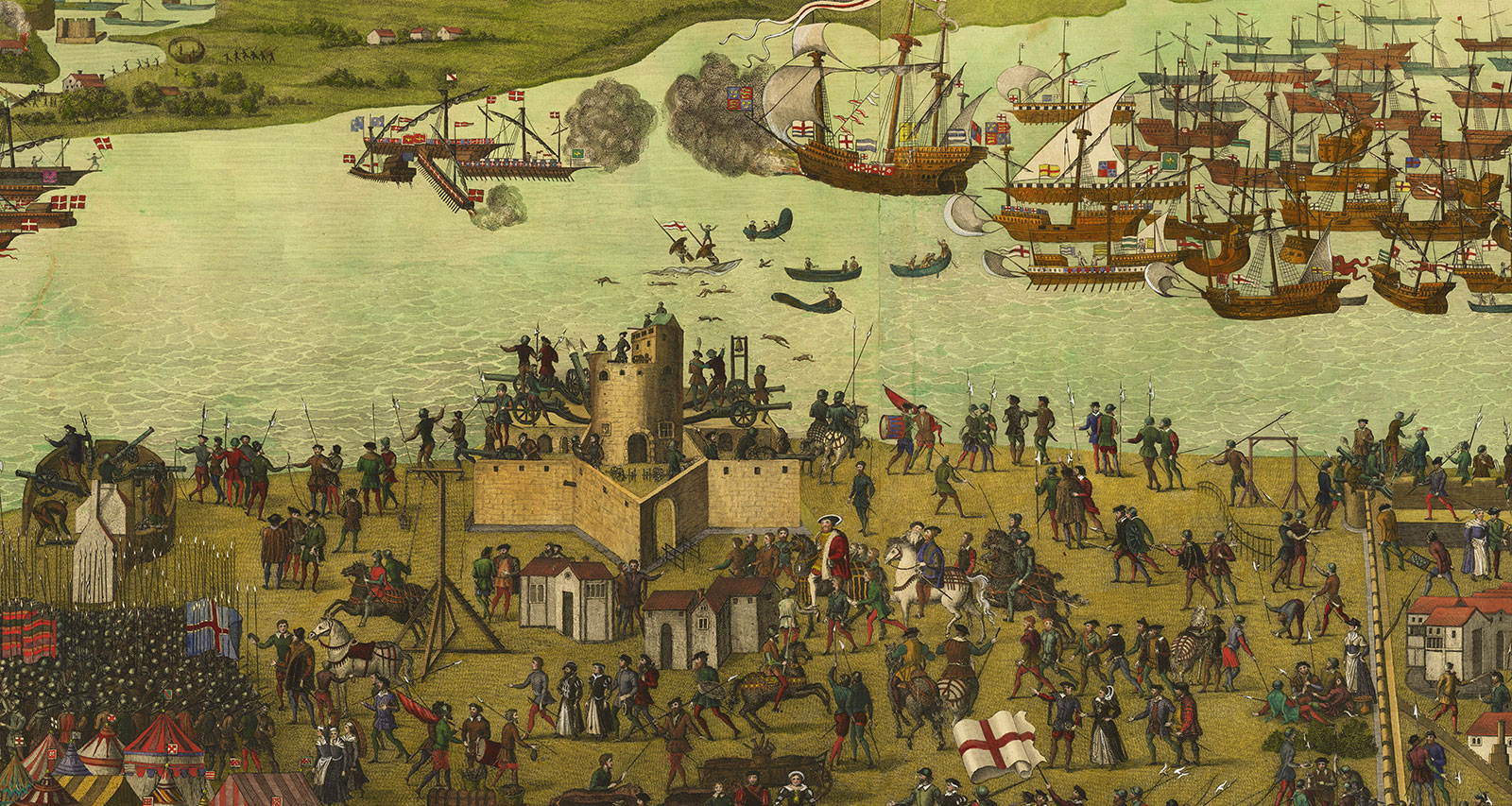
The sinking of the Mary Rose at the battle of Solent in 1545. Cowdray Engraving (detail).
Scientists have been analyzing the bodies of the Mary Rose crew members and are now publishing their results, revealing that the crew indeed was diverse, including at least one crew member of African origin. The work on the crew members of the Mary Rose demonstrates how research collaborations between scientists, archaeologists, and historians are vital to maritime history, the history of science, and the history of medicine. The new findings should provide additional evidence of interest to historians of premodern race and racism, such as collaborators in the RaceB4Race network.
The physical remains of the Mary Rose’s hull and artifacts salvaged from the shipwreck are now in the Mary Rose Museum in Portsmouth. The Mary Rose Museum website provides a history of the Mary Rose and information on the maritime archaeological operations to raise the remains of the ship.
The battle of Solent, 1545, portrayed in the Cowdray engraving.
The Mary Rose Museum’s website has a feature about the Cowdray engraving, an eighteenth-century copy of a sixteenth-century painting of the battle of Solent and the sinking of the Mary Rose.
BBC Newshas published a video report on the archaeological and DNA research on the Mary Rose crew members.
En garde ! Renaissance fairs are reopening across the United States this summer, bringing the clanging of arms and armor back to an enthusiastic public. These festivals celebrate late medieval and Renaissance culture through costume displays and historical re-enactments—including jousts, swordfights, court festivals, pageants, banquets, dances, artisanal workshops, markets, culinary demonstrations, and musical and theatrical performances.
Renaissance joust re-enactment at the St. Louis Renaissance Fair,
Many of the Renaissance fairs emerged in the 1960s and 1970s, but they have grown into multifaceted fan festivals. The Washington Post reports that “folklore and fantasy stoked a nationwide boom in elaborate seasonal Renaissance festivals. At these multi-weekend events, artisans sold jewelry, candles and clothing; musicians played lutes and flutes; and fire-eaters, jugglers, acrobats and jousters performed feats of medieval derring-do. Video-jaded kids clamored for wooden shields, swords and magic wands that could last a summer of backyard play. Many fairgoers attended in costume; people-watching alone can be worth the price of admission.”
Most Renaissance fairs were cancelled in 2020 due to the Covid-19 pandemic. Before the pandemic hit, Renaissance fairs were attracting immense crowds. “In pre-covid 2019, more than 1 million people attended more than 200 such festivals from Florida to Alberta,” according to The Washington Post.
The reopening of Renaissance fairs this summer has many fans excited, but also reminds us of the economic recovery and cultural innovation during the Renaissance following the Black Death pandemic of the mid-fourteenth century.
“After the pandemic, signs of economic and cultural recovery began to emerge with the return of market fairs. That was roughly 670 years ago. History seems to be repeating itself,” according to The Washington Post. “European fairs before and after the Black Death were once-a-year events often tied to saint days, when traveling merchants and craftsmen set up tents on village greens to sell goods to locals also lured by food and entertainment.”
Actors often portray well-known Renaissance kings and queens such as François I of France, Charles V of the Holy Roman Empire, Elizbeth I of England, and Mary Queen of Scots. Meanwhile, historical re-enactors play diverse roles of the nobles, clergy, merchants, artisans, soldiers, and peasants who inhabit the villages at Renaissance festivals.
An actress portraying Mary Queen of Scots at a Renaissance fair.
Much of the entertainment at Renaissance fairs is only vaguely linked to the historical Renaissance, since the festivals tend to blur the lines between diverse literary and film genres and historical periods: medieval peasants and archers, Renaissance courtiers, early modern gypsies, and eighteenth-century pirates all make appearances. Magical and fantastic creatures such as fairies, elves, dragons, mermaids, and witches also inhabit the woods.
Many enthusiastic festival goers don their own costumes, often inspired by film, television, comic book, role playing game, and video game characters. The Hobbit, The Lord of the Rings, Dungeons and Dragons, and Harry Potter have all fueled Renaissance fair personas. The popularity of The Game of Thrones television series has added new layers to the costume drama of Renaissance fairs in recent years.
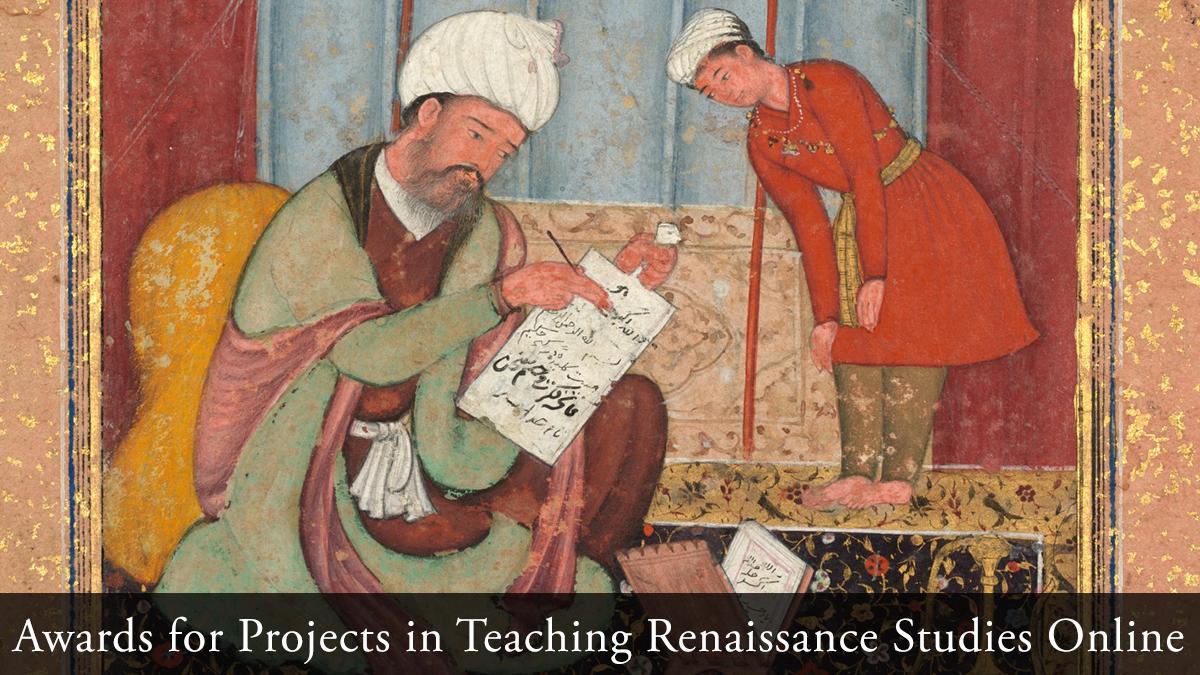
The Renaissance Society of America (RSA) recently sponsored a competition for high school teaching in the field of Renaissance Studies. High school teachers across the United States submitted teaching projects and class plans on various topics in Renaissance Studies.
The Renaissance Society of America’s Committee for Grants in Support of Innovative Teaching of Renaissance Studies has selected eight teachers’ projects to feature in an upcoming online webinar.
Here is the RSA announcement on its Awards for Projects in Teaching Renaissance Studies Online and the upcoming webinar:
The RSA Committee for Grants in Support of Innovative Teaching of Renaissance Studies to High School Students is delighted to recognize eight projects at a Zoom webinar to be held Wednesday, 30 June 2021 at 10:00 a.m.–3:30 p.m. EDT. Easily convert the time zone here. Four one-hour sessions will be held over the course of the day, each with two grantees to present and discuss their projects with those in attendance.
10:00–11:00 a.m.: Bringing the Past to Life
Tim Overkempe, “Living Pasts: Bringing History Alive through Locals and by Digital Means”
Emma Whipday, “Stay at Home Shakespeare”
Chair: Clare Carroll
11:15 a.m.–12:15 p.m.: Indigenous Cultures: Art and Music
Santiago Muñoz-Abeláez, “Paisajes coloniales: redibujando los territorios andinos en el siglo XVII [Colonial Landscapes: Redrawing Andean Territories in the 17th Century]”
Jorge Torres, “Nahua Music at the Time of the Conquest”
Chair: Susan Forscher Weiss
Lunch Break
1:15–2:15 p.m.: Archival Projects
Thomas Hendrickson, “Unedited Neo-Latin Manuscripts in the High School Classroom”
Elisa Frei, “On the Edition of Renaissance Manuscripts”
Chair: Lawrence Rhu
2:30–3:30 p.m.: Attention to Language through Literature
Johnny L. Bertolio, “Le vie dorate: Un’altra letteratura italiana: da San Francesco a Igiaba Scego [The Golden Paths: Another Diverse Italian Literature from Saint Francis to Igiaba Scego]”
Anne Blaney, “Fun with Words” (Exploring the Folger Shakespeare API)
Ancient Roman history is alive and well, and newsworthy.
An interview with Mary Beard, Professor of Classics at the University of Cambridge, in The New York Times highlights diverse ways in which Roman history is actively used in today’s society and political culture.
Mary Beard has expanded our perspectives through her decades of research on ancient Roman society and culture, published in numerous articles and books. She has stretched the boundaries of ancient history by probing issues of gender, empire, and power in Roman society in new ways.
Beard has brought ancient history to broader audiences through books such as Confronting the Classics: Traditions, Adventures, and Innovations (London: Liveright, 2013). She is also known for her work on BBC’s Civilizations television series (2018).
Northern Illinois University students in HIST 110 History of the Western World I will be interested in exploring Mary Beard’s works on Roman history.
Professor Beard’s interview on “Ancient Rome Will Never Get Old” is at The New York Times.
Professor Beard’s website is at the University of Cambridge.
Colonial Williamsburg, one of the most important sites for historical re-enactment in the United States, is increasingly stressing diversity issues in its historical interpretations of colonial American society.
The community of Williamsburg, Virginia, has been promoting building restoration and living history since the 1930s, and the colonial town and re-enactment site is managed by the Colonial Williamsburg Foundation. The Foundation’s historical interpretations of eighteenth-century life has evolved significantly over the decades, responding to new research, historiographical approaches, and social concerns.
African-American slaves formed the majority of colonial Williamsburg’s population, but slavery was not a focal point of re-enactments until relatively recently. African-American History, Women and Gender History, Atlantic World History, History of Slavery, and Early Modern World History seem to have transformed the historical approaches at Williamsburg.
The Washington Post reports on historical re-enactment at Williamsburg, focusing particularly on re-enactors (or interpreters) who now take on roles that represent the diversity of colonial Virginia.
“Stephen Seals, who heads community outreach and program development, plays James Lafayette, an enslaved Williamsburg man who served in the Continental Army under the Marquis de Lafayette. A longtime actor, Seals is a kind of archive unto himself, his psychic shelves stocked with knowledge about Colonial Williamsburg’s evolution. At one time, … the foundation did emphasize the working trades of the period. Those carpentry and gunsmithing shops are still popular, but there’s been an ever-evolving effort to reveal all facets of the community’s past.”
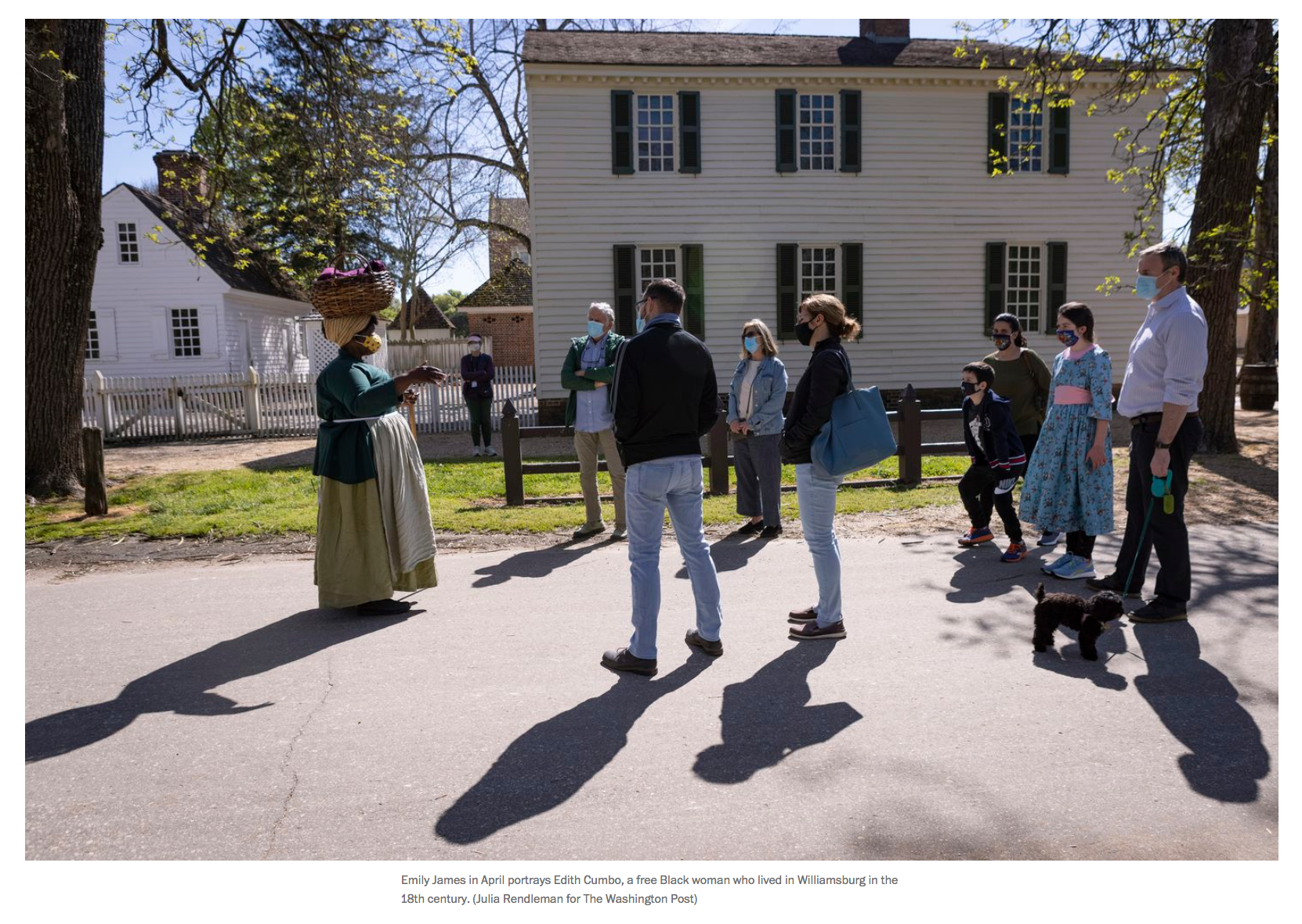
Another important part of the colonial community of Williamsburg were Free Blacks. “On the streets of Colonial Williamsburg — one of the world’s premier living-history museums — Emily James cuts a formidable figure. Portraying Edith Cumbo, a free woman of color who walked these byways in the 18th century, James tries daily to convey to tourists the humiliations and contradictions Cumbo lived with,” according to The Washington Post.
Theatrical presentations and plays complement the re-enactors’ character interpretations. Some of the new plays present diversity in gender and sexuality, including same-sex relationships.
I remember visiting Colonial Williamsburg in the 1980s and being captivated by the “feel” of eighteenth-century society. The historical buildings, costumes, horse-drawn carriages, and workshops allow visitors to experience the sights, sounds, and smells of premodern life. But, any encounters with the institution of slavery and the diverse people in Williamsburg society were limited at that time. I hope to visit Colonial Williamsburg again to observe the transformations of its historical re-enactment program.
The Fulbright Scholar Program of the United States Department of State is hosting a Fulbright U.S. Scholar: Spotlight on France Webinar on its research awards for U.S. scholars to travel to France to conduct research in various fields.
The Fulbright Research Scholar Awards provide vital support for scholars from the United States to pursue international research in nations around the world.
I have served as a Fulbright Research Scholar in France and in Belgium, allowing me to pursue archival research on religious violence, gender, and political culture in the French Wars of Religion and the Dutch Revolt.
I would encourage French historians and humanities scholars who are U.S. citizens and based at universities in the United States to consider applying for a Fulbright Research Scholar Award to conduct research in French archives and special collections.
The Fulbright Scholar Program has separate programs for U.S. scholars, international scholars, and other educators.
The Fulbright Student Program has various awards for graduate students and undergraduate students. Students at Northern Illinois University should contact their professors for advice on applying for a Fulbright Award.
The Fulbright U.S. Scholar: Spotlight on France Webinar will be held on 16 June 2021 from 2:00-3:00 (Eastern).
Here (below) is the Fulbright Scholar Program’s announcement:
Greetings from the Fulbright Program!
I hope you are doing well. Join us for an in depth look at the Fulbright U.S. Scholar Program opportunities in France. We will be joined by a State Department representative and a recent Scholar alum to highlight awards, offer general application guidance and answer questions from participants. Come prepared with your questions or simply listen along.
France offers 12 awards including:
French Studies (Arts, Humanities and Social Studies) Fulbright Award for Research in Eastern France (Grand Est) Fulbright Award for Research in Northern France (Hauts-de-France) Fulbright Award for Research in Southwestern France (Nouvelle-Aquitaine) Fulbright Postdoctoral Award in Social Sciences
For a full list of all the awards in France, click here.
The deadline to apply to the Fulbright U.S. Scholar Program 2022-2023 is September 15, 2021. U.S. citizenship is required.
The Newberry Library is currently showing an exhibition on ¡ Viva la Libertad ! Latin American and the Age of Revolutions.
¡ Viva la Libertad ! explores Latin American revolutions in the nineteenth century and their legacies for Central and South America.
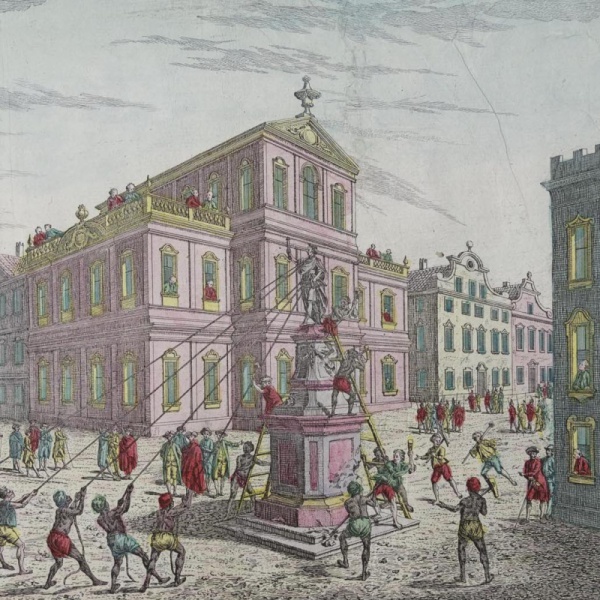
La Destruction de la Statue Royale a Nouvelle Yorck, ca. 1778, Ruggles 592, Newberry Library
The exhibition introduction reads: “As revolutions broke out in the United States, France, and Haiti, freedom movements took root in Latin America, where the colonies of Spain and Portugal fought for their own independence. In hindsight, it’s easy to assume the revolutionary floodgates opened and freedom spread inexorably throughout the hemisphere. But bitter independence struggles lasted decades.”
Undergraduate and graduate students studying Latin American History, Atlantic World History, Comparative Revolutions, Civil Wars, and related topics will want to view this exhibition. Northern Illinois University graduate students are especially encouraged to explore this exhibition and its research collections over the summer.
The Newberry Library has a website related to the exhibition. ¡ Viva la Libertad ! Latin American and the Age of Revolutions is open for in-person viewing from 2 April – 24 July 2021.











 Brian Sandberg: Historical Perspectives